
Productbeschrijving
Productbeschrijving
SWC BH Cardan Shaft Basic Parameter And Main Dimension
Cardan shaft is widely used in rolling mill, punch, straightener, crusher, ship drive, paper making equipment, common machinery, water pump equipment, test bench, and other mechanical applications.
Advantage:
1. Low life-cycle costs and long service life;
2. Increase productivity;
3. Professional and innovative solutions;
4. Reduce carbon dioxide emissions, and environmental protection;
5. High torque capacity even at large deflection angles;
6. Easy to move and run smoothly;
Gedetailleerde foto's
Productparameters
| Model | Tn kN • m |
T. |
P (.) |
LS mm |
Lmin | Size mm |
I kg. m2 | m kg |
|||||||||||
| Di js11 |
d2 H7 |
Da | Lm | n-d | k | t | b h9 |
g | Lmin | 100mm | Lmin | 100mm | |||||||
| SWC58BH | 58 | 0.15 | 0.075 | ≤22 | 35 | 325 | 47 | 30 | 38 | 35 | 4-5 | 3.5 | 1.5 | – | – | – | – | 2.2 | – |
| SWC65BH | 65 | 0.25 | 0.125 | ≤22 | 40 | 360 | 52 | 35 | 42 | 46 | 4-6 | 4.5 | 1.7 | – | – | – | – | 3.0 | – |
| SWC75BH | 75 | 0.50 | 0.25 | ≤22 | 40 | 395 | 62 | 42 | 50 | 58 | 6-6 | 5.5 | 2.0 | – | – | – | – | 5.0 | – |
| SWC90BH | 90 | 1.0 | 0.50 | ≤22 | 45 | 435 | 74.5 | 47 | 54 | 58 | 4-8 | 6.0 | 2.5 | – | – | – | – | 6.6 | – |
| SWC100BH | 100 | 1.5 | 0.75 | ≤25 | 55 | 390 | 84 | 57 | 60 | 58 | 6-9 | 7 | 2.5 | – | – | 0.0044 | 0.00019 | 6.1 | 0.35 |
| SWC120BH | 120 | 2.5 | 1.25 | ≤25 | 80 | 485 | 102 | 75 | 70 | 68 | 8-11 | 8 | 2.5 | – | – | 0.5719 | 0.00044 | 10.8 | 0.55 |
| SWC150BH | 150 | 5 | 2.5 | ≤25 | 80 | 590 | 13.0 | 90 | 89 | 80 | 8-13 | 10 | 3.0 | – | – | 0.0423 | 0.00157 | 24.5 | 0.85 |
| SWC160BH | 160 | 10 | 5 | ≤25 | 80 | 660 | 137 | 100 | 95 | 110 | 8-15 | 15 | 3.0 | 20 | 12 | 0.1450 | 0.0060 | 68 | 1.72 |
| SWC180BH | 180 | 20 | 10 | ≤25 | 100 | 810 | 155 | 105 | 114 | 130 | 8-17 | 17 | 5.0 | 24 | 14 | 0.1750 | 0.0070 | 70 | 2.8 |
| SWC200BH | 200 | 32 | 16 | ≤15 | 110 | 860 | 170 | 120 | 127 | 135 | 8-17 | 19 | 5.0 | 28 | 16 | 0.3100 | 0.0130 | 86 | 3.6 |
| SWC225BH | 225 | 40 | 20 | ≤15 | 140 | 920 | 196 | 135 | 152 | 120 | 8-17 | 20 | 5.0 | 32 | 9.0 | 0.5380 | 0.5714 | 122 | 4.9 |
| SWC250BH | 250 | 63 | 31.5 | ≤15 | 140 | 1035 | 218 | 150 | 168 | 140 | 8-19 | 25 | 6.0 | 40 | 12.5 | 0.9660 | 0.5717 | 172 | 5.3 |
| SWC285BH | 285 | 90 | 45 | ≤15 | 140 | 1190 | 245 | 170 | 194 | 160 | 8-21 | 27 | 7.0 | 40 | 15.0 | 2.0110 | 0.571 | 263 | 6.3 |
| SWC315BH | 315 | 125 | 63 | ≤15 | 140 | 1315 | 280 | 185 | 219 | 180 | 10-23 | 32 | 8.0 | 40 | 15.0 | 3.6050 | 0.571 | 382 | 8.0 |
| SWC350BH | 350 | 180 | 90 | ≤15 | 150 | 1410 | 310 | 210 | 267 | 194 | 10-23 | 35 | 8.0 | 50 | 16.0 | 7.571 | 0.2219 | 582 | 15.0 |
| SWC390BH | 390 | 250 | 125 | ≤15 | 170 | 1590 | 345 | 235 | 267 | 215 | 10-25 | 40 | 8.0 | 70 | 18.0 | 12.164 | 0.2219 | 738 | 15.0 |
| SWC440BH | 440 | 355 | 180 | ≤15 | 190 | 1875 | 390 | 255 | 325 | 260 | 16-28 | 42 | 10 | 80 | 20.0 | 21.420 | 0.4744 | 1190 | 21.7 |
| SWC490BH | 490 | 500 | 250 | ≤15 | 190 | 1985 | 435 | 275 | 325 | 270 | 16-31 | 47 | 12 | 90 | 22.5 | 32.860 | 0.4744 | 1452 | 21.7 |
| SWC550BH | 550 | 710 | 355 | ≤15 | 240 | 2300 | 492 | 320 | 426 | 305 | 16-31 | 50 | 12 | 100 | 22.5 | 68.920 | 1.3570 | 2380 | 34 |
Verpakking en verzending
Bedrijfsprofiel
HangZhou CZPT Machinery Manufacturing Co., Ltd. is a high-tech enterprise specializing in the design and manufacture of various types of coupling. There are 86 employees in our company, including 2 senior engineers and no fewer than 20 mechanical design and manufacture, heat treatment, welding, and other professionals.
Advanced and reasonable process, complete detection means. Our company actively introduces foreign advanced technology and equipment, on the basis of the condition, we make full use of the advantage and do more research and innovation. Strict to high quality and operate strictly in accordance with the ISO9000 quality certification system standard mode.
Our company supplies different kinds of products. High quality and reasonable price. We stick to the principle of “quality first, service first, continuous improvement and innovation to meet the customers” for the management and “zero defect, zero complaints” as the quality objective.
Our Services
1. Design Services
Our design team has experience in Cardan shafts relating to product design and development. If you have any needs for your new product or wish to make further improvements, we are here to offer our support.
2. Product Services
raw materials → Cutting → Forging →Rough machining →Shot blasting →Heat treatment →Testing →Fashioning →Cleaning→ Assembly→Packing→Shipping
3. Samples Procedure
We could develop the sample according to your requirement and amend the sample constantly to meet your need.
4. Research & Development
We usually research the new needs of the market and develop new models when there are new cars in the market.
5. Quality Control
Every step should be a particular test by Professional Staff according to the standard of ISO9001 and TS16949.
Veelgestelde vragen
Q 1: Are you a trading company or a manufacturer?
A: We are a professional manufacturer specializing in manufacturing
various series of couplings.
Q 2:Can you do OEM?
Yes, we can. We can do OEM & ODM for all customers with customized PDF or AI format artwork.
Q 3:How long is your delivery time?
Generally, it is 20-30 days if the goods are not in stock. It is according to quantity.
Q 4: Do you provide samples? Is it free or extra?
Yes, we could offer the sample but not for free. Actually, we have an excellent price principle, when you make the bulk order the cost of the sample will be deducted.
Q 5: How long is your warranty?
A: Our Warranty is 12 months under normal circumstances.
Q 6: What is the MOQ?
A: Usually our MOQ is 1pcs.
Q 7: Do you have inspection procedures for coupling?
A:100% self-inspection before packing.
Q 8: Can I have a visit to your factory before the order?
A: Sure, welcome to visit our factory.
Q 9: What’s your payment?
A:1) T/T.
♦Neem contact met ons op
Web: huadingcoupling
Add: No.11 HangZhou Road,Chengnan park,HangZhou City,ZheJiang Province,China
|
Verzendkosten:
Geschatte vrachtkosten per eenheid. |
To be negotiated |
|---|
| Standard Or Nonstandard: | Standard |
|---|---|
| Shaft Hole: | as Your Requirement |
| Torque: | as Your Requirement |
| Aanpassing: |
Beschikbaar
| Aanvraag op maat |
|---|
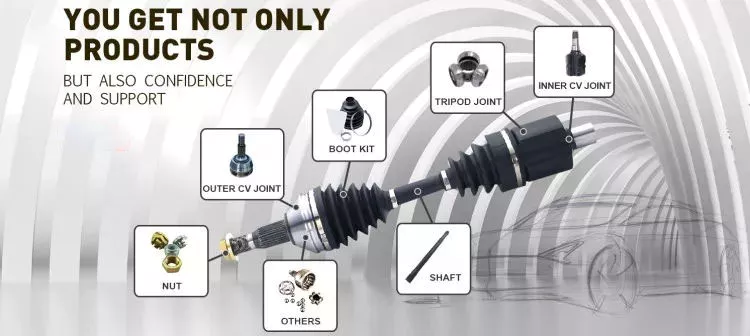
How do drive shafts ensure efficient power transfer while maintaining balance?
Drive shafts employ various mechanisms to ensure efficient power transfer while maintaining balance. Efficient power transfer refers to the ability of the drive shaft to transmit rotational power from the source (such as an engine) to the driven components (such as wheels or machinery) with minimal energy loss. Balancing, on the other hand, involves minimizing vibrations and eliminating any uneven distribution of mass that can cause disturbances during operation. Here’s an explanation of how drive shafts achieve both efficient power transfer and balance:
1. Material Selection:
The material selection for drive shafts is crucial for maintaining balance and ensuring efficient power transfer. Drive shafts are commonly made from materials such as steel or aluminum alloys, chosen for their strength, stiffness, and durability. These materials have excellent dimensional stability and can withstand the torque loads encountered during operation. By using high-quality materials, drive shafts can minimize deformation, flexing, and imbalances that could compromise power transmission and generate vibrations.
2. Design Considerations:
The design of the drive shaft plays a significant role in both power transfer efficiency and balance. Drive shafts are engineered to have appropriate dimensions, including diameter and wall thickness, to handle the anticipated torque loads without excessive deflection or vibration. The design also considers factors such as the length of the drive shaft, the number and type of joints (such as universal joints or constant velocity joints), and the use of balancing weights. By carefully designing the drive shaft, manufacturers can achieve optimal power transfer efficiency while minimizing the potential for imbalance-induced vibrations.
3. Balancing Techniques:
Balance is crucial for drive shafts as any imbalance can cause vibrations, noise, and accelerated wear. To maintain balance, drive shafts undergo various balancing techniques during the manufacturing process. Static and dynamic balancing methods are employed to ensure that the mass distribution along the drive shaft is uniform. Static balancing involves adding counterweights at specific locations to offset any weight imbalances. Dynamic balancing is performed by spinning the drive shaft at high speeds and measuring any vibrations. If imbalances are detected, additional adjustments are made to achieve a balanced state. These balancing techniques help minimize vibrations and ensure smooth operation of the drive shaft.
4. Universal Joints and Constant Velocity Joints:
Drive shafts often incorporate universal joints (U-joints) or constant velocity (CV) joints to accommodate misalignment and maintain balance during operation. U-joints are flexible joints that allow for angular movement between shafts. They are typically used in applications where the drive shaft operates at varying angles. CV joints, on the other hand, are designed to maintain a constant velocity of rotation and are commonly used in front-wheel-drive vehicles. By incorporating these joints, drive shafts can compensate for misalignment, reduce stress on the shaft, and minimize vibrations that can negatively impact power transfer efficiency and balance.
5. Maintenance and Inspection:
Regular maintenance and inspection of drive shafts are essential for ensuring efficient power transfer and balance. Periodic checks for wear, damage, or misalignment can help identify any issues that may affect the drive shaft’s performance. Lubrication of the joints and proper tightening of fasteners are also critical for maintaining optimal operation. By adhering to recommended maintenance procedures, any imbalances or inefficiencies can be addressed promptly, ensuring continued efficient power transfer and balance.
In summary, drive shafts ensure efficient power transfer while maintaining balance through careful material selection, thoughtful design considerations, balancing techniques, and the incorporation of flexible joints. By optimizing these factors, drive shafts can transmit rotational power smoothly and reliably, minimizing energy losses and vibrations that can impact performance and longevity.

Hoe dragen aandrijfassen bij aan de efficiëntie van de voertuigaandrijving en de krachtoverbrenging?
Aandrijfassen spelen een cruciale rol in de efficiëntie van voertuigaandrijving en krachtoverbrengingssystemen. Ze zijn verantwoordelijk voor het overbrengen van vermogen van de motor of krachtbron naar de wielen of aangedreven onderdelen. Hieronder volgt een gedetailleerde uitleg over hoe aandrijfassen bijdragen aan de efficiëntie van voertuigaandrijving en krachtoverbrenging:
1. Krachtoverdracht:
Aandrijfassen brengen de kracht van de motor of krachtbron over naar de wielen of aangedreven onderdelen. Door rotatie-energie efficiënt over te brengen, zorgen aandrijfassen ervoor dat het voertuig vooruit kan rijden of de machine kan aandrijven. Het ontwerp en de constructie van aandrijfassen garanderen minimaal energieverlies tijdens het overdrachtsproces, waardoor de efficiëntie van de krachtoverbrenging wordt gemaximaliseerd.
2. Koppelomzetting:
Aandrijfassen zetten het koppel van de motor of krachtbron om naar de wielen of aangedreven componenten. Koppelomzetting is noodzakelijk om de vermogenskarakteristieken van de motor af te stemmen op de eisen van het voertuig of de machine. Aandrijfassen met de juiste koppelomzettingsmogelijkheden zorgen ervoor dat het vermogen dat naar de wielen wordt overgebracht, wordt geoptimaliseerd voor efficiënte aandrijving en prestaties.
3. Homokinetische koppelingen (CV-koppelingen):
Veel aandrijfassen zijn voorzien van homokinetische koppelingen (CV-koppelingen), die helpen een constante snelheid en efficiënte krachtoverbrenging te handhaven, zelfs wanneer de aandrijvende en aangedreven componenten zich onder verschillende hoeken bevinden. Homokinetische koppelingen zorgen voor een soepele krachtoverdracht en minimaliseren trillingen of vermogensverlies die kunnen optreden als gevolg van veranderende werkhoeken. Door een constante snelheid te handhaven, dragen aandrijfassen bij aan een efficiënte krachtoverbrenging en verbeterde algehele voertuigprestaties.
4. Lichtgewicht constructie:
Efficiënte aandrijfassen worden vaak ontworpen met lichtgewicht materialen, zoals aluminium of composietmaterialen. Een lichtgewicht constructie vermindert de roterende massa van de aandrijfas, wat resulteert in een lagere inertie en een verbeterde efficiëntie. Een lagere roterende massa zorgt ervoor dat de motor sneller kan accelereren en decelereren, wat leidt tot een lager brandstofverbruik en betere algehele voertuigprestaties.
5. Minimale wrijving:
Efficiënte aandrijfassen zijn ontworpen om wrijvingsverliezen tijdens krachtoverbrenging te minimaliseren. Ze bevatten kenmerken zoals hoogwaardige lagers, wrijvingsarme afdichtingen en adequate smering om energieverliezen door wrijving te verminderen. Door wrijving te minimaliseren, verbeteren aandrijfassen de efficiëntie van de krachtoverbrenging en maximaliseren ze het beschikbare vermogen voor aandrijving of het aandrijven van andere machines.
6. Evenwichtige en trillingsvrije werking:
Aandrijfassen worden tijdens het productieproces dynamisch gebalanceerd om een soepele en trillingsvrije werking te garanderen. Onevenwichtigheden in de aandrijfas kunnen leiden tot vermogensverlies, verhoogde slijtage en trillingen die de algehele efficiëntie verminderen. Door de aandrijfas te balanceren, kan deze gelijkmatig draaien, waardoor trillingen worden geminimaliseerd en de efficiëntie van de krachtoverbrenging wordt geoptimaliseerd.
7. Onderhoud en regelmatige inspectie:
Goed onderhoud en regelmatige inspectie van aandrijfassen zijn essentieel voor het behoud van hun efficiëntie. Regelmatig smeren, inspectie van verbindingen en componenten, en snelle reparatie of vervanging van versleten of beschadigde onderdelen dragen bij aan een optimale krachtoverbrenging. Goed onderhouden aandrijfassen werken met minimale wrijving, minder vermogensverlies en een verbeterde algehele efficiëntie.
8. Integratie met efficiënte transmissiesystemen:
Aandrijfassen werken samen met efficiënte transmissiesystemen, zoals handgeschakelde, automatische of continu variabele transmissies. Deze transmissies helpen de vermogensafgifte en de overbrengingsverhoudingen te optimaliseren op basis van de rijomstandigheden en de voertuigsnelheid. Door de integratie met efficiënte transmissiesystemen dragen aandrijfassen bij aan de algehele efficiëntie van het aandrijf- en krachtoverbrengingssysteem van het voertuig.
9. Aerodynamische overwegingen:
In sommige gevallen worden aandrijfassen ontworpen met aerodynamische overwegingen in het achterhoofd. Gestroomlijnde aandrijfassen, die vaak worden gebruikt in krachtige of elektrische voertuigen, minimaliseren de luchtweerstand en verbeteren zo de algehele efficiëntie van het voertuig. Door de aerodynamische weerstand te verminderen, dragen aandrijfassen bij aan een efficiënte aandrijving en krachtoverbrenging van het voertuig.
10. Geoptimaliseerde lengte en ontwerp:
Aandrijfassen worden ontworpen met optimale lengtes en constructies om energieverliezen te minimaliseren. Een te lange aandrijfas of een onjuist ontwerp kan leiden tot extra roterende massa, verhoogde buigspanningen en energieverliezen. Door de lengte en het ontwerp te optimaliseren, maximaliseren aandrijfassen de efficiëntie van de krachtoverbrenging en dragen ze bij aan een verbeterde algehele voertuigefficiëntie.
Over het algemeen dragen aandrijfassen bij aan de efficiëntie van de voertuigvoortstuwing en krachtoverbrenging door effectieve krachtoverdracht, koppelomzetting, gebruik van homokinetische koppelingen, lichtgewicht constructie, minimale wrijving, gebalanceerde werking, regelmatig onderhoud, integratie met efficiënte transmissiesystemen, aerodynamische overwegingen en geoptimaliseerde lengte en ontwerp. Door een efficiënte krachtoverbrenging te garanderen en energieverliezen te minimaliseren, spelen aandrijfassen een belangrijke rol in het verbeteren van de algehele efficiëntie en prestaties van voertuigen en machines.

What is a drive shaft and how does it function in vehicles and machinery?
A drive shaft, also known as a propeller shaft or prop shaft, is a mechanical component that plays a critical role in transmitting rotational power from the engine to the wheels or other driven components in vehicles and machinery. It is commonly used in various types of vehicles, including cars, trucks, motorcycles, and agricultural or industrial machinery. Here’s a detailed explanation of what a drive shaft is and how it functions:
1. Definition and Construction: A drive shaft is a cylindrical metal tube that connects the engine or power source to the wheels or driven components. It is typically made of steel or aluminum and consists of one or more tubular sections with universal joints (U-joints) at each end. These U-joints allow for angular movement and compensation of misalignment between the engine/transmission and the driven wheels or components.
2. Power Transmission: The primary function of a drive shaft is to transmit rotational power from the engine or power source to the wheels or driven components. In vehicles, the drive shaft connects the transmission or gearbox output shaft to the differential, which then transfers power to the wheels. In machinery, the drive shaft transfers power from the engine or motor to various driven components such as pumps, generators, or other mechanical systems.
3. Torque and Speed: The drive shaft is responsible for transmitting both torque and rotational speed. Torque is the rotational force generated by the engine or power source, while rotational speed is the number of revolutions per minute (RPM). The drive shaft must be capable of transmitting the required torque without excessive twisting or bending and maintaining the desired rotational speed for efficient operation of the driven components.
4. Flexible Coupling: The U-joints on the drive shaft provide a flexible coupling that allows for angular movement and compensation of misalignment between the engine/transmission and the driven wheels or components. As the suspension system of a vehicle moves or the machinery operates on uneven terrain, the drive shaft can adjust its length and angle to accommodate these movements, ensuring smooth power transmission and preventing damage to the drivetrain components.
5. Length and Balance: The length of the drive shaft is determined by the distance between the engine or power source and the driven wheels or components. It should be appropriately sized to ensure proper power transmission and avoid excessive vibrations or bending. Additionally, the drive shaft is carefully balanced to minimize vibrations and rotational imbalances, which can cause discomfort, reduce efficiency, and lead to premature wear of drivetrain components.
6. Safety Considerations: Drive shafts in vehicles and machinery require proper safety measures. In vehicles, drive shafts are often enclosed within a protective tube or housing to prevent contact with moving parts and reduce the risk of injury in the event of a malfunction or failure. Additionally, safety shields or guards are commonly installed around exposed drive shafts in machinery to protect operators from potential hazards associated with rotating components.
7. Maintenance and Inspection: Regular maintenance and inspection of drive shafts are essential to ensure their proper functioning and longevity. This includes checking for signs of wear, damage, or excessive play in the U-joints, inspecting the drive shaft for any cracks or deformations, and lubricating the U-joints as recommended by the manufacturer. Proper maintenance helps prevent failures, ensures optimal performance, and prolongs the service life of the drive shaft.
In summary, a drive shaft is a mechanical component that transmits rotational power from the engine or power source to the wheels or driven components in vehicles and machinery. It functions by providing a rigid connection between the engine/transmission and the driven wheels or components, while also allowing for angular movement and compensation of misalignment through the use of U-joints. The drive shaft plays a crucial role in power transmission, torque and speed delivery, flexible coupling, length and balance considerations, safety, and maintenance requirements. Its proper functioning is essential for the smooth and efficient operation of vehicles and machinery.


editor by CX 2023-09-26























