
Deskripsi Produk
Deskripsi Produk
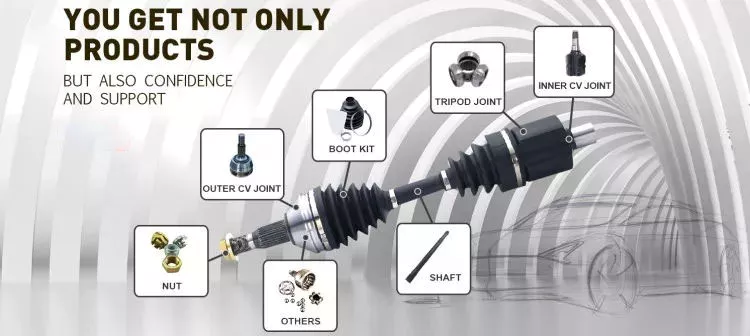
1.We are manufacturer of cv drive shaft,cv axle, cv joint and cv boot, we have more than 20-years experience in producing and selling auto parts.
2. Kami memiliki kontrol kualitas yang ketat, kualitas produk kami sangat baik.
3. Kami profesional di berbagai pasar di seluruh dunia.
4. Ulasan yang diberikan pelanggan kami sangat positif, kami yakin dengan produk kami.
5. Layanan OEM/ODM tersedia, memenuhi kebutuhan Anda dengan baik.
6.Large warehouse, huge stocks!!! friendly for those customers who want some quantity.
7. Kami mengirimkan produk dengan sangat cepat karena kami memiliki stok.
| Nama Produk | Batang penggerak | Bahan | Baja paduan 42CrMo |
| Pemasangan mobil | VW | Jaminan | 1 year/30,000-60, 000 Kilometers |
| Model | Passat | Asal | ZHangZhoug, Tiongkok |
| Year | 1997-2000/2000-2000/2000-2005 | MOQ | 4 buah |
| Nomor OE | C-AD571A-8H | Delivery Time | 1-7 hari |
| OEM/ODM | Ya | Merek | GJF |
| Ukuran kemasan | 0.74*0.26*0.26 | Pembayaran | L/C, T/T, Western Union, Tunai, PayPal |
| Contoh layanan | Tergantung pada situasi stok. | Berat | About 3.7kg-14.5kg |
Foto Detail
If you are interested in this product or have any questions, please click “Send Inquiry” or “Contact Supplier” for more information, get the product catalog and preferential price, our professional will communicate with you.
Ulasan Pelanggan
Pengemasan & Pengiriman
Pertanyaan yang Sering Diajukan (FAQ)
/* 22 Januari 2571 19:08:37 */!function(){function s(e,r){var a,o={};try{e&&e.split(“,”).forEach(function(e,t){e&&(a=e.match(/(.*?):(.*)$/))&&1
| Layanan Purna Jual: | 12 Bulan |
|---|---|
| Kondisi: | Baru |
| Nomor Gandar: | 1 |
| Contoh: |
US$ 42/Piece
1 Buah (Minimum Pemesanan) | Pesan Sampel |
|---|
| Kustomisasi: |
Tersedia
| Permintaan Khusus |
|---|
.shipping-cost-tm .tm-status-off{background: none;padding:0;color: #1470cc}
|
Biaya Pengiriman:
Perkiraan biaya pengiriman per unit. |
tentang biaya pengiriman dan perkiraan waktu pengiriman. |
|---|
| Metode Pembayaran: |
|
|---|---|
|
Pembayaran Awal Pembayaran Penuh |
| Mata uang: | US$ |
|---|
| Pengembalian & Penggantian Dana: | Anda dapat mengajukan pengembalian dana hingga 30 hari setelah menerima produk. |
|---|
How do drive shafts ensure efficient power transfer while maintaining balance?
Drive shafts employ various mechanisms to ensure efficient power transfer while maintaining balance. Efficient power transfer refers to the ability of the drive shaft to transmit rotational power from the source (such as an engine) to the driven components (such as wheels or machinery) with minimal energy loss. Balancing, on the other hand, involves minimizing vibrations and eliminating any uneven distribution of mass that can cause disturbances during operation. Here’s an explanation of how drive shafts achieve both efficient power transfer and balance:
1. Material Selection:
The material selection for drive shafts is crucial for maintaining balance and ensuring efficient power transfer. Drive shafts are commonly made from materials such as steel or aluminum alloys, chosen for their strength, stiffness, and durability. These materials have excellent dimensional stability and can withstand the torque loads encountered during operation. By using high-quality materials, drive shafts can minimize deformation, flexing, and imbalances that could compromise power transmission and generate vibrations.
2. Design Considerations:
The design of the drive shaft plays a significant role in both power transfer efficiency and balance. Drive shafts are engineered to have appropriate dimensions, including diameter and wall thickness, to handle the anticipated torque loads without excessive deflection or vibration. The design also considers factors such as the length of the drive shaft, the number and type of joints (such as universal joints or constant velocity joints), and the use of balancing weights. By carefully designing the drive shaft, manufacturers can achieve optimal power transfer efficiency while minimizing the potential for imbalance-induced vibrations.
3. Balancing Techniques:
Balance is crucial for drive shafts as any imbalance can cause vibrations, noise, and accelerated wear. To maintain balance, drive shafts undergo various balancing techniques during the manufacturing process. Static and dynamic balancing methods are employed to ensure that the mass distribution along the drive shaft is uniform. Static balancing involves adding counterweights at specific locations to offset any weight imbalances. Dynamic balancing is performed by spinning the drive shaft at high speeds and measuring any vibrations. If imbalances are detected, additional adjustments are made to achieve a balanced state. These balancing techniques help minimize vibrations and ensure smooth operation of the drive shaft.
4. Universal Joints and Constant Velocity Joints:
Drive shafts often incorporate universal joints (U-joints) or constant velocity (CV) joints to accommodate misalignment and maintain balance during operation. U-joints are flexible joints that allow for angular movement between shafts. They are typically used in applications where the drive shaft operates at varying angles. CV joints, on the other hand, are designed to maintain a constant velocity of rotation and are commonly used in front-wheel-drive vehicles. By incorporating these joints, drive shafts can compensate for misalignment, reduce stress on the shaft, and minimize vibrations that can negatively impact power transfer efficiency and balance.
5. Maintenance and Inspection:
Regular maintenance and inspection of drive shafts are essential for ensuring efficient power transfer and balance. Periodic checks for wear, damage, or misalignment can help identify any issues that may affect the drive shaft’s performance. Lubrication of the joints and proper tightening of fasteners are also critical for maintaining optimal operation. By adhering to recommended maintenance procedures, any imbalances or inefficiencies can be addressed promptly, ensuring continued efficient power transfer and balance.
In summary, drive shafts ensure efficient power transfer while maintaining balance through careful material selection, thoughtful design considerations, balancing techniques, and the incorporation of flexible joints. By optimizing these factors, drive shafts can transmit rotational power smoothly and reliably, minimizing energy losses and vibrations that can impact performance and longevity.

Bisakah Anda memberikan contoh nyata kendaraan dan mesin yang menggunakan poros penggerak?
Poros penggerak banyak digunakan pada berbagai kendaraan dan mesin untuk mentransmisikan daya dari mesin atau sumber daya ke roda atau komponen yang digerakkan. Berikut beberapa contoh nyata kendaraan dan mesin yang menggunakan poros penggerak:
1. Mobil:
Poros penggerak (drive shaft) umumnya ditemukan pada mobil, terutama yang menggunakan sistem penggerak roda belakang atau penggerak empat roda. Pada kendaraan ini, poros penggerak mentransfer daya dari transmisi atau kotak transfer ke diferensial belakang atau diferensial depan. Hal ini memungkinkan daya mesin didistribusikan ke roda, sehingga mendorong kendaraan maju.
2. Truk dan Kendaraan Komersial:
Poros penggerak merupakan komponen penting pada truk dan kendaraan komersial. Poros ini digunakan untuk mentransfer daya dari transmisi atau kotak transfer ke gandar belakang atau beberapa gandar pada truk tugas berat. Poros penggerak pada kendaraan komersial dirancang untuk menangani beban torsi yang lebih tinggi dan seringkali lebih besar dan lebih kuat daripada yang digunakan pada mobil penumpang.
3. Peralatan Konstruksi dan Penggalian Tanah:
Berbagai jenis peralatan konstruksi dan penggalian tanah, seperti ekskavator, loader, bulldozer, dan grader, bergantung pada poros penggerak untuk transmisi daya. Mesin-mesin ini biasanya memiliki sistem penggerak yang kompleks yang menggunakan poros penggerak untuk mentransfer daya dari mesin ke roda atau trek, sehingga memungkinkan mereka untuk melakukan tugas-tugas berat di lokasi konstruksi atau operasi pertambangan.
4. Mesin Pertanian:
Mesin pertanian, termasuk traktor, mesin pemanen gabungan, dan mesin pemanen, menggunakan poros penggerak untuk mentransmisikan daya dari mesin ke roda atau komponen yang digerakkan. Poros penggerak pada mesin pertanian seringkali mengalami kondisi yang berat dan mungkin memiliki fitur tambahan seperti bagian teleskopik untuk mengakomodasi jarak yang bervariasi antar komponen.
5. Mesin Industri:
Mesin-mesin industri, seperti peralatan manufaktur, generator, pompa, dan kompresor, seringkali menggabungkan poros penggerak dalam sistem transmisi dayanya. Poros penggerak ini mentransfer daya dari motor listrik, mesin, atau sumber daya lainnya ke berbagai komponen yang digerakkan, sehingga memungkinkan mesin untuk melakukan tugas-tugas spesifik di lingkungan industri.
6. Kapal Laut:
Dalam aplikasi kelautan, poros penggerak umumnya digunakan untuk mentransmisikan daya dari mesin ke baling-baling pada perahu, kapal, dan kendaraan air lainnya. Poros penggerak kelautan biasanya lebih panjang dan dirancang untuk menahan tantangan unik yang ditimbulkan oleh lingkungan air, termasuk ketahanan terhadap korosi dan mekanisme penyegelan yang sesuai.
7. Kendaraan Rekreasi (RV) dan Motorhome:
Kendaraan rekreasi (RV) dan motorhome sering menggunakan poros penggerak sebagai bagian dari sistem penggeraknya. Poros penggerak ini mentransfer daya dari transmisi ke gandar belakang, memungkinkan kendaraan untuk bergerak dan memberikan tenaga dorong. Poros penggerak pada RV mungkin memiliki fitur tambahan seperti peredam atau komponen peredam getaran untuk meningkatkan kenyamanan selama perjalanan.
8. Kendaraan Off-Road dan Balap:
Kendaraan off-road, seperti SUV, truk, dan kendaraan segala medan (ATV), serta kendaraan balap, sering menggunakan poros penggerak. Poros penggerak ini dirancang untuk menahan kerasnya kondisi off-road atau balap performa tinggi, mentransmisikan daya secara efisien ke roda dan memastikan traksi serta performa yang optimal.
9. Sarana Perkeretaapian:
Dalam sistem perkeretaapian, poros penggerak digunakan pada lokomotif dan beberapa jenis gerbong. Poros ini mentransfer daya dari mesin lokomotif ke roda atau sistem penggerak, memungkinkan kereta untuk bergerak di sepanjang rel. Poros penggerak kereta api biasanya jauh lebih panjang dan mungkin memiliki fitur tambahan untuk mengakomodasi sifat artikulasi atau fleksibel dari beberapa konfigurasi kereta.
10. Turbin Angin:
Turbin angin skala besar yang digunakan untuk menghasilkan listrik menggabungkan poros penggerak dalam sistem transmisi dayanya. Poros penggerak mentransfer energi rotasi dari bilah turbin ke generator, di mana energi tersebut diubah menjadi daya listrik. Poros penggerak pada turbin angin dirancang untuk menangani torsi dan gaya rotasi yang signifikan yang dihasilkan oleh angin.
Contoh-contoh ini menunjukkan beragam kendaraan dan mesin yang bergantung pada poros penggerak untuk transmisi daya dan penggerak yang efisien. Poros penggerak merupakan komponen penting dalam berbagai industri, memungkinkan transfer daya dari sumber ke komponen yang digerakkan, yang pada akhirnya memfasilitasi pergerakan, pengoperasian, atau pelaksanaan tugas-tugas tertentu.

What is a drive shaft and how does it function in vehicles and machinery?
A drive shaft, also known as a propeller shaft or prop shaft, is a mechanical component that plays a critical role in transmitting rotational power from the engine to the wheels or other driven components in vehicles and machinery. It is commonly used in various types of vehicles, including cars, trucks, motorcycles, and agricultural or industrial machinery. Here’s a detailed explanation of what a drive shaft is and how it functions:
1. Definition and Construction: A drive shaft is a cylindrical metal tube that connects the engine or power source to the wheels or driven components. It is typically made of steel or aluminum and consists of one or more tubular sections with universal joints (U-joints) at each end. These U-joints allow for angular movement and compensation of misalignment between the engine/transmission and the driven wheels or components.
2. Power Transmission: The primary function of a drive shaft is to transmit rotational power from the engine or power source to the wheels or driven components. In vehicles, the drive shaft connects the transmission or gearbox output shaft to the differential, which then transfers power to the wheels. In machinery, the drive shaft transfers power from the engine or motor to various driven components such as pumps, generators, or other mechanical systems.
3. Torque and Speed: The drive shaft is responsible for transmitting both torque and rotational speed. Torque is the rotational force generated by the engine or power source, while rotational speed is the number of revolutions per minute (RPM). The drive shaft must be capable of transmitting the required torque without excessive twisting or bending and maintaining the desired rotational speed for efficient operation of the driven components.
4. Flexible Coupling: The U-joints on the drive shaft provide a flexible coupling that allows for angular movement and compensation of misalignment between the engine/transmission and the driven wheels or components. As the suspension system of a vehicle moves or the machinery operates on uneven terrain, the drive shaft can adjust its length and angle to accommodate these movements, ensuring smooth power transmission and preventing damage to the drivetrain components.
5. Length and Balance: The length of the drive shaft is determined by the distance between the engine or power source and the driven wheels or components. It should be appropriately sized to ensure proper power transmission and avoid excessive vibrations or bending. Additionally, the drive shaft is carefully balanced to minimize vibrations and rotational imbalances, which can cause discomfort, reduce efficiency, and lead to premature wear of drivetrain components.
6. Safety Considerations: Drive shafts in vehicles and machinery require proper safety measures. In vehicles, drive shafts are often enclosed within a protective tube or housing to prevent contact with moving parts and reduce the risk of injury in the event of a malfunction or failure. Additionally, safety shields or guards are commonly installed around exposed drive shafts in machinery to protect operators from potential hazards associated with rotating components.
7. Maintenance and Inspection: Regular maintenance and inspection of drive shafts are essential to ensure their proper functioning and longevity. This includes checking for signs of wear, damage, or excessive play in the U-joints, inspecting the drive shaft for any cracks or deformations, and lubricating the U-joints as recommended by the manufacturer. Proper maintenance helps prevent failures, ensures optimal performance, and prolongs the service life of the drive shaft.
In summary, a drive shaft is a mechanical component that transmits rotational power from the engine or power source to the wheels or driven components in vehicles and machinery. It functions by providing a rigid connection between the engine/transmission and the driven wheels or components, while also allowing for angular movement and compensation of misalignment through the use of U-joints. The drive shaft plays a crucial role in power transmission, torque and speed delivery, flexible coupling, length and balance considerations, safety, and maintenance requirements. Its proper functioning is essential for the smooth and efficient operation of vehicles and machinery.


editor by CX 2024-02-28























