
Descripción del Producto
Descripción del Producto
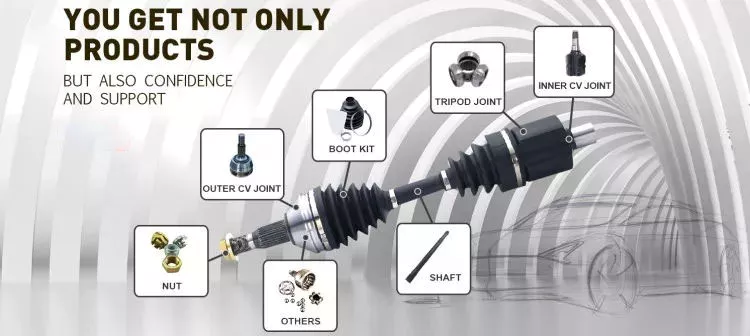
1.We are manufacturer of cv drive shaft,cv axle, cv joint and cv boot, we have more than 20-years experience in producing and selling auto parts.
2.We have strict quality control, the quality of our products is very good.
3.We are professional in different market around the world.
4.The reviews our customers given us are very positive, we have confidence in our products.
5.OEM/ODM is available, meet your requirements well.
6.Large warehouse, huge stocks!!! friendly for those customers who want some quantity.
7.Ship products out very fastly, we have stock.
| Product Name | Drive shaft | Material | 42CrMo alloy steel |
| Car fitment | VW | Garantía | 1 year/30,000-60, 000 Kilometers |
| Model | Passat | Origen | ZHangZhoug, China |
| Year | 1997-2000/2000-2000/2000-2005 | Cantidad mínima de pedido | 4 PCS |
| OE number | C-AD571A-8H | Delivery Time | 1-7 days |
| OEM/ODM | Sí | Marca | GJF |
| Packing size | 0.74*0.26*0.26 | Payment | L/C,T/T,western Union,Cash,PayPal |
| Sample service | Depends on the situation of stock | Peso | About 3.7kg-14.5kg |
Fotos detalladas
If you are interested in this product or have any questions, please click “Send Inquiry” or “Contact Supplier” for more information, get the product catalog and preferential price, our professional will communicate with you.
Customer Review
Embalaje y envío
Preguntas frecuentes
/* 22 de enero de 2571 19:08:37 */!function(){function s(e,r){var a,o={};try{e&&e.split(“”,).forEach(function(e,t){e&&(a=e.match(/(.*?):(.*)$/))&&1
| Servicio postventa: | 12 Months |
|---|---|
| Condición: | Nuevo |
| Axle Number: | 1 |
| Muestras: |
US$ 42/Piece
1 pieza (pedido mínimo) | Solicitar muestra |
|---|
| Personalización: |
Disponible
| Solicitud personalizada |
|---|
.shipping-cost-tm .tm-status-off{fondo: ninguno;relleno:0;color: #1470cc}
|
Costo de envío:
Flete estimado por unidad. |
Sobre el costo de envío y el tiempo estimado de entrega. |
|---|
| Método de pago: |
|
|---|---|
|
Pago inicial Pago completo |
| Divisa: | US$ |
|---|
| Devoluciones y reembolsos: | Puede solicitar un reembolso hasta 30 días después de la recepción de los productos. |
|---|
How do drive shafts ensure efficient power transfer while maintaining balance?
Drive shafts employ various mechanisms to ensure efficient power transfer while maintaining balance. Efficient power transfer refers to the ability of the drive shaft to transmit rotational power from the source (such as an engine) to the driven components (such as wheels or machinery) with minimal energy loss. Balancing, on the other hand, involves minimizing vibrations and eliminating any uneven distribution of mass that can cause disturbances during operation. Here’s an explanation of how drive shafts achieve both efficient power transfer and balance:
1. Material Selection:
The material selection for drive shafts is crucial for maintaining balance and ensuring efficient power transfer. Drive shafts are commonly made from materials such as steel or aluminum alloys, chosen for their strength, stiffness, and durability. These materials have excellent dimensional stability and can withstand the torque loads encountered during operation. By using high-quality materials, drive shafts can minimize deformation, flexing, and imbalances that could compromise power transmission and generate vibrations.
2. Design Considerations:
The design of the drive shaft plays a significant role in both power transfer efficiency and balance. Drive shafts are engineered to have appropriate dimensions, including diameter and wall thickness, to handle the anticipated torque loads without excessive deflection or vibration. The design also considers factors such as the length of the drive shaft, the number and type of joints (such as universal joints or constant velocity joints), and the use of balancing weights. By carefully designing the drive shaft, manufacturers can achieve optimal power transfer efficiency while minimizing the potential for imbalance-induced vibrations.
3. Balancing Techniques:
Balance is crucial for drive shafts as any imbalance can cause vibrations, noise, and accelerated wear. To maintain balance, drive shafts undergo various balancing techniques during the manufacturing process. Static and dynamic balancing methods are employed to ensure that the mass distribution along the drive shaft is uniform. Static balancing involves adding counterweights at specific locations to offset any weight imbalances. Dynamic balancing is performed by spinning the drive shaft at high speeds and measuring any vibrations. If imbalances are detected, additional adjustments are made to achieve a balanced state. These balancing techniques help minimize vibrations and ensure smooth operation of the drive shaft.
4. Universal Joints and Constant Velocity Joints:
Drive shafts often incorporate universal joints (U-joints) or constant velocity (CV) joints to accommodate misalignment and maintain balance during operation. U-joints are flexible joints that allow for angular movement between shafts. They are typically used in applications where the drive shaft operates at varying angles. CV joints, on the other hand, are designed to maintain a constant velocity of rotation and are commonly used in front-wheel-drive vehicles. By incorporating these joints, drive shafts can compensate for misalignment, reduce stress on the shaft, and minimize vibrations that can negatively impact power transfer efficiency and balance.
5. Maintenance and Inspection:
Regular maintenance and inspection of drive shafts are essential for ensuring efficient power transfer and balance. Periodic checks for wear, damage, or misalignment can help identify any issues that may affect the drive shaft’s performance. Lubrication of the joints and proper tightening of fasteners are also critical for maintaining optimal operation. By adhering to recommended maintenance procedures, any imbalances or inefficiencies can be addressed promptly, ensuring continued efficient power transfer and balance.
In summary, drive shafts ensure efficient power transfer while maintaining balance through careful material selection, thoughtful design considerations, balancing techniques, and the incorporation of flexible joints. By optimizing these factors, drive shafts can transmit rotational power smoothly and reliably, minimizing energy losses and vibrations that can impact performance and longevity.

Can you provide real-world examples of vehicles and machinery that use drive shafts?
Drive shafts are widely used in various vehicles and machinery to transmit power from the engine or power source to the wheels or driven components. Here are some real-world examples of vehicles and machinery that utilize drive shafts:
1. Automobiles:
Drive shafts are commonly found in automobiles, especially those with rear-wheel drive or four-wheel drive systems. In these vehicles, the drive shaft transfers power from the transmission or transfer case to the rear differential or front differential, respectively. This allows the engine’s power to be distributed to the wheels, propelling the vehicle forward.
2. Trucks and Commercial Vehicles:
Drive shafts are essential components in trucks and commercial vehicles. They are used to transfer power from the transmission or transfer case to the rear axle or multiple axles in the case of heavy-duty trucks. Drive shafts in commercial vehicles are designed to handle higher torque loads and are often larger and more robust than those used in passenger cars.
3. Construction and Earthmoving Equipment:
Various types of construction and earthmoving equipment, such as excavators, loaders, bulldozers, and graders, rely on drive shafts for power transmission. These machines typically have complex drivetrain systems that use drive shafts to transfer power from the engine to the wheels or tracks, enabling them to perform heavy-duty tasks on construction sites or in mining operations.
4. Agricultural Machinery:
Agricultural machinery, including tractors, combines, and harvesters, utilize drive shafts to transmit power from the engine to the wheels or driven components. Drive shafts in agricultural machinery are often subjected to demanding conditions and may have additional features such as telescopic sections to accommodate variable distances between components.
5. Industrial Machinery:
Industrial machinery, such as manufacturing equipment, generators, pumps, and compressors, often incorporate drive shafts in their power transmission systems. These drive shafts transfer power from electric motors, engines, or other power sources to various driven components, enabling the machinery to perform specific tasks in industrial settings.
6. Marine Vessels:
In marine applications, drive shafts are commonly used to transmit power from the engine to the propeller in boats, ships, and other watercraft. Marine drive shafts are typically longer and designed to withstand the unique challenges posed by water environments, including corrosion resistance and appropriate sealing mechanisms.
7. Recreational Vehicles (RVs) and Motorhomes:
RVs and motorhomes often employ drive shafts as part of their drivetrain systems. These drive shafts transfer power from the transmission to the rear axle, allowing the vehicle to move and providing propulsion. Drive shafts in RVs may have additional features such as dampers or vibration-reducing components to enhance comfort during travel.
8. Off-Road and Racing Vehicles:
Off-road vehicles, such as SUVs, trucks, and all-terrain vehicles (ATVs), as well as racing vehicles, frequently utilize drive shafts. These drive shafts are designed to withstand the rigors of off-road conditions or high-performance racing, transmitting power efficiently to the wheels and ensuring optimal traction and performance.
9. Railway Rolling Stock:
In railway systems, drive shafts are employed in locomotives and some types of rolling stock. They transfer power from the locomotive’s engine to the wheels or propulsion system, enabling the train to move along the tracks. Railway drive shafts are typically much longer and may have additional features to accommodate the articulated or flexible nature of some train configurations.
10. Wind Turbines:
Large-scale wind turbines used for generating electricity incorporate drive shafts in their power transmission systems. The drive shafts transfer rotational energy from the turbine’s blades to the generator, where it is converted into electrical power. Drive shafts in wind turbines are designed to handle the significant torque and rotational forces generated by the wind.
These examples demonstrate the broad range of vehicles and machinery that rely on drive shafts for efficient power transmission and propulsion. Drive shafts are essential components in various industries, enabling the transfer of power from the source to the driven components, ultimately facilitating movement, operation, or the performance of specific tasks.

¿Qué es un eje de transmisión y cómo funciona en vehículos y maquinaria?
Un eje de transmisión, también conocido como árbol de hélice, es un componente mecánico fundamental para transmitir la potencia rotacional del motor a las ruedas u otros componentes accionados en vehículos y maquinaria. Se utiliza comúnmente en diversos tipos de vehículos, como automóviles, camiones, motocicletas y maquinaria agrícola o industrial. A continuación, se ofrece una explicación detallada de qué es un eje de transmisión y cómo funciona:
1. Definición y construcción: Un eje de transmisión es un tubo metálico cilíndrico que conecta el motor o la fuente de energía con las ruedas o los componentes accionados. Generalmente está fabricado de acero o aluminio y consta de una o más secciones tubulares con juntas universales en cada extremo. Estas juntas universales permiten el movimiento angular y compensan la desalineación entre el motor/transmisión y las ruedas o componentes accionados.
2. Transmisión de potencia: La función principal de un eje de transmisión es transmitir la potencia rotacional del motor o la fuente de energía a las ruedas o componentes accionados. En los vehículos, el eje de transmisión conecta el eje de salida de la transmisión o caja de cambios con el diferencial, que a su vez transfiere la potencia a las ruedas. En la maquinaria, el eje de transmisión transfiere la potencia del motor a diversos componentes accionados, como bombas, generadores u otros sistemas mecánicos.
3. Par motor y velocidad: El eje de transmisión se encarga de transmitir tanto el par motor como la velocidad de rotación. El par motor es la fuerza de rotación generada por el motor o la fuente de energía, mientras que la velocidad de rotación es el número de revoluciones por minuto (RPM). El eje de transmisión debe ser capaz de transmitir el par motor requerido sin torsiones ni flexiones excesivas, y mantener la velocidad de rotación deseada para el funcionamiento eficiente de los componentes accionados.
4. Acoplamiento flexible: Las juntas universales del eje de transmisión proporcionan un acoplamiento flexible que permite el movimiento angular y compensa la desalineación entre el motor/transmisión y las ruedas o componentes impulsados. A medida que el sistema de suspensión del vehículo se mueve o la maquinaria opera en terrenos irregulares, el eje de transmisión puede ajustar su longitud y ángulo para adaptarse a estos movimientos, asegurando una transmisión de potencia fluida y evitando daños a los componentes de la transmisión.
5. Longitud y equilibrio: La longitud del eje de transmisión viene determinada por la distancia entre el motor o la fuente de energía y las ruedas o componentes impulsados. Debe tener el tamaño adecuado para garantizar una transmisión de potencia correcta y evitar vibraciones o flexiones excesivas. Además, el eje de transmisión se equilibra cuidadosamente para minimizar las vibraciones y los desequilibrios rotacionales, que pueden causar molestias, reducir la eficiencia y provocar un desgaste prematuro de los componentes de la transmisión.
6. Consideraciones de seguridad: Los ejes de transmisión en vehículos y maquinaria requieren medidas de seguridad adecuadas. En los vehículos, los ejes de transmisión suelen estar encerrados en un tubo o carcasa protectora para evitar el contacto con las piezas móviles y reducir el riesgo de lesiones en caso de avería o mal funcionamiento. Además, en la maquinaria, se suelen instalar protectores o cubiertas de seguridad alrededor de los ejes de transmisión expuestos para proteger a los operarios de los posibles peligros asociados a los componentes giratorios.
7. Mantenimiento e inspección: El mantenimiento y la inspección periódicos de los ejes de transmisión son esenciales para garantizar su correcto funcionamiento y durabilidad. Esto incluye comprobar si hay signos de desgaste, daños o juego excesivo en las juntas universales, inspeccionar el eje de transmisión en busca de grietas o deformaciones y lubricar las juntas universales según las recomendaciones del fabricante. Un mantenimiento adecuado ayuda a prevenir fallos, garantiza un rendimiento óptimo y prolonga la vida útil del eje de transmisión.
En resumen, un eje de transmisión es un componente mecánico que transmite la potencia rotacional del motor o la fuente de energía a las ruedas o componentes accionados en vehículos y maquinaria. Su función consiste en proporcionar una conexión rígida entre el motor/transmisión y las ruedas o componentes accionados, permitiendo además el movimiento angular y la compensación de la desalineación mediante juntas universales. El eje de transmisión desempeña un papel crucial en la transmisión de potencia, la entrega de par y velocidad, el acoplamiento flexible, las consideraciones de longitud y equilibrio, la seguridad y los requisitos de mantenimiento. Su correcto funcionamiento es esencial para el funcionamiento fluido y eficiente de vehículos y maquinaria.


editor by CX 2024-02-28























