
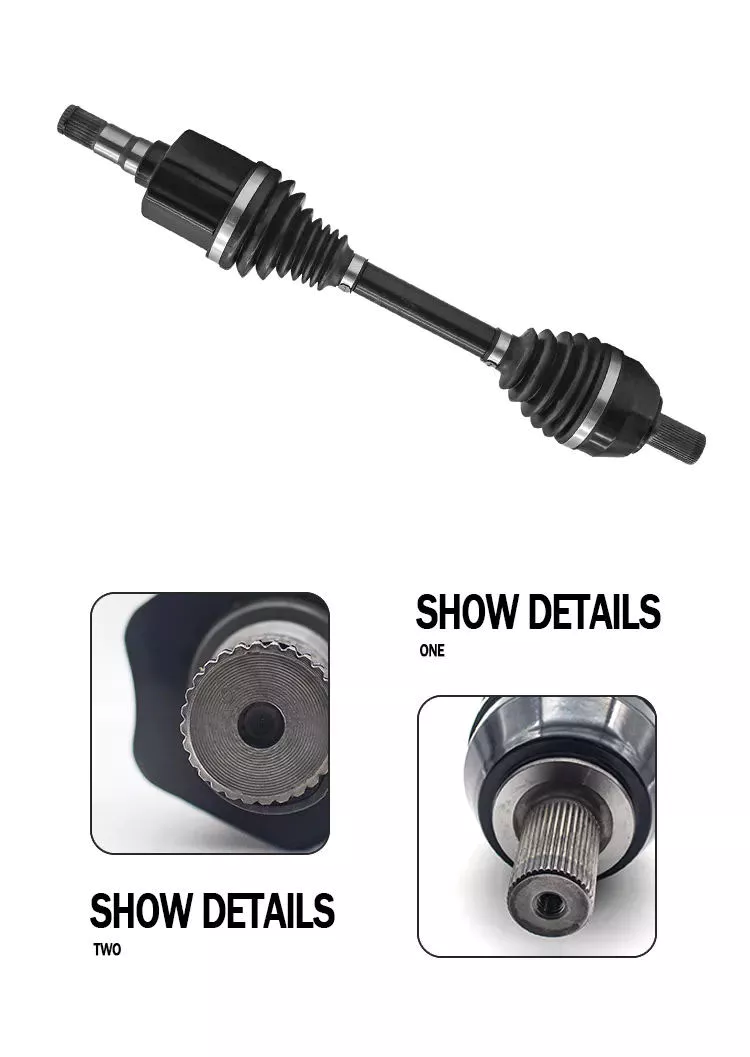
Description du produit
Brief Introduction
Processing flow
Applications
Quality Control
Packaging & Delivery
Packaging details:Standard plywood case
Delivery detail: 30-35 working days,depend on the actual produce condition
FAQ
Q1: What is the location of your company?
A1: Our company is located in the HangZhou City ,ZheJiang ,China.Welcome to visit our factory at anytime!
Q2: How does your factory do regarding quality control?
A2: Our standard QC system to control quality.
Q3: What is your delivery time?
A3: Usually within 25 days after the receipt of payment.Delivery time must depend on the actual produce condition.
Q4: What are your strengths?
A4: 1.We are the manufacturer,having competitive advantage in price.
2.A large part of money is put into advancing CNC equipments and product
R&D department annual,the performance of cardan shaft can be guaranteed.
3.About quality issues or follow-up after-sales service,we report directly to the boss.
4.We have the ambitions to exploring and developing the world’s cardan shaft market and
we believe we can.
| Matériel: | Alloy Steel |
|---|---|
| Load: | Arbre de transmission |
| Stiffness & Flexibility: | Stiffness / Rigid Axle |
| Journal Diameter Dimensional Accuracy: | IT6-IT9 |
| Axis Shape: | Straight Shaft |
| Shaft Shape: | Hollow Axis |
| Personnalisation : |
Disponible
| Demande personnalisée |
|---|
Comment les fabricants garantissent-ils la compatibilité des arbres de prise de force avec différents équipements ?
Les fabricants mettent en œuvre diverses mesures pour garantir la compatibilité des arbres de prise de force (PDF) avec différents équipements. Cette compatibilité est essentielle pour assurer un transfert efficace de la puissance de la source d'énergie à la machine entraînée, sans compromettre les performances, la sécurité ni la facilité d'utilisation. Voici une explication détaillée des mesures prises par les fabricants pour garantir cette compatibilité :
1. Normalisation : Les arbres de prise de force sont conçus et fabriqués selon des spécifications normalisées. Ces spécifications définissent les paramètres essentiels tels que les dimensions de l'arbre, le diamètre des cannelures, les couples admissibles et les exigences de sécurité. En respectant ces normes, les fabricants garantissent la compatibilité des arbres de prise de force avec une large gamme d'équipements répondant aux mêmes exigences. La normalisation permet l'interchangeabilité : les arbres de prise de force d'un fabricant peuvent ainsi être utilisés avec des équipements d'un autre fabricant, à condition qu'ils respectent les mêmes spécifications.
2. Collaboration avec les fabricants d'équipements : Les fabricants d'arbres de prise de force collaborent étroitement avec les constructeurs d'équipements pour garantir la compatibilité. Ensemble, ils comprennent les exigences spécifiques des équipements et conçoivent des arbres de prise de force qui s'intègrent parfaitement aux machines. Cette collaboration peut impliquer le partage de spécifications techniques, la réalisation d'essais conjoints et l'échange de retours d'expérience. Ce partenariat permet aux fabricants de résoudre tout problème de compatibilité dès les premières étapes de la conception et du développement, aboutissant ainsi à des arbres de prise de force parfaitement adaptés aux besoins des équipements.
3. Options de personnalisation : Les fabricants d'arbres de prise de force proposent des options de personnalisation pour s'adapter aux différentes configurations d'équipements. Ils offrent une grande flexibilité en termes de longueur d'arbre, de dimensions des cannelures, de conception des étriers et de mécanismes d'accouplement. Les fabricants d'équipements peuvent spécifier les paramètres requis, et les arbres de prise de force sont personnalisés en conséquence. Ceci garantit que les arbres de prise de force correspondent précisément aux exigences d'entrée/sortie de puissance et aux méthodes de connexion de l'équipement, assurant ainsi compatibilité et transmission de puissance efficace.
4. Tests et validation : Les fabricants mettent en œuvre des processus de test et de validation rigoureux afin de garantir la compatibilité et les performances des arbres de prise de force. Ces arbres sont soumis à divers tests, notamment des tests de couple, de vitesse de rotation et de durabilité. Ces tests vérifient que les arbres de prise de force peuvent supporter les charges de puissance et les conditions de fonctionnement prévues sans défaillance. En validant les performances des arbres de prise de force, les fabricants s'assurent de leur compatibilité avec une large gamme d'équipements et de leur capacité à transmettre la puissance de manière fiable dans différents scénarios d'utilisation.
5. Conformité aux normes de l'industrie : Les fabricants d'arbres de prise de force (PDF) respectent les normes et réglementations du secteur afin de garantir la compatibilité. Des organismes tels que l'ASABE (American Society of Agricultural and Biological Engineers) établissent des normes de sécurité et de performance pour les arbres de PDF. Les fabricants conçoivent et produisent leurs arbres conformément à ces normes, s'assurant ainsi que leurs produits répondent aux exigences nécessaires en matière de compatibilité et de sécurité. Le respect des normes industrielles garantit aux fabricants d'équipements et aux utilisateurs finaux que les arbres de PDF sont compatibles et adaptés à une utilisation avec différents équipements.
6. Documentation et directives : Les fabricants fournissent une documentation et des directives complètes pour aider les fabricants d'équipements et les utilisateurs finaux à garantir la compatibilité. Cette documentation comprend les spécifications techniques, les instructions d'installation, les consignes de maintenance et les recommandations de sécurité. Elle aide les fabricants d'équipements à choisir l'arbre de prise de force adapté à leur matériel et fournit des conseils sur son installation et son utilisation correctes. En suivant les directives du fabricant, les fabricants d'équipements peuvent garantir la compatibilité et optimiser les performances des arbres de prise de force.
7. Recherche et développement en cours : Les fabricants d'arbres de prise de force investissent continuellement dans la recherche et le développement afin d'améliorer la compatibilité avec différents équipements. Ils se tiennent informés des tendances du secteur, des avancées technologiques et de l'évolution des exigences en matière d'équipements. Ces efforts constants de recherche et développement leur permettent d'améliorer la conception, les matériaux et les caractéristiques des arbres de prise de force, garantissant ainsi leur compatibilité avec les dernières innovations et résolvant tout problème de compatibilité éventuel.
En adoptant la standardisation, en collaborant avec les fabricants d'équipements, en proposant des options de personnalisation, en réalisant des tests rigoureux, en respectant les normes industrielles, en fournissant la documentation et les directives nécessaires et en investissant dans la recherche et le développement, les fabricants garantissent la compatibilité des arbres de prise de force avec différents équipements. Cette compatibilité permet une intégration fluide, un transfert de puissance efficace et des performances optimales pour une large gamme de machines et d'équipements dans divers secteurs industriels.

How do PTO shafts handle variations in load and torque during operation?
PTO (Power Take-Off) shafts are designed to handle variations in load and torque during operation by employing specific mechanisms and features that ensure efficient power transfer and protection against overload conditions. Here’s a detailed explanation of how PTO shafts handle variations in load and torque:
1. Mechanical Design: PTO shafts are engineered with robust mechanical design principles that enable them to handle variations in load and torque. They are typically constructed using high-strength materials such as steel, which provides durability and resistance to bending or twisting forces. The shaft’s diameter, wall thickness, and overall dimensions are carefully calculated to withstand the expected torque levels and load variations. The mechanical design of the PTO shaft ensures that it can transmit power reliably and accommodate the dynamic forces encountered during operation.
2. Universal Joints: Universal joints are a key component of PTO shafts that allow for flexibility and compensation of misalignment between the power source and driven machinery. These joints can accommodate variations in angular alignment, which may occur due to changes in load or movement of the machinery. Universal joints consist of a cross-shaped yoke with needle bearings that allow for smooth rotation and transfer of torque, even when the shafts are not perfectly aligned. The design of universal joints enables PTO shafts to handle variations in load and torque while maintaining consistent power transmission.
3. Slip Clutches: Slip clutches are often incorporated into PTO shafts to provide overload protection. These clutches allow the PTO shaft to slip or disengage momentarily when excessive torque or resistance is encountered. Slip clutches typically consist of friction plates that can be adjusted to a specific torque setting. When the torque surpasses the predetermined limit, the clutch slips, preventing damage to the PTO shaft and connected equipment. Slip clutches are particularly useful when sudden changes in load or torque occur, providing a safety mechanism to protect the PTO shaft and associated machinery.
4. Torque Limiters: Torque limiters are another protective feature found in some PTO shafts. These devices are designed to automatically disengage the power transmission when a predetermined torque threshold is exceeded. Torque limiters can be mechanical, such as shear pin couplings or friction clutches, or electronic, utilizing sensors and control systems. When the torque exceeds the set limit, the torque limiter disengages, preventing further power transfer and protecting the PTO shaft from overload conditions. Torque limiters are effective in handling sudden spikes in torque and safeguarding the PTO shaft and associated equipment.
5. Maintenance and Inspection: Regular maintenance and inspection of PTO shafts are essential to ensure their proper functioning and ability to handle variations in load and torque. Routine maintenance includes lubrication of universal joints, inspection of shaft integrity, and tightening of fasteners. Regular inspections allow for early detection of wear, misalignment, or other issues that may affect the PTO shaft’s performance. By addressing maintenance and inspection requirements, operators can identify and address any concerns that may arise due to variations in load and torque, ensuring the continued safe and efficient operation of the PTO shaft.
6. Operator Awareness and Control: Operators play a crucial role in managing variations in load and torque during PTO shaft operation. They should be aware of the machinery’s operational limits, including the recommended torque ratings and load capacities of the PTO shaft. Proper training and understanding of the equipment’s capabilities enable operators to make informed decisions and adjust the operation when encountering significant load or torque changes. Operators should also be vigilant in monitoring the equipment’s performance, watching for any signs of excessive vibration, noise, or other indications of potential issues related to load and torque variations.
By incorporating robust mechanical design, utilizing universal joints, slip clutches, torque limiters, and implementing proper maintenance practices, PTO shafts are equipped to handle variations in load and torque during operation. These features ensure reliable power transmission, protect against overload conditions, and contribute to the safe and efficient functioning of the PTO shaft and the machinery it drives.
What is a PTO shaft and how is it used in agricultural and industrial equipment?
A power take-off (PTO) shaft is a mechanical component used in agricultural and industrial equipment to transfer power from a power source, such as an engine or motor, to another machine or implement. It is a driveline shaft that transmits rotational power and torque, allowing the connected equipment to perform various tasks. PTO shafts are commonly used in agricultural machinery, such as tractors, as well as in industrial equipment, including generators, pumps, and construction machinery. Here’s a detailed explanation of what a PTO shaft is and how it is used:
Structure and Components: A typical PTO shaft consists of a hollow metal tube with universal joints at each end. The hollow tube allows the shaft to rotate freely, while the universal joints accommodate angular misalignments between the power source and the driven equipment. The universal joints consist of a cross-shaped yoke with needle bearings, providing flexibility and allowing the transmission of power at varying angles. Some PTO shafts may also include a telescopic section to adjust the length for different equipment setups or to accommodate varying distances between the power source and the driven machine.
Power Transfer: The primary function of a PTO shaft is to transfer power and torque from the power source to the driven equipment. The power source, typically an engine or motor, drives the PTO shaft through a mechanical connection, such as a gearbox or a clutch. As the power source rotates, it transmits rotational force to the PTO shaft. The PTO shaft, in turn, transfers this rotational power and torque to the driven equipment, enabling it to perform its intended function. The torque and rotational speed transmitted through the PTO shaft depend on the power source’s characteristics and the gear ratio or clutch engagement.
Agricultural Applications: In agriculture, PTO shafts are commonly used in tractors to power various implements and attachments. The PTO shaft is connected to the tractor’s power take-off, a rotating drive shaft located at the rear of the tractor. By engaging the PTO clutch, the tractor’s engine power is transferred through the PTO shaft to the attached implements. Agricultural machinery, such as mowers, balers, tillers, sprayers, and grain augers, often rely on PTO shafts to receive power for their operation. The PTO shaft allows the implements to be powered directly by the tractor’s engine, eliminating the need for separate power sources and increasing the versatility and efficiency of agricultural operations.
Industrial Applications: PTO shafts also find extensive use in various industrial applications. Industrial equipment, such as generators, pumps, compressors, and industrial mixers, often incorporate PTO shafts to receive power from engines or electric motors. The PTO shaft connects the power source to the driven equipment, allowing it to operate and perform its intended function. In construction machinery, PTO shafts can be found in equipment like concrete mixers, hydraulic hammers, and post hole diggers, enabling the transfer of power from the machinery’s engine to the specific attachment or tool being used.
Safety Considerations: It is important to note that PTO shafts can pose safety risks if not handled properly. The rotating shaft can cause serious injuries if operators come into contact with it while it is in operation. To ensure safety, PTO shafts are often equipped with shielding or guards that cover the rotating shaft and universal joints, preventing accidental contact. It is crucial to maintain and inspect these safety features regularly to ensure their effectiveness. Additionally, operators should receive proper training on PTO shaft operation, including safe attachment and detachment procedures, as well as the use of personal protective equipment when working near PTO-driven machinery.
In summary, a PTO shaft is a mechanical component used in agricultural and industrial equipment to transmit power and torque from a power source to a driven machine or implement. It enables the direct power transfer from engines or motors to various equipment, increasing efficiency and versatility in agricultural and industrial operations. While PTO shafts offer significant benefits, operators must be aware of the associated safety considerations and take appropriate precautions to prevent accidents and injuries.


editor by CX 2023-09-18























