
📍 Bury St Edmunds, Suffolk IP32 7LX, United Kingdom | 📧 [email protected]
Scenario: High-Torque Mixing, Rubber Compounding, Polymer Processing
Region Focus: United Kingdom (Manchester, Birmingham, Suffolk, Gateshead hubs)
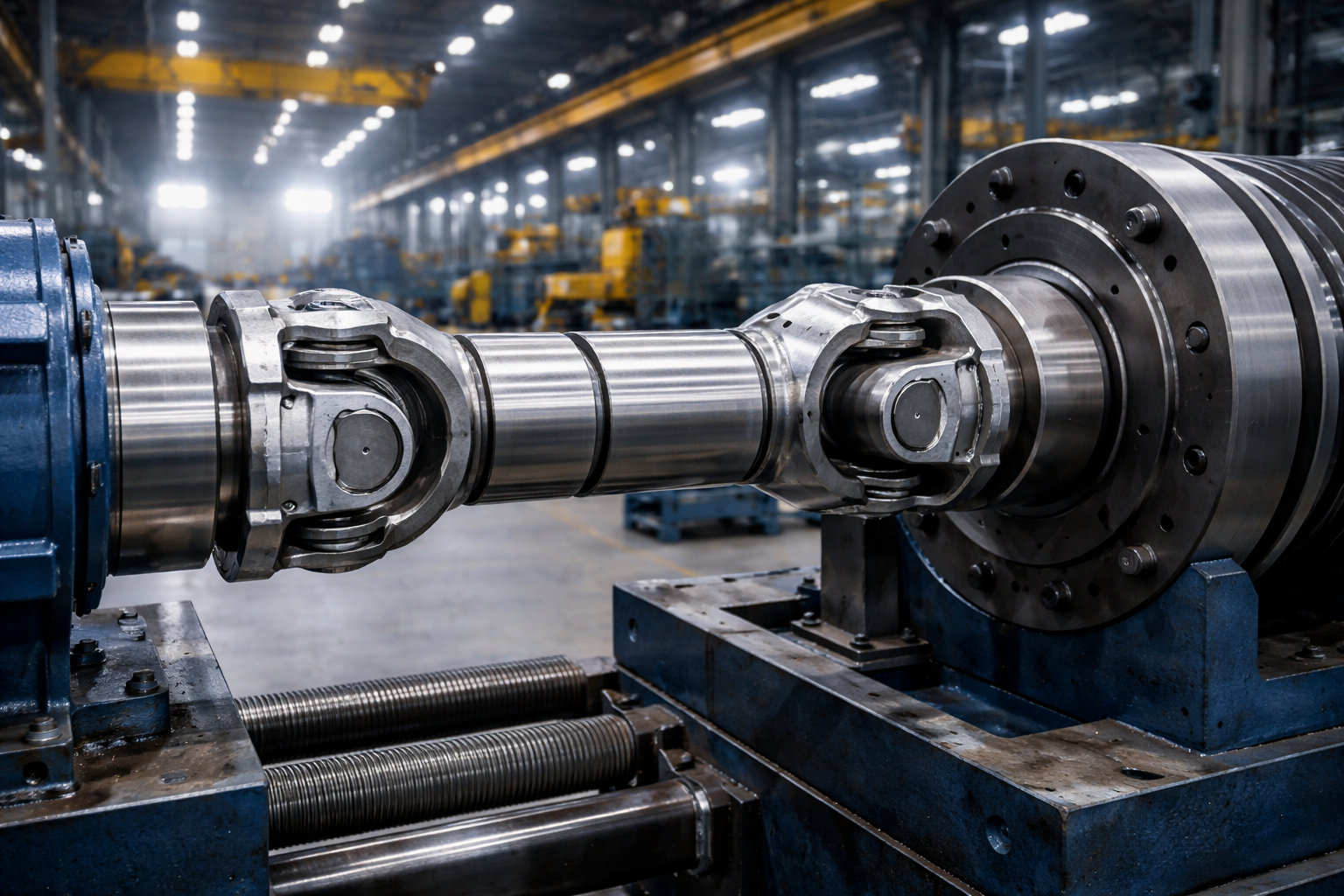
Engineered to withstand the extreme shock loading, thermal radiation, and carbon black contamination inherent in intensive mixing operations. Our shafts deliver 20,000+ hour operational lifecycles under standard Service Factors of 2.5.
Request Technical Drawing & Quote
Critical Engineering Challenges in Rubber Mixing
Internal mixers (commonly known by their generic trademark Banbury®) are the “heart” of any tire or technical rubber product factory. Whether these machines are located in tire manufacturing centers near Birmingham or in specialized polymer plants in Manchester, they generate a unique set of destructive forces that standard, general-purpose universal joints simply cannot withstand.
The “Ram Drop” Shock Load
When pneumatic or hydraulic cylinders press the raw rubber blocks and carbon black into the mixing chamber, the resistance does not change linearly but exhibits chaotic behavior. The rotor experiences instantaneous torque peaks, which can exceed 300% of the motor’s rated power. In this situation, the journals of standard drive shafts used in pumps or fans would undergo plastic deformation. Our drive shafts utilize surface-hardened alloy steel (18CrNiMo7-6) universal joints, with optimized core hardness to enhance toughness and prevent brittle fracture during these overload events that last for milliseconds.
Thermal Degradation & Contamination
The mixing chamber operates at temperatures exceeding 160°C (320°F). Radiant heat affects the viscosity of the lubricant in the universal joint bearings. Furthermore, the ubiquitous carbon black dust creates an abrasive environment. If the seals fail, the needle bearings will essentially become a grinding paste. For British factories handling carbon compound-rich materials, we specifically employ a double-lip Viton® sealing system with an external metal dust cover (labyrinth design).
🔧 Engineer’s Notebook: The “Monday Morning” Cold Start
Location: Tyre Retreading Facility, Leeds, West Yorkshire
Date: November 2024
We received a call for help from a factory manager whose old F270 mixer was experiencing frequent breakdowns. The drive shaft was breaking every four months. Upon on-site inspection, we identified the culprit: “low-temperature starting viscosity.” To save energy, the factory shut down its heating system on weekends. On Monday mornings, the rubber mixture would become as hard as a rock. The existing drive shaft (a competitor’s brand) could only withstand the running torque, not the starting torque required to shear the cold, hardened rubber.
The solution: We modified and installed a custom heavy-duty series drive shaft (equivalent to GWB 687.65) and modified the flange interface so it would fit the existing gearbox without requiring the motor to be moved. We also upgraded the universal joint to a “maintenance-free” design to reduce the need for lubrication in the narrow and dangerous space between the gearbox and the mixer wall. The result: The new drive shaft has been running for 18 months without any failures.
Technical Specification Matrix: Internal Mixer Series
The following parameters represent our standard capabilities for mixer applications. Custom lengths and flange patterns are machined at our Suffolk facility to match specific OEM requirements (e.g., Farrel, HF, Kobelco style interfaces).
| Parameter ID | Description | Specification / Range |
|---|---|---|
| TS-001 | Nominal Torque Capacity (Tn) | 25 kNm – 550 kNm |
| TS-002 | Fatigue Torque Rating (Tdw) | 1.5x Nominal |
| TS-003 | Breaking Torque (Tcs) | Min. 3.5x Nominal |
| TS-004 | Flange Diameter Range | 225 mm – 620 mm |
| TS-005 | Swing Diameter (D) | 180 mm – 550 mm |
| TS-006 | Length Compensation (Spline Travel) | 80 mm – 400 mm (Long-travel available) |
| TS-007 | Spline Coating | Rilsan® / Molybdenum Disulphide (MoS2) |
| TS-008 | Maximum Deflection Angle | 15° (Standard) / 25° (High-Angle) |
| TS-009 | Dynamic Balancing Quality | G6.3 / G2.5 (ISO 1940-1) |
| TS-010 | Cross Material | 18CrNiMo7-6 Case Hardened |
| TS-011 | Yoke Material | 42CrMo4 Forged Steel |
| TS-012 | Tube Material | St52.3 / High-Strength DOM |
| TS-013 | Operating Temperature | -20°C to +180°C (High-Temp Grease) |
| TS-014 | Painting Specification | Epoxy Primer + 2K Polyurethane (RAL 5010/7016) |
| TS-015 | Lubrication Points | Centralized or Individual Cup Options |
| TS-016 | Flange Connection Type | DIN / SAE / Face Key / Hirth Serration |
| TS-017 | Fastener Grade | 10.9 or 12.9 (Geomet Coated) |
| TS-018 | Bearing Life (L10) | > 25,000 Hours @ 50% Load |
| TS-019 | Service Factor (K) Application | 2.0 – 3.0 (Rubber Mixing) |
| TS-020 | Torsional Stiffness | 1.2 x 10^6 Nm/rad (Avg size) |
| TS-021 | Critical Speed Limit | Dependent on length (Detailed in manual) |
| TS-022 | Sealing System | Double-lip + Metal Deflector |
| TS-023 | Retaining Ring Type | Internal Snap Ring / Bolted Plate |
| TS-024 | Weld Certification | ISO 3834-2 |
| TS-025 | NDT Testing | 100% Magnetic Particle on Welds |
| TS-026 | Traceability | Laser Etched Serial # + QR Code |
| TS-027 | Packaging | VCI Anti-corrosion Wrap + Wooden Crate |
| TS-028 | Warranty | 12 Months Operation / 18 Months Shipment |
| TS-029 | UKCA Compliance | Yes (Supply of Machinery Regulations 2008) |
| TS-030 | Weight Range | 45 kg – 1,200 kg |
Disclaimer: All original equipment manufacturer (OEM) names, part numbers, and descriptions (e.g., GWB, GKN, Comer, Voith) are used for reference purposes only. UK pto-drive-shafts.com Co.,Ltd. is an independent manufacturer and is not affiliated with these brands.
UK Regulatory Compliance & Safety (PUWER)
In the United Kingdom, the Provision and Use of Work Equipment Regulations 1998 (PUWER) places strict liability on factory owners to ensure that all rotating machinery is adequately guarded. A spinning drive shaft on a Banbury mixer stores lethal kinetic energy.
Compliance Features of Our Shafts:
- Smooth Profile Welding: We minimize protruding weld beads to reduce entanglement risks, although this does not negate the need for guarding.
- Guard Integration Points: Our bearing housings can be machined with mounting points for stationary guard bearings, allowing the yellow safety guard to “float” on the shaft, a common requirement in UK health and safety audits.
- Vibration Monitoring Ready: We offer optional machined flats on the bearing caps for mounting wireless accelerometers, allowing predictive maintenance teams to monitor imbalance before it becomes a catastrophic failure.
Regional Industry Focus: Serving the UK Core
We supply bespoke transmission solutions across the Great Britain manufacturing landscape:
- Manchester & The North West: The historic heart of the UK’s rubber proofing and moulding industry. We offer 24-hour emergency courier replacement services to Trafford Park and surrounding industrial estates.
- Birmingham & The Midlands: Supporting the automotive supply chain (tyre and hose manufacturing) with Just-In-Time (JIT) shaft deliveries.
- Suffolk & The East: From our base in Bury St Edmunds, we coordinate engineering consultations and site visits for complex retrofit projects.
Gearbox Solutions for Internal Mixers
The drive shaft acts like a fuse, while the gearbox is the power source. The reduction gearbox in the internal mixer is one of the most expensive and complex components in the entire rubber processing production line. It must convert the high rotational speed of the electric motor (typically 1000-1500 rpm) into the enormous low-speed torque required for kneading the raw rubber (rotor speed is typically 30-60 rpm), while also withstanding the separating forces that try to push the gears apart.
The “Uni-Drive” vs. “Dual-Drive” Architecture
In modern UK facilities, we predominantly see the Uni-Drive system. A single large AC motor drives a dual-output gearbox. This gearbox is a technological marvel, often employing a combination of double-helical (herringbone) gears to cancel out axial thrust loads, or advanced planetary stages for high power density.
Our Gearbox Capabilities (Replacement & Refurbishment)
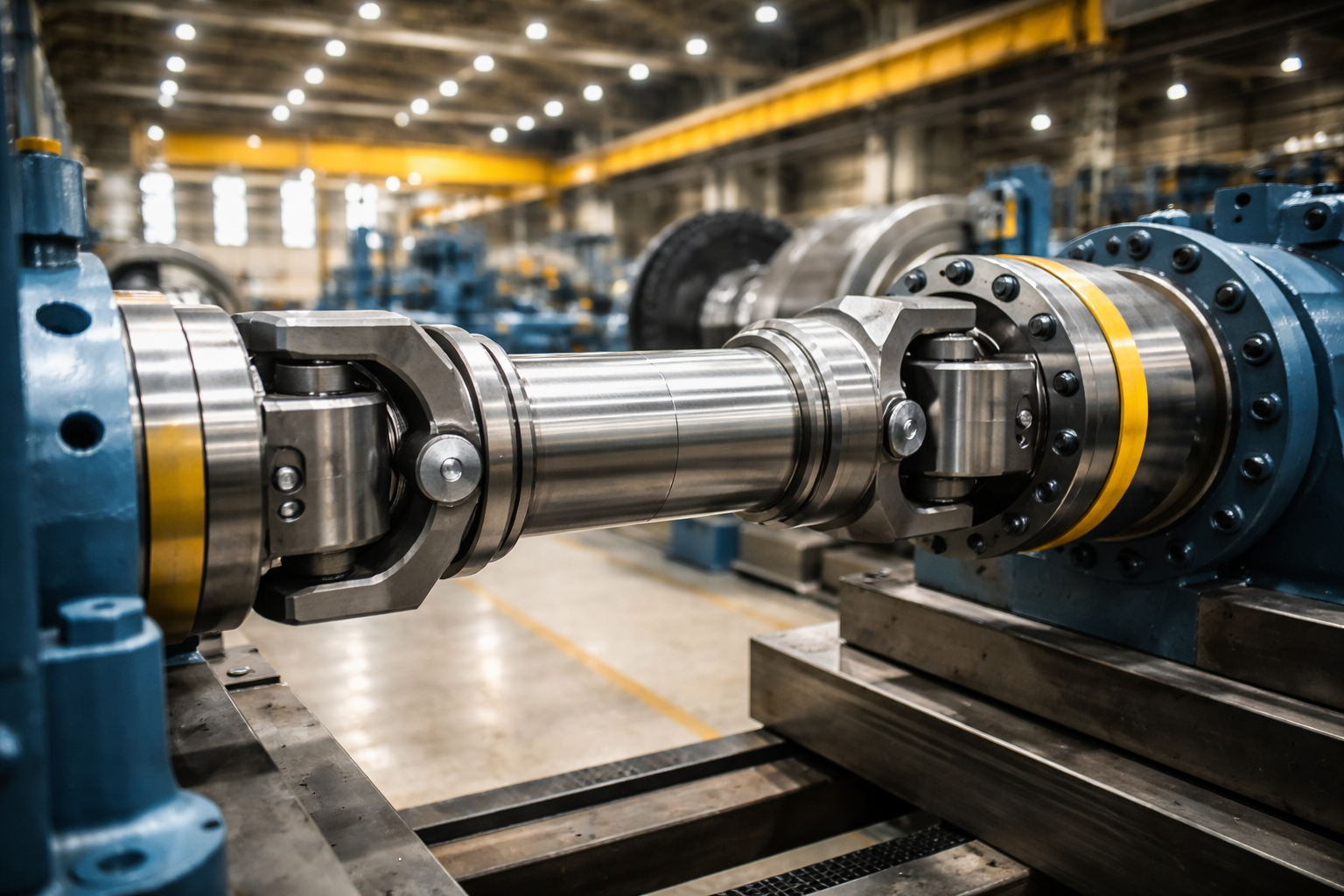
We manufacture and refurbish drop-in replacement gearboxes for mixers ranging from small 1.5-liter lab mixers to massive 620-liter production units.
1. Case Hardening & Grinding:
All gearing is manufactured from 18CrNiMo7-6 steel, carburized to 58-62 HRC. This hardness is non-negotiable for handling the shock loads described earlier. Following heat treatment, gear teeth are profile ground to DIN Quality 5 or better. This precision grinding ensures:
- Noise Reduction: Essential for meeting UK workplace noise exposure limits (Control of Noise at Work Regulations 2005).
- Load Distribution: Ensures contact across the full face width of the gear, preventing localized pitting.
2. Lubrication & Cooling Systems:
A mixer gearbox generates significant heat. We supply integrated lubrication units that include:
- Duplex Filters: Allowing filter changes without stopping the gearbox.
- Air/Oil Coolers: Sized for UK summer ambient temps (up to 35°C design ambient).
- Flow Monitoring: Digital flow meters interlocked with the main motor starter to prevent dry running.
3. Bearing Arrangements:
The output shafts of a mixer gearbox are subjected to immense radial and axial loads caused by the “separating force” of the rotors mixing the rubber. We utilize premium spherical roller bearings or custom-designed tapered roller bearings from Tier-1 suppliers (SKF/Timken/FAG) to handle these vector forces.
Gearbox Technical Parameters (Example for 270L Mixer)
- Input Power: 1200 kW
- Input Speed: 1000 RPM
- Ratio: 25:1 (Nominal)
- Output Torque: > 350 kNm per shaft
- Service Factor: 2.5 AGMA
- Weight: Approx. 18,000 kg
We strongly recommend replacing the input and output couplings (gear couplings or cardan shafts) whenever a gearbox is overhauled. A worn coupling is the primary cause of input shaft seal failure and high-speed bearing vibration.
Maintenance & Failure Prevention: A Guide for Maintenance Managers
Through our analysis of over 500 failed shafts in the UK polymer sector, we have identified the “Deadly Trio” of failure modes:
- Fatigue Fracture at the Yoke Ear: Caused by under-specifying the Service Factor. If your mixer frequently runs “cold” compounds or natural rubber with high viscosity, a standard catalogue shaft will fail via fatigue crack initiation at the stress concentration point of the cross-hole. Solution: Our “Heavy-Wall” yoke design adds 15% more material section in this critical zone.
- Spline Seizure (Galling): The telescopic section must expand and contract as the mixer moves on its vibration mounts. If the spline is unlubricated or made of soft material, it seizes. Once seized, axial vibrations are transmitted directly to the gearbox output bearings, destroying them. Solution: Molybdenum-coated splines with automatic lubrication channels.
- Cross Overheating: High operating angles (>5 degrees) cause rapid heat buildup in the needle cups. Solution: We conduct a Torsional Analysis and Layout Review to minimize operating angles during installation.
Frequently Asked Questions (FAQ)
How do I measure a drive shaft for a Banbury mixer replacement?
You must measure the compressed length (Lz), the flange diameter, the bolt circle diameter, and the number of bolt holes. Crucially for mixers, measure the “Swing Diameter” (clearance) to ensure the new, potentially stronger shaft does not hit the gearbox casing or floor structures. Download our PDF measurement guide for a step-by-step checklist.
Can you match GWB or Spicer part numbers?
Yes, we have an extensive cross-reference database for GWB 587/687 series, Spicer 1810/1910 series, and others. Simply send us the data plate photo or the OEM part number, and we will quote a functionally equivalent or upgraded unit.
What is the lead time for a custom heavy-duty shaft in the UK?
For emergency breakdowns in the UK, we can often assemble shafts from stock components within 24-48 hours. For fully custom forged units, typical production time is 4-6 weeks, which is significantly faster than the 12-16 week industry average.
📰 UK Rubber Industry News Brief
- Sustainability Push: The British Rubber and Polyurethane Products Association (BRPPA) recently highlighted new initiatives for recycling end-of-life tyres, driving demand for re-processing mixers.
- Energy Efficiency: New grants are available for UK manufacturers upgrading to high-efficiency motors and drive systems in 2026.
- Northern Powerhouse: Investments in Manchester’s advanced materials sector are boosting demand for precision mixing equipment.
Edit by gzl























