
In-depth Analysis of Tractor Power Take-Off Shaft Drive Systems, Safety Regulations, and Operational Stability
In the vast and complex ecosystem of modern agricultural machinery, few components are as crucial, yet often overlooked, as the power take-off (PTO) drive shaft. Like a mechanical umbilical cord, it transmits the immense power of the tractor engine to various implements used for tilling the soil, harvesting crops, and managing the land. As traditional and fundamental users of universal drive shafts, the agricultural sector requires engineering solutions that balance high torque transmission, exceptional environmental adaptability, and absolute safety. This technical blog will delve into tractor power take-off shaft drive systems. Leveraging the engineering expertise of pto-drive-shafts.com Ltd. in the UK, we will dissect its mechanical structure, analyze the harsh operating environment of the field, and outline stringent configuration standards to ensure efficiency and personal safety.
The Anatomy of Tractor PTO Drive Systems
Definition and Core Functionality
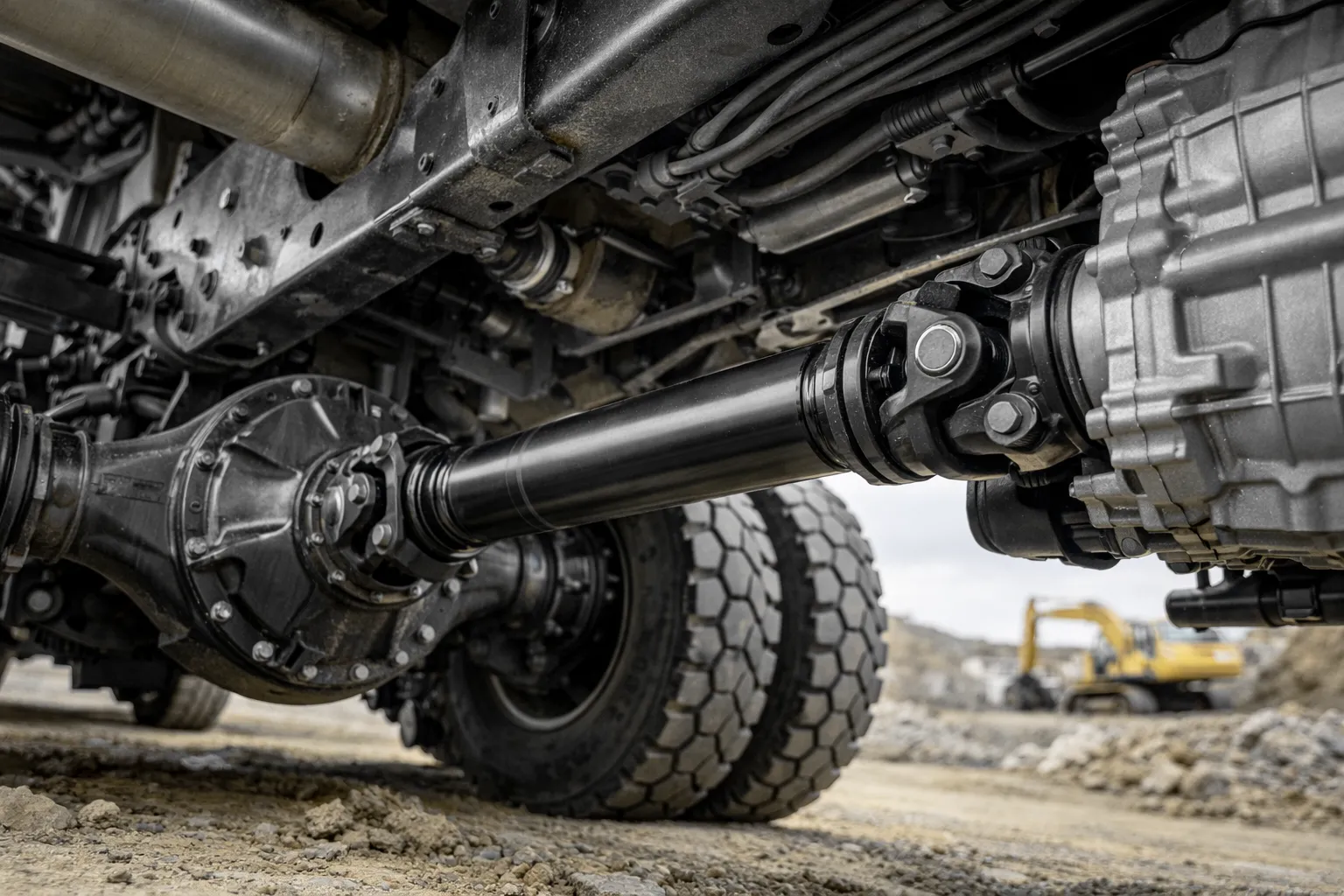
A tractor power take-off (PTO) drive system is a specially designed mechanical component used to transmit the rotational power of a tractor to implements such as lawnmowers, balers, rotary tillers, or seeders. This system connects the tractor’s power take-off shaft (PTO), typically located at the rear of the vehicle, to the implement input connection (IIC).
Unlike stationary industrial drives, agricultural PTOs must transmit power through constantly changing geometry. The distance and angle between the power source and receiver constantly change as the tractor travels on uneven terrain, turns, or lifts implements via a three-point suspension system. The PTO adapts to these changes through angle compensation via universal joints (Cartan joints) and length compensation via telescopic rods (sliding profile tubes).
Standardization: The 540 and 1000 RPM Paradigms
To ensure compatibility across global machinery brands, the interface is governed by strict ISO standards. The two dominant speed classifications are:
- 540 RPM: The traditional standard, typically utilizing a 6-spline shaft. It is common for general-purpose implements like hay rakes, balers, and smaller cutters.
- 1000 RPM: Designed for higher power transmission efficiency, often utilizing a 20-spline or 21-spline shaft. This is prevalent in heavy-duty applications such as large rotary harrows, forage harvesters, and commercial flail mowers.
The selection of the correct shaft class is paramount; mismatching a shaft to the tractor’s horsepower output can lead to catastrophic torsional failure.
Deep Analysis: The Brutal Reality of Field Operating Conditions
The agricultural environment is arguably one of the most hostile settings for precision mechanical components. Designing a PTO shaft for a factory floor is vastly different from designing one for a muddy field in Suffolk. We categorize the challenges into three distinct vectors: Variable Load Dynamics, Kinematic Extremes, and Environmental Aggression.
Variable Load Dynamics and Shock Loading
Agricultural operations are rarely steady-state. The torque curve is characterized by violent fluctuations.
Scenario A: The Shock Load. Consider a rotary cutter clearing dense brush. The rotor has high inertia. If the blades strike a hidden granite rock or a tree stump, the kinetic energy is instantly arrested. This creates a massive torque spike (shock load) that travels back up the drive shaft. Without adequate yield strength or protection mechanisms, the shaft profiles can twist, or the cross-kits can shatter.
Scenario B: The Cyclic Load. A square baler compresses hay using a plunger mechanism. Every compression stroke sends a pulse of resistance through the drivetrain. This cyclic loading induces fatigue stress in the metal, testing the endurance limit of the yokes and tubes.
Kinematic Extremes: Angles and Telescoping
The geometry of the connection is fluid.
- Angular Misalignment: Standard universal joints operate efficiently up to approx 25 degrees. However, when a tractor turns at the headland (the end of a field row), the angle can briefly exceed this. Operating a standard joint at high angles causes “speed fluctuation”—a non-uniform velocity that generates vibration and hammering noises.
- Telescopic Compression: When a tractor traverses a ditch, the implement may nose-dive, shortening the distance to the tractor. The PTO shaft must telescope inward (collapse) instantly. If the sliding profiles are seized due to rust or poor lubrication, the shaft acts as a solid rod, transferring axial thrust that can destroy the tractor’s PTO gearbox bearings or the implement’s input shaft case.
Environmental Aggression
The “office” of a PTO shaft is outdoors, exposed to the elements 24/7.
- Contamination: Mud, straw, silage, and chemical fertilizers create an abrasive paste that works its way into moving parts.
- Corrosion: Rain, irrigation water, and morning dew promote oxidation. A rusted telescoping tube increases friction coefficient significantly, leading to the axial thrust issues mentioned above.
- Thermal Stress: In high summer, components can reach scorching temperatures due to internal friction and solar radiation; in winter, lubricants thicken, resisting flow to the needle bearings.
Technical Configuration Requirements for Modern Agriculture
To combat these extreme conditions, UK pto-drive-shafts.com Co.,Ltd. adheres to rigorous engineering configurations. A compliant and durable PTO shaft is not just a metal bar; it is a system of integrated safety and performance features.
The First Line of Defense: Safety Guarding
The rotational energy of a PTO shaft is lethal. At 540 RPM, a shaft rotates 9 times per second. A loose piece of clothing, a shoelace, or long hair touching a bare shaft can wrap around it instantly, pulling the operator into the machine with devastating force.
Therefore, Safety Guarding is not optional; it is a fundamental mandate (referenced by safety bodies globally, including HSE in the UK and OSHA in the US).
- Full Enclosure: The shaft must be enclosed in a high-density polyethylene (HDPE) shield that covers the entire length of the tube and the universal joints.
- The Bearing Principle: The guard rides on bearings (nylon or ball bearings) on the shaft. This ensures that if a person touches the guard, the guard stops rotating due to friction/contact, while the inner steel shaft continues to spin and transmit power.
- Restraint Chains: Guard chains must be anchored to the tractor and the implement to prevent the guard from spinning with the shaft during operation.
- Durability: The guard must withstand UV degradation and, crucially, be strong enough to support the weight of a person stepping on it (step-on test), although stepping on shafts should always be discouraged.
Advanced Joint Technology: The Wide-Angle Solution
For operations requiring tight turns, such as with trailed sprayers or balers, standard Universal Joints are insufficient. The industry solution is the Wide-Angle (Constant Velocity – CV) Joint.
A CV joint utilizes a centering disk or double-cardan arrangement that allows the shaft to transmit power smoothly at angles up to 80 degrees without speed fluctuation. This allows the operator to turn the tractor at the end of a row without disengaging the PTO, significantly boosting productivity.
Torque Protection Mechanisms
To protect the expensive tractor transmission and the implement gearbox from the “shock loads” described earlier, the PTO shaft acts as the fuse. We integrate specific torque limiters:
| Protection Device | Mechanism | Application Scenario |
|---|---|---|
| Shear Bolt Limiter | A grade-specific bolt snaps when torque exceeds a limit, disconnecting the drive. | Slurry tankers, snow blowers. Simple, cost-effective protection for occasional jams. |
| Friction Clutch | Spring-loaded friction discs slip under excessive load, then re-engage when load decreases. | Rotary tillers, heavy mowers. Best for continuous protection without stopping to replace parts. |
| Overrunning Clutch (Free-wheel) | Transmits power one way only. Allows high-inertia implements to spin down freely when tractor stops. | Large balers, drum mowers. Prevents implement inertia from pushing the tractor forward. |
Maintenance-Friendly Design
Given the difficult field conditions, maintenance must be simplified.
Lubrication: High-quality shafts feature easily accessible grease zerks (nipples).
Profile Coating: Using Rilsan or specialized anti-friction coatings on the telescoping tubes to reduce thrust loads and prevent seizing.
Connection: Quick-release mechanisms (collars or push-pins) ensure the operator can connect the shaft to the tractor safely and securely, even with gloved hands.
Best Practices: Storage and Safety Checklist
Warning: Never approach a rotating PTO shaft. Always disengage the PTO and stop the engine before performing maintenance.
Proper Storage
The lifespan of a PTO shaft is often determined by how it is stored when not in use. Leaving a shaft lying in the dirt is a recipe for failure.
Use the Chain Hook: Most safety guards come with a chain that can be used to suspend the shaft from the implement, keeping it off the ground.
Clean and Grease: Before winter storage, separate the two halves, clean the tubes, re-grease them, and slide them back together. This prevents the “telescopic seizure” that plagues many farmers in the spring.
Pre-Operation Checklist
- Guard Integrity: Is the plastic shield intact? If it is cracked or missing, do not operate.
- Free Rotation: Can the guard spin independently of the shaft?
- Locking Mechanism: Is the shaft securely locked onto the tractor PTO stub? (Push and pull to verify).
- Overlap: Ensure there is sufficient tube overlap (at least 1/3 of tube length) in the working position, and that the shaft does not bottom out (hit the end) when the implement is raised.
- Lubrication: Have the cross kits and tubes been greased according to the schedule (usually every 8 hours of work)?
UK pto-drive-shafts.com Co.,Ltd.
Your Trusted Partner in Agricultural Power Transmission
Address: Bury St Edmunds, Suffolk IP32 7LX, UK
Email: [email protected]
Specialization: Agricultural Machinery PTO Drive Shafts & Components























