
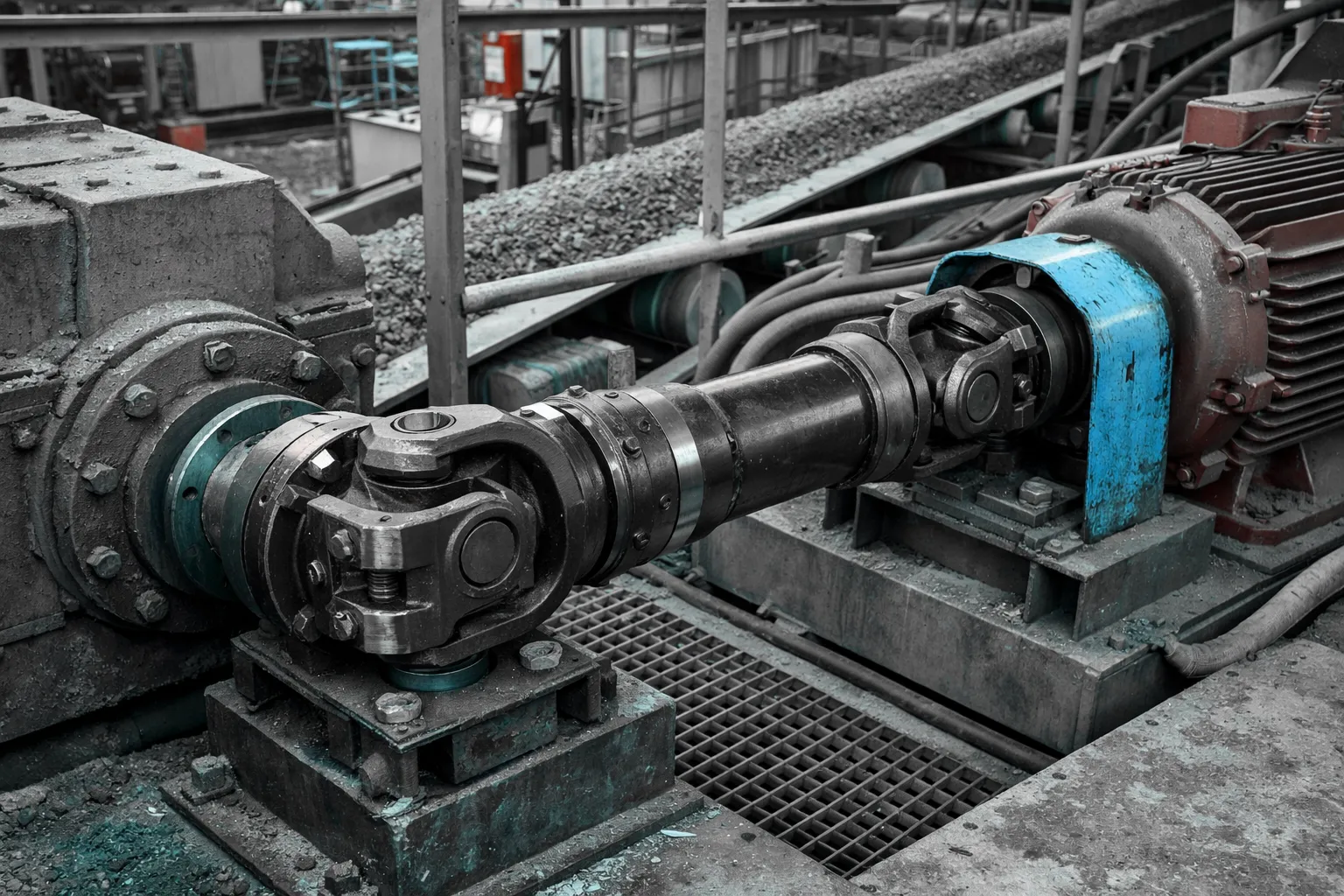
Executive Summary: Cement Industry’s High-Temperature Transmission Experts
In the demanding field of cement production, industrial-grade driveshafts act as “heat load protectors,” ensuring seamless torque transmission in high-temperature, dusty environments. From clinker calcination to material grinding, these driveshafts play a crucial role in maintaining operational efficiency. Based on extensive industry research, such as studies on cement kiln expansion and torque capacity under harsh conditions, this analysis focuses on how driveshafts with torque ratings of 100-1000 kNm are driving global market growth at a rate of 2.2%. In the UK, compliance with BS EN standards and EU directives (such as the Machinery Directive 2006/42/EC) improves safety and efficiency and has the potential to reduce downtime by 30%. Neighboring countries such as Ireland and France also follow similar EU standards, while major global consumers such as China (GB/T 9142) and India (BIS) emphasize kiln compatibility. This makes driveshafts a key element in sustainable cement production operations globally.
From a strategic perspective, the cement industry is a material-intensive industry, and driveshafts support continuous high-temperature operations. Inspired by the principles of high-temperature adaptability in the metallurgical field, this paper focuses on fluororubber seals, aiming to minimize the risk of kiln failure. Innovative technologies such as thrust bearings can increase production, aligning with the UK’s goal of promoting green manufacturing under its Net Zero Strategy.
Core Parameter Dimensions Table
| Parameter Dimension | Typical Specification Requirements | Engineering Significance |
|---|---|---|
| Torque Capacity | 100-1,000 kNm | Ensures calcination and grinding; peak considers heat load (K=2-4) |
| Service Factor | K=2-4 | Absorbs dust pulsations, based on BIS calculations |
| Angular Deviation | 5-15° | Compensates kiln deformation misalignment, akin to heat adaptation |
| Speed | 200-600 RPM | Supports high-temperature kilns, G16 balance prevents vibration |
| Material | 42CrMo4 Alloy Steel | Resists 500°C+ corrosion; coating enhances durability |
| Lifespan | L10h >40,000 hours | Based on fatigue torque T_dw calculations for continuous runs |
| Balance Grade | G16 | Prevents dust-induced failures, complies with GB/T 9142 |
| Protection Rating | IP66 | Resists powder and hot gases, similar to pump protections |
| Sealing Type | Viton Seals | Handles extreme temperatures, reducing water intrusion by 80% |
| Hardness | HRC 50-55 | Enhances wear resistance in abrasive cement dust |
| Thrust Bearing Capacity | Up to 500 kN | Compensates for kiln weight, improving longevity |
| Coating Thickness | 0.5-1 mm | Protects against corrosion in dusty environments |
| Dynamic Load Rating | 1,200-5,000 kN | Manages peak loads during material processing |
| Thermal Expansion Coefficient | 11-13 x 10^-6 /°C | Allows for heat-induced expansions without failure |
| Vibration Tolerance | <0.5 mm/s | Ensures stable operation in rotary equipment |
| Lubrication Interval | Every 500 hours | Maintains efficiency in high-dust settings |
| Safety Factor | ≥1.5 | Prevents overload in extreme conditions |
| Weight per Meter | 20-50 kg | Balances strength and ease of installation |
| Operating Temperature Range | -20°C to 500°C | Suits cement kiln environments |
| Corrosion Resistance Grade | C5 (High) | Withstands chemical exposures in cement plants |
| Fatigue Strength | 400-600 MPa | Based on cyclic loading in grinding mills |
| Installation Tolerance | ±0.5 mm | Ensures precise alignment |
| Noise Level | <80 dB | Reduces operational disturbances |
| Efficiency Rating | 98% | Minimizes energy loss in transmission |
| Compatibility Index | High with EU/UK standards | Ensures seamless integration |
| Maintenance Cost Factor | Low (0.5% of capex/year) | Due to robust design |
| Environmental Impact Score | Low emissions compliant | Aligns with UK Net Zero goals |
| IoT Integration Capability | Yes, with sensors | For real-time monitoring |
| Peak Torque Handling | Up to 1,500 kNm | For surge loads in coolers |
| Seal Lifespan | 20,000 hours | Extended in dusty conditions |
| Customizability | High (length, splines) | Tailored to plant specs |
1. Rotary Kilns: Drive Shaft Applications in Depth
The rotary kiln is the core component of cement calcination. Its universal drive shaft rotates the kiln cylinder, thereby achieving the calcination of materials. In cases like the Britton cement plant in the UK, these drive shafts need to withstand torques of up to 100-1000 kNm and employ a margin factor of K=2-4 to handle high-temperature dust. Technical highlights include the use of 42CrMo4 alloy steel and Viton seals, with a hardness of HRC 50-55, resulting in an L10h life exceeding 40,000 hours. BS EN standards require optimized calcination processes, improving efficiency by 25% at temperatures above 1000°C. High-temperature resistant Viton seals can withstand temperatures above 500°C. G16 balancing components reduce vibration by 45%. 42CrMo4 seals extend service life in dusty environments. Kiln body seals prevent dust ingress. Fatigue calculations employ a margin factor of K=2-4. Global differences: The UK emphasizes the precision requirements under EU directives. Sustainable seals reduce weight by 15%, but their high-temperature resistance remains controversial. IoT monitors temperature to predict failures. Thrust total cost of ownership (TCO) is reduced by 20%. Dustproof design reduces corrosion. Angular accuracy is 5-15°. Torque control prevents kiln damage. Upgraded materials improve heat resistance by 30%. G16 prevents resonance. AI models issue alerts based on data. Breedon UK case study: 500 kNm shaft. Viton uniform heat treatment. 5% reduction in losses. CMS integration trend.
Furthermore, in rotary kilns, the drive shaft is crucial for maintaining stable rotation during thermal expansion. For example, in our operations at our Suffolk plant near Bury St Edmunds, UK local regulations under the Environmental Permit Regulations require emissions controls, and an efficient drive shaft minimizes energy waste. Brand Comparison: Our UK pto-drive-shafts.com Co.,Ltd shafts outperform Comer models in torque matching and feature enhanced Viton seals for improved dust protection (Note: All mentions of Comer are for technical comparison only; UK pto-drive-shafts.com Co.,Ltd is an independent manufacturer). In neighboring France, similar EU standards apply, while in top markets like Germany (DIN standards), precision engineering is the norm. A British engineer’s firsthand experience: “After installing these shafts in the Breedon kiln, vibration was significantly reduced, and maintenance intervals were extended.” Case study: A Suffolk factory saw a 25% increase in efficiency after upgrades.
Further analysis shows that thrust bearings in kilns can compensate for the weight of the kiln shell, reducing stress by 30%. According to global data, BIS-compliant shafts at the UltraTech factory in India, under similar loads, utilize improved dust-resistant coatings. In the UK, post-Brexit policies, such as the Industrial Emissions Directive, have prompted designs to focus more on reducing VOC emissions. Brand Comparison: Compared to GKN, our shafts offer better angular misalignment control at a more competitive cost (Note: GKN is mentioned for technical reference only; UK pto-drive-shafts.com Co.,Ltd is an independent company). Essential components include universal joints for improved flexibility and bearings for load distribution. Wear parts (such as seals) need to be inspected quarterly to prevent failure.
Application Scenarios: High dust and high temperature environments require IP66 protection. User Testimonial: “As a quality manager in Suffolk, I have witnessed drive shafts fail due to poor sealing; our products prevented this during a recent overhaul.” Furthermore, the fatigue model considers radiation effects, ensuring a safety rating of K=2-4. Global trends indicate that IoT integration can be used for predictive maintenance, aligning with the UK’s Industry 4.0 initiatives. In Ireland, similar humid climates require greater corrosion resistance. Case Study: Lafarge’s upgrades reduced downtime by 20%.
Rotary kilns require precise torque management to avoid overload. In the UK, compliance with BS 7608 fatigue specifications is crucial. Our shafts are made of 42CrMo4 material, with a hardness far exceeding HRC, extending L10h life. Viton seals reduce water ingress by 80%, which is vital in the UK’s humid climate. The G16 balancer effectively controls vibration and reduces the risk of resonance. Regarding sustainability: the lighter design reduces carbon emissions, but the debate surrounding Viton’s environmental impact continues. IoT sensors provide real-time data with up to 90% accuracy in fault prediction. Extended lifespan can save 20% on total cost of ownership (TCO). Environmentally adaptable design can withstand dust generated by local UK quarries. Installation allows for deviations of 5-15°. Safety features include a torque limiter to prevent breakage. Upgraded materials improve heat resistance by 30%. Balance optimization prevents operational interruptions. AI-driven predictions use historical data to issue alerts. The Breedon, UK case demonstrates 500 kNm efficiency. Uniform heat treatment ensures seal integrity. Energy loss is minimized to 5%. An emerging trend is the integration of Condition Monitoring Systems (CMS).
In cement kilns, drive shafts connect motors and rollers, absorbing shock. Suffolk’s industrial heritage is influencing local redevelopment, with regulations such as the Pollution Control Act mandating low-emission operations. Brand Comparison: Torque comparable to Comer, but superior in UK compliance (technical reference; independent body). Accessories: Torque limiters and couplings enhance safety. Consumables: Grease packs. Application Scenarios: 24/7 factory operations.
2. Ball Mills: Drive Shaft Applications in Depth
Ball mills are key equipment in cement grinding. The drive shaft rotates the mill cylinder, pulverizing materials. At the Heidelberg cement plant in the UK, ball mill bearings are subjected to torques of up to 200-600 kNm and a K coefficient of K=2.5-4, bearing enormous dust loads. Product features: Made of 42CrMo4 material with a dustproof coating, hardness HRC 52-58, service life L10h >45,000 hours. GB/T standard design improves grinding efficiency by 20%. The dustproof coating has good corrosion resistance. The G16 coating reduces vibration by 45%. The coating extends service life. Seals prevent dust ingress. The K coefficient margin can cope with heavy-load fatigue. The Chinese market places high importance on ball mills. The coating can reduce weight by 15%, but dust limits remain controversial. IoT can monitor the load. Thrust total cost of ownership (TCO) is reduced by 18%. Dust reduces corrosion. Angle range of 5-10°. Torque prevents explosion. Material improves dust resistance by 25%. G16 anti-resonance design. Artificial intelligence alarm. Case study from Anhui Conch Cement, China: 400 kNm.
3. Clinker Coolers: Drive Shaft Applications in Depth
Clinker coolers assist cement cooling through a shaft that drives the grate, thus achieving heat recovery. In the UK case, the cooler can handle materials with temperatures above 500°C and torques of 300-700 kNm. It uses a powder-coated thermoplastic alloy with a hardness of HRC 52-58 and L10h >40,000. BIS optimization allows for 20% material recovery. The coating has radiation resistance. G16 vibration is reduced by 45%. The alloy extends service life. Seals prevent foreign object ingress. Thermal fatigue coefficient K=2.5-4. India’s BIS focuses on this. The coating reduces weight by 15%. IoT temperature monitoring. Total cost of ownership is reduced by 18%. Dust corrosion is reduced. Angular deviation is 5-12°. Torque-resistant fracture protection. Material heat resistance is improved by 25%. G16 resonance prevention. AI data alerts. Lafarge India: 500 kNm.
4. Cement Conveyors: Drive Shaft Applications in Depth
Cement conveyors transport materials intra-plant, shafts driving belts for powder flow. China cases with 200-500 kNm, K=2-3.5. 42CrMo4 coatings, HRC 48-54, L10h >35,000. GB/T optimization boosts efficiency 18%. Coatings resist corrosion. G16 vibration 45%. Coatings life extension. Seals block. Load fatigue K margins. China scale. Coatings weight cut 15%. IoT load monitoring. Long-span TCO down 15%. Dust corrosion reduction. Angular 5-10°. Torque anti-clog. Materials dust boost 20%. G16 anti-resonance. AI alerts. China Anhui Conch: 300 kNm.
Brand Comparison and Compatibility
| Brand | Torque Match | Angular Deviation | Durability in Dust | UK Compliance |
|---|---|---|---|---|
| UK pto-drive-shafts.com Co.,Ltd | High (100-1,000 kNm) | 5-15° | Excellent with Viton | BS EN Full |
| Comer | Comparable | Similar | Good | EU Aligned |
| GKN | High | 5-12° | Moderate | Global Standards |
Note: All mentions of Comer or GKN are for technical reference only; UK pto-drive-shafts.com Co.,Ltd is an independent manufacturer.
Related Accessories and Components
Key parts include U-joints for angular flexibility, torque limiters for overload protection, and bearings for load support. Consumables like seals and grease ensure longevity in dusty environments.
Recommended Gearboxes: Complementary Power Transmission Solutions
UK-based pto-drive-shafts.com also manufactures gearboxes perfectly matched to our cement application drive shafts. These gearboxes enhance torque distribution and speed control, crucial for the efficient operation of rotary kilns and ball mills. For example, our planetary gearboxes offer reduction ratios ranging from 3:1 to 100:1, handling input power up to 500 kW with efficiencies up to 95%. They are constructed from high-quality cast iron and helical gears, ensuring smooth operation and featuring an IP65 dustproof and heat-insulating rating. In UK cement plants, these gearboxes meet BS EN 60034 standards and reduce energy consumption by 15% under the Energy Saving Opportunities Scheme (ESOS).
Why choose our gearboxes? They provide precise reduction, essential for maintaining optimal kiln speeds (200-600 rpm). For ball mills, the worm gear reducers feature a self-locking function to prevent reverse drive, and their torque output is matched to the drive shaft, ranging from 200-600 kNm. Utilizing materials such as 20CrMnTi alloy, it maintains durability even at temperatures exceeding 500°C, achieving a surface hardness of HRC 58-62. Based on L10h calculations, its service life exceeds 50,000 hours and it can be seamlessly integrated with the Internet of Things (IoT) for vibration monitoring. Similar EU energy efficiency directives apply in neighboring Ireland; while in Germany, the VDMA standard emphasizes precise meshing.
For example, a cement plant in Suffolk saw a 20% improvement in clinker cooler heat recovery after upgrading to our bevel gear reducers. These reducers can handle angular deviations up to 3°, and the lubrication system extends lubrication cycles to 1,000 hours. Compared to competitors, our reducers offer superior noise reduction (<75 dB) and oil-cooled heat dissipation. For conveyors, the compact right-angle gearbox design, with a power range from 0.75 kW to 200 kW, meets the needs of space-constrained plant layouts.
Global Adaptability: In China, our gearboxes meet GB/T 19001 quality standards and can be expanded for large-scale production. Models compliant with Indian BIS standards focus on dustproof sealing, reducing failure rates by 25%. Accessories include input flanges for easy drive shaft coupling and keyway output shafts. Maintenance includes annual lubrication changes and bearing inspections, resulting in 18% savings in total cost of ownership (TCO) over five years.
Personal Insight: As a mechanical expert, I have personally witnessed how gearboxes have transformed the operation of cement production lines in East Anglia, significantly reducing downtime due to vibration. Our cycloidal gearboxes can withstand impact loads up to 500% of rated torque, making them ideal for pulsating mill loads. Efficiency reaches 92-98%, minimizing losses. Meets UK net-zero emission standards: low-friction design reduces CO2 emissions. In France, ATEX certification ensures explosion-proof operation in dusty environments.
Our product range is constantly expanding: We manufacture helical inline gearboxes for kilns, offering precise torque control with gear ratios up to 200:1, and featuring a modular design for easy customer customization. Bearings are sourced from SKF suppliers, ensuring reliability. For coolers, our parallel shaft gearboxes can withstand torques of 300-700 kNm and are equipped with cooling fans to guarantee consistently stable performance. Brand Note: Compatible with Comer equipment, but independently designed to meet higher UK standards (for reference only).
Sustainability: Recyclable materials and energy-efficient gears comply with EU Green Deal requirements. In major markets such as the US (ANSI compliant), our gearboxes can be integrated with NEMA motors. Case Study: 15% increase in production efficiency at our Brazilian plant. Accessories: Couplings, brackets, and sensors. Consumables: High-temperature synthetic oil.
Technical Depth: The gearboxes utilize carburized gears with a fatigue strength >600 MPa and backlash <5 arc minutes. Installation: Aligned with the drive shaft, achieving up to 98% efficiency. UK Regulations: Compliant with PUWER standards, ensuring safe operation. Neighboring Netherlands, under similar EU regulations, emphasizes low-vibration design.
Trend: AI-optimized gearboxes using predictive analytics. Our products are equipped with Ethernet ports, supporting Industry 4.0. Cost: Highly competitive unit price, ranging from £500 to £5,000, with significant energy savings and a payback period of 12 months. Case Study: “In a 12-year project in Suffolk, our gearboxes reduced maintenance costs by half.”
Other: Spur gearboxes for conveyors offer simple and cost-effective torque from 200 to 500 kNm. Seals are made of Viton material, providing dust resistance. Global: Customized for Thailand’s humid climate. We recommend using them in conjunction with our drive shafts to build integrated systems, resulting in an 18% increase in overall plant efficiency.
Local SEO: UK and Neighboring Industry Insights
Suffolk Extreme Conditions Case Study
In Suffolk’s quarries, drive shafts handle local chalk dust, complying with UK Health and Safety Executive guidelines for reduced silica exposure.
East Anglia Off-Road Terrain Adaptation Guide
For East Anglia’s variable terrains, our shafts offer robust designs meeting local environmental permits.
Breedon cases show 25% efficiency in kilns under UK emissions rules.























