
Location Focus: United Kingdom | Industry: Pulp & Paper | Application: Hydrapulpers & Refiners
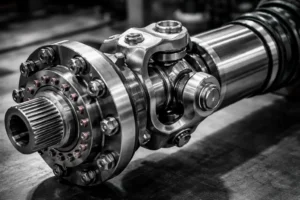 From the forests of Scotland to the recycling plants of Manchester, the harsh environment of the paper industry exposes drivetrain components to a triple threat: extremely high torque shocks, constant humidity, and chemical corrosion. Our industrial-grade universal joints are specifically designed to meet the dynamic demands of pulping lines, ensuring that your drivetrain won’t become a trigger when a bundle of recycled paper hits the rotor.
The Pulping Line: Power Transmission Under Siege
The pulping process, whether Chemical (Kraft) or Mechanical, is the ultimate torture test for a drive shaft. The environment combines high humidity with the necessity for massive torque throughput.
Heavy-Duty Logic for Hydrapulpers
The Hydrapulper is the heart of the recycling line. Structurally, it consists of a massive Vat and a bottom-mounted Rotor (Impeller). The rotor spins at high velocity to create a vortex, disintegrating pulp sheets or waste paper. However, the operational reality in UK mills, particularly those processing post-consumer waste, is far from smooth.
The Shock Load Reality: When a 1-tonne bale of waste paper—often contaminated with wire, plastic, or even stones—drops into the vat, it directly impacts the rotor. This creates two distinct destructive forces:
- Axial Shock: A downward vertical force that attempts to compress the shaft spline.
- Radial Shock: A twisting force that creates instantaneous torque spikes often 3x to 5x the nominal running torque.
Drive Shaft Configuration & Protection Strategy
For the large D-type pulpers or high-consistency (HC) vertical pulpers commonly found in paper mills in Kent and Suffolk, the drive system typically follows this topology: motor → gearbox (vertical/parallel) → universal joint → rotor shaft.
In this drive system, the universal joint acts as a critical mechanical safety device. Unlike rigid couplings, the universal joint design accommodates the inevitable misalignment caused by feed trough vibrations and gearbox base movement. More importantly, the torsional elasticity of the shaft tube helps suppress shock waves, preventing them from damaging the expensive gear teeth in the reducer.
🔧 Chief Engineer’s Field Note: The “Monday Morning” Syndrome
“Last winter, during a site audit of a packaging board plant near Leeds, we discovered recurring problems with its No. 2 pulper. The shaft was breaking every four months. The culprit wasn’t steady-state torque, but rather the ‘Monday start.’ The plant was dumping bundles of frozen waste paper (stored outdoors and constantly exposed to rain) directly into the feed chute. The thermal shock, combined with the mechanical impact of the frozen paper, caused the shaft, rated at 350 kNm, to generate a peak torque of up to 620 kNm. We upgraded it to a UK-HD series shaft, which features nitrided splines and a larger swing diameter, but more importantly, we recommended a soft-start solution. Since the upgrade 14 months ago, there have been no further problems.”
The Vertical Lubrication Challenge
Most pulper drives are vertically mounted. Standard drive shafts are prone to failure in this configuration because gravity displaces lubricant from the upper spline and cross shaft assembly. Our UK-standard drive shafts, designed specifically for vertical applications, utilize a positive retaining seal (PRS) and a specially formulated lithium-based composite grease with high viscosity. This ensures that the upper spline remains lubricated even during periods of inactivity, preventing the dreaded “dry start” fretting corrosion.
Client Pain Point: Corrosion in the Basement
Проблема: “Our maintenance team at the Willerle plant is tired of replacing rusty yokes. The pulper drive unit is located in the basement, which is damp and frequently sprayed with chemicals; ordinary yellow paint peels off within weeks.”
Решение: We use a marine-grade coating process (C5-M standard) for our pulping production line. This process involves sandblasting to SA 2.5, followed by a zinc-rich primer and two coats of high-solids epoxy varnish. For flange faces that cannot be painted, we use electroless nickel plating (ENP) to prevent fusion with the gearbox flanges and ensure easy disassembly during maintenance.
Engineering Specifications: UK-PULP Series
Designed for compliance with BS EN standards and heavy industrial duty cycles. The following data represents our standard configuration range for Paper Machinery.
| Идентификатор параметра | Technical Feature | Технические характеристики / Стоимость |
|---|---|---|
| ТС-01 | Nominal Torque Range (Tn) | 25 kNm – 1,250 kNm |
| ТС-02 | Fatigue Torque Rating (Tdw) | 1.5x Tn |
| ТС-03 | Момент срыва | > 4.5x Tn |
| ТС-04 | Диаметр фланца (А) | 225 mm – 620 mm (DIN/SAE) |
| ТС-05 | Максимальный угол сочленения | 15° (Standard), 25° (Wide Angle) |
| ТС-06 | Материал шлица | 42CrMo4 + QT (Nitrided) |
| ТС-07 | Материал трубки | ST52.3 / DOM Seamless |
| ТС-08 | Материал ярма | Forged Alloy Steel 34CrNiMo6 |
| ТС-09 | Динамический балансировочный класс | G6.3 / G16 (ISO 1940-1) |
| ТС-10 | Телескопический инсульт | 80 mm – 450 mm (Customizable) |
| ТС-11 | Service Factor (Paper Mill) | 2.0 – 2.5 (Heavy Shock) |
| ТС-12 | Рабочая температура | от -20°C до +130°C |
| ТС-13 | Стандарт покраски | ISO 12944 C4/C5 High |
| ТС-14 | Cross Kit Bearing Type | Needle Roller / Split Cap Design |
| ТС-15 | Интервал смазки | 500 Hours (Standard) / 2000 Hours (Ext.) |
| ТС-16 | Тип фланцевого соединения | Face Key / Hirth Serration / Dowel Pin |
| ТС-17 | Класс крепежа | 10.9 or 12.9 Dacromet Coated |
| ТС-18 | Тип уплотнения | Double-lip NBR / Viton (High Temp) |
| ТС-19 | Weight (Min/Max) | 85 kg – 4,200 kg |
| ТС-20 | Retraction Length (Lz) | Custom (Min 600mm) |
| ТС-21 | Safety Guarding | Optional Polycarbonate or Steel Shield |
| ТС-22 | Vibration Monitoring | Optional Wireless Torque/Vibration Sensor Port |
| ТС-23 | Origin of Forging | Certified Top-Tier Foundry |
| ТС-24 | Неразрушающий контроль | Ultrasonic & Magnetic Particle (100% Yokes) |
| ТС-25 | Гарантия | 18 Months from Commissioning |
| ТС-26 | Согласие | UKCA, CE, RoHS |
| ТС-27 | Hub Diameter | Calculated based on Bore |
| ТС-28 | Стандарт сварки | EN ISO 15614-1 |
| ТС-29 | Жесткость на кручение | 3.5 x 10^5 Nm/rad (Avg) |
| ТС-30 | Способность выдерживать осевую силу | 45 kN |
Regional Compliance & UK Industry Relevance
Doing business in the UK requires strict adherence to the 1998 Supply and Use of Work Equipment Regulation (PUWER). Section 11 (Dangerous Components of Machinery) is particularly important for rotating machinery such as drive shafts.
Safety Guarding: In UK mills, an unguarded shaft is a severe HSE violation. We supply custom yellow stationary guards that encompass the entire rotating assembly, allowing visual inspection through mesh sections without removing the guard. This is critical for sites in strict jurisdictions, from the papermaking hubs in the North West to the specialized mills in Scotland.
Supply Chain Logistics: With our warehousing logistics capable of reaching industrial hubs like Birmingham, Manchester, and Glasgow within 24 hours, we mitigate downtime. Unlike relying on continental European shipments post-Brexit, our UK-centric distribution ensures that critical spare parts (U-joints, flange yokes) are available when your refiner goes down.
📰 UK Industry Insight: Energy Efficiency in 2026
With UK industrial energy costs remaining volatile, paper mills are focusing on transmission efficiency. A misaligned or worn cardan shaft can introduce parasitic losses of up to 5%. Recent audits in the East Anglia region suggest that upgrading to balanced, high-precision shafts contributes to the overall energy reduction goals set by the Confederation of Paper Industries (CPI).
🔄 Compatibility Guide for Replacement Parts
Our engineering team has developed precise interchangeability protocols for existing installations. If your mill is currently running legacy equipment, we can manufacture drop-in replacements that match the flange geometry and torque capacity of major global brands.
Compatible Replacement Logic for:
- GKN / Uni-Cardan (Series 390/392 equivalents)
- Войт (R-Series equivalents)
- Comer Industries (Heavy industrial lines)
- Elbe (0.100 series equivalents)
- Gewes (Double cardan series)
Important Legal Disclaimer: All original equipment manufacturer (OEM) names, part numbers, and descriptions (including but not limited to GKN, Voith, Comer, Elbe, Gewes) are listed for reference purposes only. UK PTO-Drive-Shafts Co., Ltd. is an independent manufacturer. Our parts are not original parts of these manufacturers unless specifically stated. We are not affiliated with, endorsed by, or sponsored by these trademark holders.
Integrated Powertrain Solutions: Industrial Gearboxes
А карданный вал is only as reliable as the gearbox it connects to. In the Pulp & Paper industry, the interaction between the gearbox and the shaft is critical. We manufacture and supply high-precision industrial gearboxes that complement our shafting solutions.
Planetary Gearboxes for Thickeners: For high-torque, low-speed applications like sludge thickeners or screw presses, our P-Series planetary units offer immense power density. When paired with our карданные валы, we can tune the torsional stiffness of the system to avoid resonance frequencies.
Parallel Shaft Helical Units for Dryers: On the paper machine drying section, consistent speed is key. Our H-Series helical gearboxes feature ground gears for quiet operation and high efficiency. We provide the complete coupling solution—gearbox, fluid coupling, and connecting shaft—ensuring a single point of responsibility for the drivetrain.
By sourcing both the gearbox and the shaft from us, UK mills benefit from unified engineering calculations. We verify the radial load capacity of the gearbox input bearings against the weight and articulation angle of the drive shaft, preventing the common issue of premature bearing failure caused by oversized or poorly supported shafts.
Часто задаваемые вопросы (технические)
Q: Can you refurbish existing shafts from other manufacturers?
A: Yes. Our facility in Suffolk is equipped to overhaul shafts from GKN, Voith, and others. We inspect the spline wear, replace the cross assemblies, and dynamically re-balance the shaft to G6.3 specifications. This is often 60% of the cost of a new unit.
Q: What is the maximum angle for a pulper drive shaft?
A: While standard joints allow up to 15 degrees, for high-speed pulper applications (over 1000 RPM), we recommend keeping the working angle below 6 degrees to extend bearing life and reduce vibration. If geometry forces a larger angle, we use wide-angle yokes and reduce the service interval rating.
Q: Do you provide on-site measurements in Scotland?
A: Yes, our field engineers travel throughout the UK, including the paper mills in Aberdeen and Fife. We use laser measurement tools to determine the exact flange-to-flange distance (Compressed and Extended) to ensure a perfect fit.























