
Produktbeskrivelse
Produktbeskrivelse
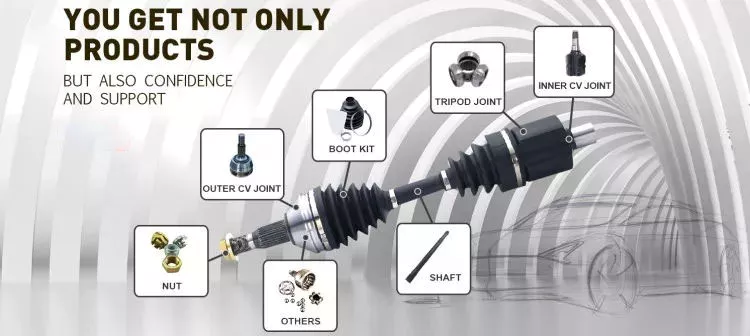
Our compay always insists high-quality standard producing and continually improve ourselves since the very beginning of company’s establishment, we always contribute to make perfect combination of equipment and technology, made the high stable quality.
| Part Name | CV AXLE |
| Mærke | AUTOJET/AAE/STOP/ as customers requirements |
| Anvendelse | Auto Transmission System |
| car maker | All AMERICAN,BIRTITSH, JAPANESS, and KOREAN |
| Placement on Vehicle | Right/ Left |
| Materiale | Iron/Steel |
| Garanti | 12 Months |
| Sample | Tilgængelig |
| Pris | Negotiable |
| Place of origin | Any Chinese port |
| Delivery time | 30-45 days after confirmed |
| Packing | Processional |
| MOQ | 100 PCS |
| Payment | L/C,T/T,Western Union,PayPal |
Detaljerede billeder
Main Products
Firmaprofil
ZheJiang CZPT Macinery equipments is a new developing manufacturing company. Producing Auto parts production lines. As well we have 15 years of exporting auto parts for all automotive products. As after market supplies. Our main products are SHOCK ABSORBING, POWER STEERING SYSTEMS, SUSPENSION, CV AXLE, CV JONTS, and AUTO LIGHTS. We have our own brands and we do customize brand for customers requirements. Our products are produced under quality control team. Two advantage we offer; Genuine parts quality and After market price best value parts. Our products has 98% warranty for 1 year form date of use. Some items are warranty per KM 98% means we accept a claim if the damaged parts more then 2% of the quantity up to manufacturing fault for After Sales Service We have different solutions for different customers. Our company is sincerely willing to cooperate with enterprises from all over the world in order to realize a CZPT situation since the trend of economic globalization has developed with an irresistible force.
Our Factories
Emballage og forsendelse
Ofte stillede spørgsmål
1.Are you a factory or a trading company ?
We are a factory and trading company at the same time.
2.Where is your company located ? How can I visit there ?
Our company is located in HangZhou, all clients, from home and abroad, are warmly welcomed to visit us .
3.How about the quality of the products ?
Our products are of high quality and we have registered and reputable brands.
4.What’s the MOQ for each items ?
100 pieces.
5.Could we supply samples ?
We offer samples,but the samples should be paid.
6.What’s the delivery time ?
30-45 working days after confirmed
7.What’s our shipping ways ?
We can provide different types of shipping such as sea, air, and land.
/* 22. januar 2571 19:08:37 */!function(){function s(e,r){var a,o={};try{e&&e.split(“,”).forEach(function(e,t){e&&(a=e.match(/(.*?):(.*)$/))
| Eftersalgsservice: | 1 år |
|---|---|
| Tilstand: | Ny |
| Farve: | Sort |
| Certificering: | ISO, IATF-16949 |
| Type: | CV Axle |
| Applikationsmærke: | Toyota |
| Tilpasning: |
Tilgængelig
| Tilpasset anmodning |
|---|
How do drive shafts ensure efficient power transfer while maintaining balance?
Drive shafts employ various mechanisms to ensure efficient power transfer while maintaining balance. Efficient power transfer refers to the ability of the drive shaft to transmit rotational power from the source (such as an engine) to the driven components (such as wheels or machinery) with minimal energy loss. Balancing, on the other hand, involves minimizing vibrations and eliminating any uneven distribution of mass that can cause disturbances during operation. Here’s an explanation of how drive shafts achieve both efficient power transfer and balance:
1. Material Selection:
The material selection for drive shafts is crucial for maintaining balance and ensuring efficient power transfer. Drive shafts are commonly made from materials such as steel or aluminum alloys, chosen for their strength, stiffness, and durability. These materials have excellent dimensional stability and can withstand the torque loads encountered during operation. By using high-quality materials, drive shafts can minimize deformation, flexing, and imbalances that could compromise power transmission and generate vibrations.
2. Designovervejelser:
The design of the drive shaft plays a significant role in both power transfer efficiency and balance. Drive shafts are engineered to have appropriate dimensions, including diameter and wall thickness, to handle the anticipated torque loads without excessive deflection or vibration. The design also considers factors such as the length of the drive shaft, the number and type of joints (such as universal joints or constant velocity joints), and the use of balancing weights. By carefully designing the drive shaft, manufacturers can achieve optimal power transfer efficiency while minimizing the potential for imbalance-induced vibrations.
3. Balancing Techniques:
Balance is crucial for drive shafts as any imbalance can cause vibrations, noise, and accelerated wear. To maintain balance, drive shafts undergo various balancing techniques during the manufacturing process. Static and dynamic balancing methods are employed to ensure that the mass distribution along the drive shaft is uniform. Static balancing involves adding counterweights at specific locations to offset any weight imbalances. Dynamic balancing is performed by spinning the drive shaft at high speeds and measuring any vibrations. If imbalances are detected, additional adjustments are made to achieve a balanced state. These balancing techniques help minimize vibrations and ensure smooth operation of the drive shaft.
4. Universal Joints and Constant Velocity Joints:
Drive shafts often incorporate universal joints (U-joints) or constant velocity (CV) joints to accommodate misalignment and maintain balance during operation. U-joints are flexible joints that allow for angular movement between shafts. They are typically used in applications where the drive shaft operates at varying angles. CV joints, on the other hand, are designed to maintain a constant velocity of rotation and are commonly used in front-wheel-drive vehicles. By incorporating these joints, drive shafts can compensate for misalignment, reduce stress on the shaft, and minimize vibrations that can negatively impact power transfer efficiency and balance.
5. Maintenance and Inspection:
Regular maintenance and inspection of drive shafts are essential for ensuring efficient power transfer and balance. Periodic checks for wear, damage, or misalignment can help identify any issues that may affect the drive shaft’s performance. Lubrication of the joints and proper tightening of fasteners are also critical for maintaining optimal operation. By adhering to recommended maintenance procedures, any imbalances or inefficiencies can be addressed promptly, ensuring continued efficient power transfer and balance.
In summary, drive shafts ensure efficient power transfer while maintaining balance through careful material selection, thoughtful design considerations, balancing techniques, and the incorporation of flexible joints. By optimizing these factors, drive shafts can transmit rotational power smoothly and reliably, minimizing energy losses and vibrations that can impact performance and longevity.
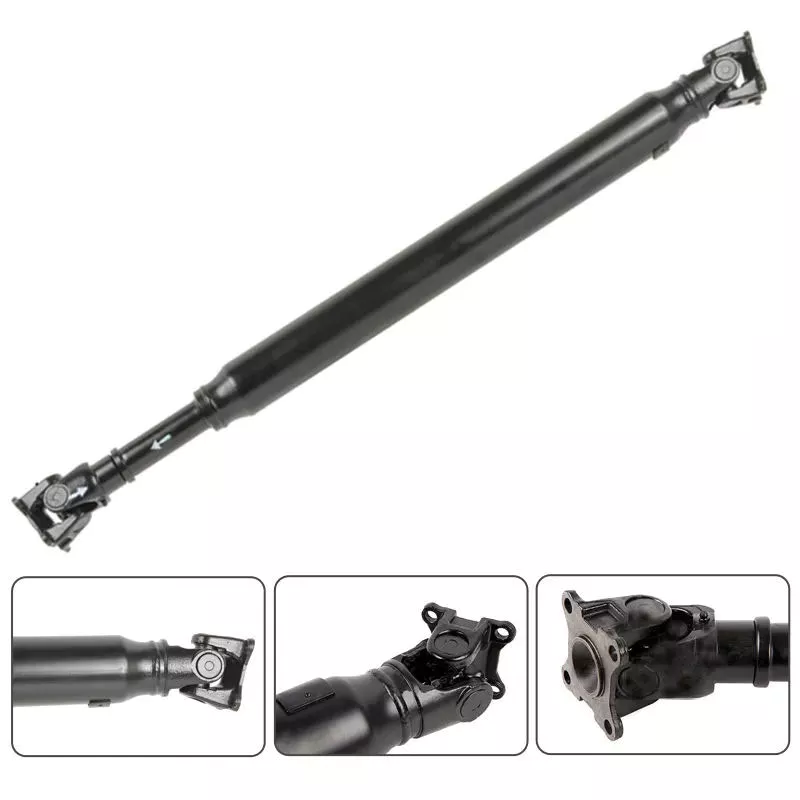
Can drive shafts be customized for specific vehicle or equipment requirements?
Yes, drive shafts can be customized to meet specific vehicle or equipment requirements. Customization allows manufacturers to tailor the design, dimensions, materials, and other parameters of the drive shaft to ensure compatibility and optimal performance within a particular vehicle or equipment. Here’s a detailed explanation of how drive shafts can be customized:
1. Dimensional Customization:
Drive shafts can be customized to match the dimensional requirements of the vehicle or equipment. This includes adjusting the overall length, diameter, and spline configuration to ensure proper fitment and clearances within the specific application. By customizing the dimensions, the drive shaft can be seamlessly integrated into the driveline system without any interference or limitations.
2. Material Selection:
The choice of materials for drive shafts can be customized based on the specific requirements of the vehicle or equipment. Different materials, such as steel alloys, aluminum alloys, or specialized composites, can be selected to optimize strength, weight, and durability. The material selection can be tailored to meet the torque, speed, and operating conditions of the application, ensuring the drive shaft’s reliability and longevity.
3. Joint Configuration:
Drive shafts can be customized with different joint configurations to accommodate specific vehicle or equipment requirements. For example, universal joints (U-joints) may be suitable for applications with lower operating angles and moderate torque demands, while constant velocity (CV) joints are often used in applications requiring higher operating angles and smoother power transmission. The choice of joint configuration depends on factors such as operating angle, torque capacity, and desired performance characteristics.
4. Torque and Power Capacity:
Customization allows drive shafts to be designed with the appropriate torque and power capacity for the specific vehicle or equipment. Manufacturers can analyze the torque requirements, operating conditions, and safety margins of the application to determine the optimal torque rating and power capacity of the drive shaft. This ensures that the drive shaft can handle the required loads without experiencing premature failure or performance issues.
5. Balancing and Vibration Control:
Drive shafts can be customized with precision balancing and vibration control measures. Imbalances in the drive shaft can lead to vibrations, increased wear, and potential driveline issues. By employing dynamic balancing techniques during the manufacturing process, manufacturers can minimize vibrations and ensure smooth operation. Additionally, vibration dampers or isolation systems can be integrated into the drive shaft design to further mitigate vibrations and enhance overall system performance.
6. Integration and Mounting Considerations:
Customization of drive shafts takes into account the integration and mounting requirements of the specific vehicle or equipment. Manufacturers work closely with the vehicle or equipment designers to ensure that the drive shaft fits seamlessly into the driveline system. This includes adapting the mounting points, interfaces, and clearances to ensure proper alignment and installation of the drive shaft within the vehicle or equipment.
7. Collaboration and Feedback:
Manufacturers often collaborate with vehicle manufacturers, OEMs (Original Equipment Manufacturers), or end-users to gather feedback and incorporate their specific requirements into the drive shaft customization process. By actively seeking input and feedback, manufacturers can address specific needs, optimize performance, and ensure compatibility with the vehicle or equipment. This collaborative approach enhances the customization process and results in drive shafts that meet the exact requirements of the application.
8. Compliance with Standards:
Customized drive shafts can be designed to comply with relevant industry standards and regulations. Compliance with standards, such as ISO (International Organization for Standardization) or specific industry standards, ensures that the customized drive shafts meet quality, safety, and performance requirements. Adhering to these standards provides assurance that the drive shafts are compatible and can be seamlessly integrated into the specific vehicle or equipment.
In summary, drive shafts can be customized to meet specific vehicle or equipment requirements through dimensional customization, material selection, joint configuration, torque and power capacity optimization, balancing and vibration control, integration and mounting considerations, collaboration with stakeholders, and compliance with industry standards. Customization allows drive shafts to be precisely tailored to the needs of the application, ensuring compatibility, reliability, and optimal performance.

Kan du forklare de forskellige typer drivaksler og deres specifikke anvendelser?
Drivaksler findes i forskellige typer, der hver især er designet til at passe til specifikke anvendelser og krav. Valget af drivaksel afhænger af faktorer som køretøjs- eller udstyrstype, behov for kraftoverføring, pladsbegrænsninger og driftsforhold. Her er en forklaring af de forskellige typer drivaksler og deres specifikke anvendelser:
1. Massiv aksel:
En solid aksel, også kendt som en drivaksel i ét stykke eller massiv stål, er en enkelt, uafbrudt aksel, der løber fra motoren eller strømkilden til de drevne komponenter. Det er et simpelt og robust design, der anvendes i mange anvendelser. Solide aksler findes almindeligvis i baghjulstrukne køretøjer, hvor de overfører kraft fra transmissionen til bagakslen. De bruges også i industrimaskiner, såsom pumper, generatorer og transportbånd, hvor en lige og stiv kraftoverførsel er påkrævet.
2. Rørformet skaft:
Rørformede aksler, også kaldet hule aksler, er drivaksler med en cylindrisk rørlignende struktur. De er konstrueret med en hul kerne og er typisk lettere end massive aksler. Rørformede aksler tilbyder fordele såsom reduceret vægt, forbedret vridningsstivhed og bedre dæmpning af vibrationer. De finder anvendelse i forskellige køretøjer, herunder biler, lastbiler og motorcykler, samt i industrielt udstyr og maskiner. Rørformede drivaksler bruges almindeligvis i forhjulstrukne køretøjer, hvor de forbinder transmissionen med forhjulene.
3. Aksel med konstant hastighed (CV):
CV-aksler (Constant Velocity) er specielt designet til at håndtere vinkelbevægelser og opretholde en konstant hastighed mellem motor/transmission og de drevne komponenter. De har CV-led i begge ender, hvilket giver fleksibilitet og kompensation for vinkelændringer. CV-aksler bruges almindeligvis i forhjulstrukne og firehjulstrukne køretøjer, såvel som i terrængående køretøjer og visse tunge maskiner. CV-leddene muliggør jævn kraftoverførsel, selv når hjulene drejes eller affjedringen bevæger sig, hvilket reducerer vibrationer og forbedrer den samlede ydeevne.
4. Glideledsaksel:
Slipleksler, også kendt som teleskopiske aksler, består af to eller flere rørformede sektioner, der kan glide ind og ud af hinanden. Dette design muliggør længdejustering og imødekommer ændringer i afstanden mellem motor/transmission og de drevne komponenter. Slipleksler bruges almindeligvis i køretøjer med lange akselafstande eller justerbare affjedringssystemer, såsom nogle lastbiler, busser og fritidskøretøjer. Ved at give fleksibilitet i længden sikrer slipleksler en konstant kraftoverførsel, selv når køretøjets chassis oplever bevægelse eller ændringer i affjedringsgeometrien.
5. Dobbelt kardanaksel:
En dobbelt kardanaksel, også kaldet en dobbelt universalaksel, er en type drivaksel, der inkorporerer to universalled. Denne konfiguration hjælper med at reducere vibrationer og minimere leddenes driftsvinkler, hvilket resulterer i en jævnere kraftoverførsel. Dobbelte kardanaksler bruges almindeligvis i tunge applikationer, såsom lastbiler, terrængående køretøjer og landbrugsmaskiner. De er særligt velegnede til applikationer med høje momentkrav og store driftsvinkler, hvilket giver forbedret holdbarhed og ydeevne.
6. Kompositskaft:
Kompositaksler er lavet af kompositmaterialer som kulfiber eller glasfiber, hvilket giver fordele som reduceret vægt, forbedret styrke og korrosionsbestandighed. Kompositkardinalaksler bruges i stigende grad i højtydende køretøjer, sportsvogne og racerbiler, hvor vægtreduktion og forbedret effekt-til-vægt-forhold er afgørende. Kompositkonstruktionen muliggør præcis justering af stivhed og dæmpningsegenskaber, hvilket resulterer i forbedret køretøjsdynamik og drivlinjeeffektivitet.
7. Kraftoverføringsaksel:
Kraftudtagsaksler (PTO-aksler) er specialiserede drivaksler, der anvendes i landbrugsmaskiner og visse typer industrielt udstyr. De er designet til at overføre kraft fra motoren eller strømkilden til forskellige redskaber, såsom plæneklippere, ballepressere eller pumper. Kraftudtagsaksler har typisk en notforbindelse i den ene ende for at forbinde til strømkilden og et universalled i den anden ende for at imødekomme vinkelbevægelser. De er kendetegnet ved deres evne til at overføre høje momentniveauer og deres kompatibilitet med en række forskellige drevne redskaber.
8. Marineaksel:
Marineaksler, også kendt som propelaksler eller haleaksler, er specielt designet til marinefartøjer. De overfører kraft fra motoren til propellen, hvilket muliggør fremdrift. Marineaksler er normalt lange og fungerer i et barskt miljø, udsat for vand, korrosion og høje momentbelastninger. De er typisk lavet af rustfrit stål eller andre korrosionsbestandige materialer og er designet til at modstå de udfordrende forhold, der opstår i marine applikationer.
Det er vigtigt at bemærke, at de specifikke anvendelser af drivaksler kan variere afhængigt af køretøjs- eller udstyrsproducenten, såvel som de specifikke design- og tekniske krav. Ovenstående eksempler fremhæver almindelige anvendelser for hver type drivaksel, men der kan være yderligere variationer og specialiserede designs baseret på specifikke branchebehov og teknologiske fremskridt.


editor by CX 2024-04-16























