
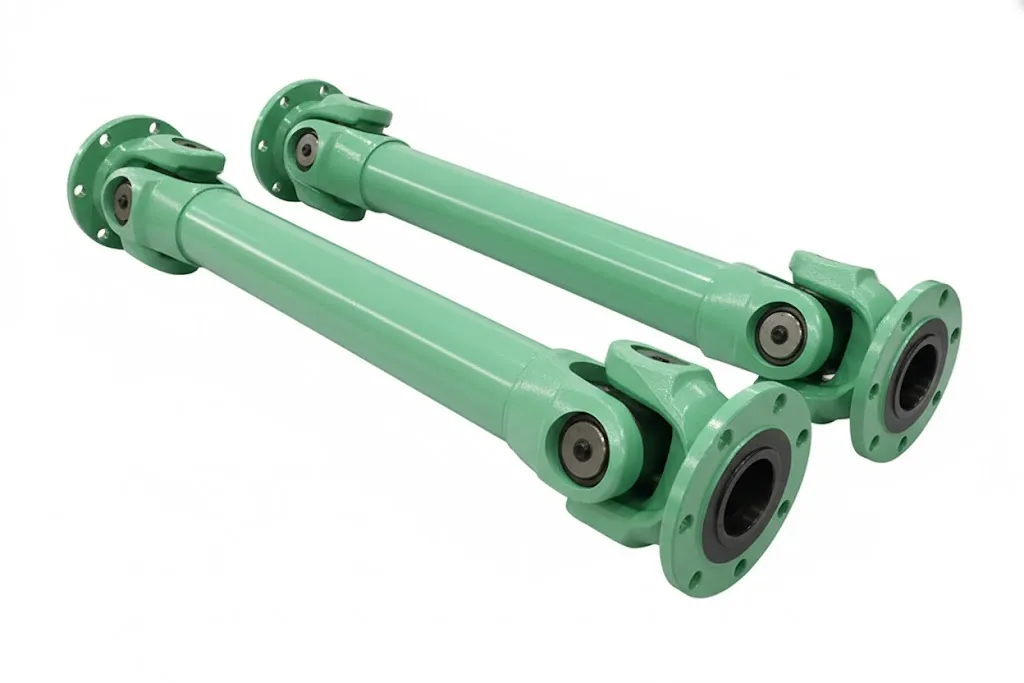
1. The Critical Physics of STS Main Hoist Mechanisms
In the high-stakes environment of ports like Felixstowe, Southampton, and Liverpool, the Ship-to-Shore (STS) crane functions as the primary artery of global trade. The Main Hoist Mechanism is the absolute core of this system. Unlike standard industrial applications, the drive train here faces a unique triad of challenges: massive variable loads, structural elasticity, and harsh marine corrosion.
Typically driven by dual high-power motors (often 2x500kW or exceeding 800kW in ultra-large container vessels handling), the synchronization of these motors is paramount for controlling container Trim, List, and Skew.
Why Rigid Couplings Fail in Hoisting
We often see older crane designs attempting to use gear couplings or rigid flange connections here. This is a fundamental engineering error in modern heavy-lift scenarios. When an STS crane lifts a 60-tonne twin-lift load, the entire steel structure of the machinery house flexes. The “gantry frame” is not a rigid block; it is an elastic spring. This deformation causes the axis of the motor and the axis of the gearbox to shift relative to each other—sometimes by millimeters.
A rigid coupling transfers this misalignment force directly into the bearings. The result? Premature failure of the motor bearings or the gearbox high-speed shaft seals. The Industrial Cardan Shaft is the only mechanical solution that effectively decouples these radial forces while transmitting torque with zero backlash.
2. Technical Specification Matrix: Series STS-Heavy
Below is the engineering data for our primary STS Main Hoist Cardan Shafts. These specifications are derived from operational requirements in C5-M marine environments (ISO 12944).
| ID tham số | Sự miêu tả | Specification / Value Range |
|---|---|---|
| P-01 | Nominal Torque ($T_{nom}$) | 45 kNm – 580 kNm |
| P-02 | Fatigue Torque ($T_{fatigue}$) | 1.5 x $T_{nom}$ |
| P-03 | Breaking Torque ($T_{break}$) | > 3.5 x $T_{nom}$ (Safety Factor based on Snag Loads) |
| P-04 | Flange Diameter (Swing) | 225 mm – 620 mm |
| P-05 | Standard Length ($L_{min}$) | Customizable (Typically 800mm – 3500mm) |
| P-06 | Axial Compensation (Stroke) | +80mm / -80mm (Standard), Long-stroke available |
| P-07 | Góc lệch tối đa | 15° (Operational), 25° (Static) |
| P-08 | Tốc độ quay (Tối đa) | 3,500 RPM (Depends on balancing grade) |
| P-09 | Điểm cân bằng | G6.3 hoặc G2.5 (ISO 1940-1) |
| P-10 | Kết nối mặt bích | Face Key (DIN 15451) or Hirth Serration (High Shock) |
| P-11 | Tuổi thọ ổ bi ($L_{10h}$) | > 50,000 Hours (under load spectrum) |
| P-12 | Vật liệu Spline | 42CrMo4 with Rilsan® Coating (Low Friction) |
| P-13 | Cross Material | 18CrNiMo7-6 (Case Hardened) |
| P-14 | Vật liệu ống | High-strength seamless steel (St52-3 or higher) |
| P-15 | Tiêu chuẩn sơn | ISO 12944 C5-M (Marine High Durability > 15 years) |
| P-16 | DFT (Dry Film Thickness) | 320 microns (Zinc Rich Primer + Epoxy + PU) |
| P-17 | Phạm vi nhiệt độ hoạt động | -30°C to +80°C (North Sea to Mediterranean) |
| P-18 | Hệ thống niêm phong | Multi-lip Cassette Seal + Metal Labyrinth |
| P-19 | Điểm bôi trơn | Centralized block or Extended nipples for safety |
| P-20 | Loại chất bôi trơn | Lithium Complex EP2 with Marine Additives |
| P-21 | Độ cứng xoắn | 2.5 x 10^6 Nm/rad (Calculated per application) |
| P-22 | Cân nặng | 150 kg – 2,200 kg |
| P-23 | Cấp độ bu lông | 10.9 or 12.9 (Dacromet Coated) |
| P-24 | Bảo vệ Spline | Nylon/Teflon glide coating to prevent fretting |
| P-25 | Chứng nhận | DNV-GL, Lloyds Register (upon request), EN 10204 3.1 |
| P-26 | Shock Factor ($K_A$) | 2.0 – 2.5 (Sốc nặng) |
| P-27 | Chu kỳ bảo trì | Relubrication every 500-1000 hours (or sealed for life options) |
3. Localized Engineering: Combating the North Sea Environment
In the UK and Northern Europe, mechanical components face an enemy more relentless than heavy loads: The Atmosphere. Ports like Immingham or Rotterdam are subjected to high-salinity air, horizontal rain, and rapid temperature cycles. A standard industrial drive shaft painted with simple alkyd enamel will begin to corrode within weeks. The rust creeps under the seals, contaminating the needle bearings, leading to what we call “Seizure Failure.”
Our shafts engineered for the UK market adhere to strict BS EN ISO 12944 standards. We utilize a C5-M (Very High Marine) coating protocol. Furthermore, specifically for the UK market where LOLER (Quy định về hoạt động nâng hạ và thiết bị nâng hạ năm 1998) compliance is mandatory, our shafts come with full traceability documentation. Every yoke, every cross kit, and every tube weld is NDT tested (Magnetic Particle & Ultrasonic) to ensure that when a Health & Safety Executive (HSE) inspector audits your crane files, the paperwork is as robust as the steel.
Regional Application Matrix
- Felixstowe/Southampton (Container Terminals): High-speed, high-cycle fatigue resistance required for main hoists. Focus on G6.3 balancing.
- Immingham/Port Talbot (Bulk Handling): Heavy shock resistance for Grab Unloaders handling iron ore and coal. Focus on Hirth serration flanges.
- Aberdeen/Peterhead (Offshore Support): Extreme corrosion resistance for deck cranes. Focus on sealed-for-life splines.
4. Interchangeability and Technical Comparison
We understand that Port Engineers often manage a mixed fleet of ZPMC, Liebherr, Konecranes, and Kalmar equipment. These machines often come originally fitted with shafts from brands like Dana GWB, Voith, or Maina. Our manufacturing philosophy focuses on “Drop-in Replacement” capability with enhanced durability features.
Comparison: Spline Technology
Many standard OEM shafts utilize steel-on-steel sliding splines. In the humid UK port environment, if lubrication intervals are missed (even by a few days), these splines suffer from fretting corrosion. Our UK-Spec shafts utilize Rilsan® (Polyamide 11) coating on the male splines. This provides a self-lubricating barrier that prevents metal-to-metal seizure, reduces axial thrust forces on your motor bearings by up to 40%, and dampens vibration.
Comparison: Flange Design
While standard DIN flanges rely purely on face friction and keys, for high-impact applications (like Grab Unloaders), we recommend and manufacture Hirth Serration flanges. The interlocking tooth design eliminates the risk of flange slippage during emergency stops or snag loads, a common failure point in standard designs.
Case Study: The “Phantom Vibration” at a Major Scottish Port
The Problem: In 2023, a major bulk terminal in Scotland reported persistent, high-frequency vibration on the boom hoist of a 15-year-old Mobile Harbor Crane (MHC). The vibration was causing repeated failures of the hydraulic pump input seals. The original driveshaft had been replaced twice with “budget” alternatives, but the issue persisted.
The Diagnosis: Our engineering team from Bury St Edmunds visited the site. We performed a phase analysis and discovered that the previous supplier had provided a shaft with standard phasing, ignoring the complex compound angles of the MHC boom movement. Furthermore, the “budget” shaft had a spline backlash of 0.8mm, which was amplifying the diesel engine’s torsional pulses.
Giải pháp: We engineered a custom heavy-duty cardan shaft with Zero-Backlash Coated Splines and corrected the yoke phasing to cancel out the non-uniform velocity fluctuations inherent in the Z-drive configuration. We also upgraded the balancing grade to G2.5.
The Result: Vibration levels dropped by 85%. The pump seal failure rate went from “monthly” to “zero in 18 months.” The maintenance chief, Mr. Alistair C., noted: “It’s not just a shaft; it’s a vibration damper. We saved £15,000 in pump repairs in the first year alone.”
[VIDEO PLACEHOLDER: Time-lapse video of a shaft installation on a crane, showing alignment and bolting torque procedures.]
6. Critical Spares and Wear Components
A breakdown strategy is not a strategy. To ensure 24/7 availability of your port equipment, we recommend stocking the following critical spares alongside your complete shaft assemblies:
- Universal Joint Kits (Cross & Bearing): The sacrificial element. Our kits include quadruple-lip seals specifically for coal dust and salt spray environments.
- Flange Bolt Sets: Never reuse high-tensile bolts. We supply Dacromet-coated 10.9 or 12.9 grade bolt kits with every maintenance interval.
- Mặt bích đi kèm: Often overlooked, the mating flange on the gearbox side can wear. If the shaft flange is new but the gearbox flange is worn, friction grip is lost.
Related Product Recommendation: Industrial Gearboxes
The driveshaft is the guardian of the gearbox. If you are replacing a shaft due to catastrophic failure, check your gearbox input shaft bearings. We also manufacture and supply high-performance Planetary and Helical Gearboxes designed for hoisting applications. Pairing a balanced, low-axial-thrust shaft with a precision gearbox ensures the longevity of the entire driveline.
7. Installation Guide: The 10-Point Reliability Check
Even the best shaft will fail if installed poorly. Follow this SOP for STS Hoist Shafts:
- Clean the Surfaces: Remove all rust, paint, and grease from the mating flange faces. They must be dry and bright metal to metal.
- Check Phasing: Ensure the yokes at both ends are aligned (unless designed with offset phasing). Misalignment creates destructive vibration.
- Support the Shaft: Use a crane or hoist to support the shaft weight during installation. Do not let it hang on the bolts during tightening.
- Torque Sequence: Tighten bolts in a star pattern. Use a calibrated torque wrench. Do not use an impact gun for final torque.
- Alignment Check: Use laser alignment tools to ensure the Motor and Gearbox axes are within the manufacturer’s tolerance (typically < 0.1mm offset). The cardan shaft compensates for dynamic movement, not static misalignment laziness.
- Tẩy sạch dầu mỡ: Pump grease until new, clean grease appears at all four bearing seals. This purges air and old contaminants.
- Bảo vệ an toàn: Ensure the yellow safety guard is secure and does not rotate with the shaft.
- Document: Record the installation date and bolt torque values for LOLER compliance records.
8. ROI Analysis: The Cost of “Cheap” vs. “Engineered”
Procurement managers often look at the price tag. Engineers look at the lifecycle cost.
Scenario: Main Hoist Shaft for Panamax Crane.
- Budget Shaft: £2,500. Lifespan: 2 Years. Maintenance: Monthly greasing. Risk: High spline wear damaging motor bearings.
- UK pto-drive-shafts.com Marine Spec: £3,800. Lifespan: 6+ Years. Maintenance: Quarterly. Feature: Rilsan coating saves motor bearings (Value: £5,000+).
The “expensive” shaft delivers a 300% ROI by extending the maintenance interval and protecting the £50,000 motor from axial thrust damage.
9. Industry Updates: Port Modernization
Cập nhật tháng 1 năm 2026: With the UK government’s push for “Freeports” and the decarbonization of maritime transport, ports are upgrading to heavier electric cranes. This shift increases the torque demand at zero RPM (holding torque). Our new generation of “E-Drive Ready” trục are designed to handle the instant torque delivery of permanent magnet motors without torsional wind-up.
Get in Touch
UK pto-drive-shafts.com Co.,Ltd.
Engineering HQ: Bury St Edmunds, Suffolk IP32 7LX, UK
E-mail: [email protected]
Supplying the backbone of UK and European Industry: From Felixstowe to Rotterdam, from Mining to Metallurgy.























