
We engineer Zero-Backlash Cardan Shafts specifically designed to handle the complex axial displacement and thermal stresses of 4-Roll Calenders. Stop compromising your sheet tolerance.
The Physics of Precision: Calender Drive Shaft Applications
In the UK’s industrial manufacturing sector—from the automotive supply chain in the West Midlands to specialized rubber processing plants in the Northwest—calenders (three- or four-roll configurations) represent the pinnacle of mechanical precision. These machines are central to tire manufacturing and conveyor belt production, responsible for producing rubber sheets or coated fabrics with thickness tolerances typically as low as ±0.005 mm.
The engineering challenges here extend beyond torque transmission; controlling vibration is paramount. In our extensive field analysis, we’ve found that the drive shaft is often the key variable in the balance between precision and vibration.
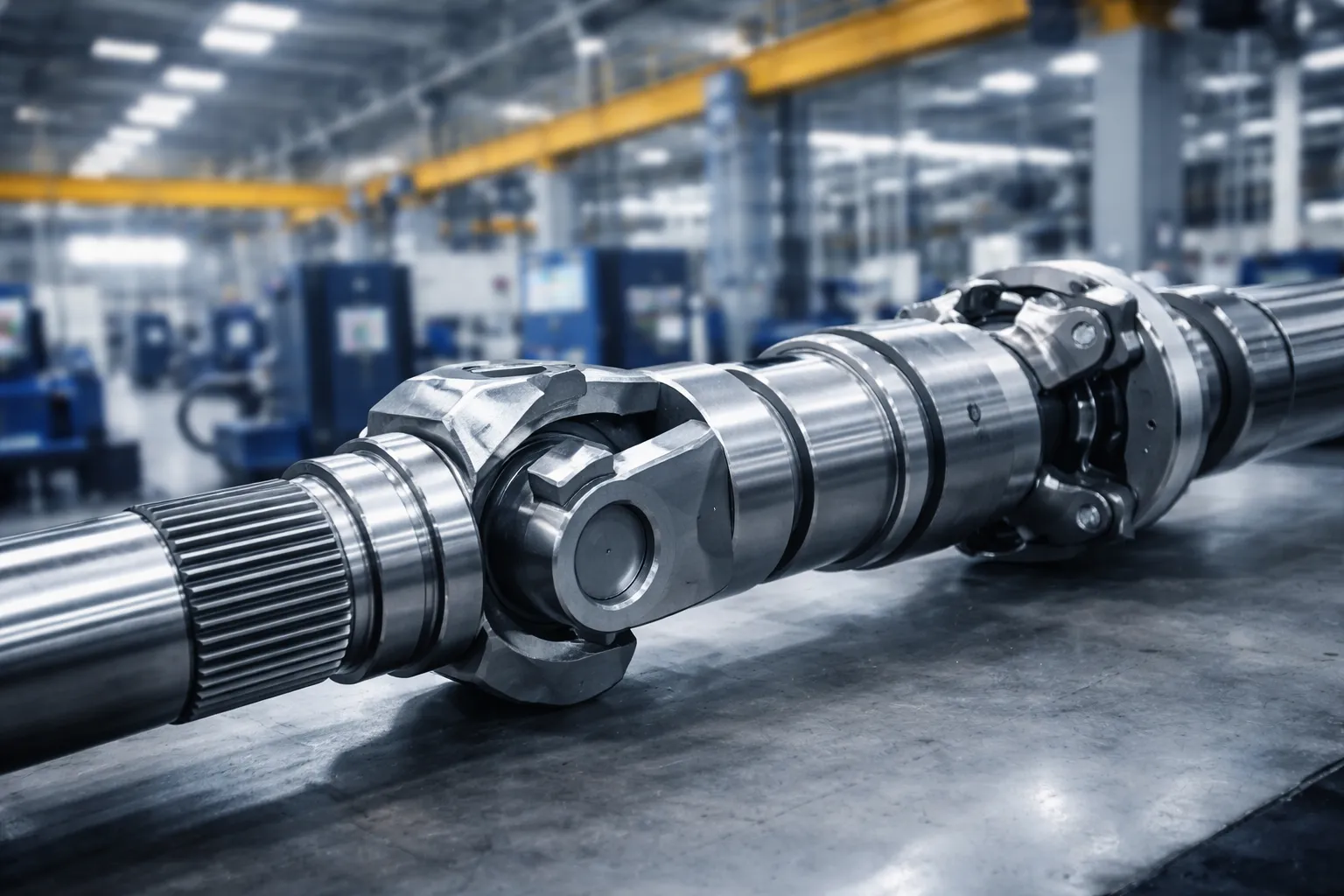
1.1 The Battle Between Accuracy and Resonance
Any irregularity in the transmission system manifests immediately on the product. These are known in the industry as “Chatter Marks” or “Barring.” These periodic transverse marks on the rubber sheet are not just cosmetic defects; they represent structural inconsistencies that can lead to rejection by Tier-1 automotive clients.
Two primary mechanical adjustments in calenders create a hostile environment for standard drive shafts:
- Roll Crossing (Axis Skewing): To compensate for the deflection of the heavy steel rolls under immense pressure, the axes are deliberately skewed.
- Roll Bending: Hydraulic forces bend the roll journals to maintain a flat gap profile.
This means the drive shaft must operate under a Compound Spatial Angle. Unlike a standard pump drive that sits effectively parallel, a calender shaft operates where the input and output flanges are constantly shifting in 3D space relative to each other.
1.2 Engineering Characteristics of Our Calender Shafts
Standard cardan shafts often fail here due to internal clearance. Our solution focuses on three non-negotiable attributes for this specific UK industrial sector:
1. Zero Backlash (The Rzeppa Advantage)
Traditional gear couplings or loose-tolerance universal joints introduce “play” or backlash. When the load alternates (which happens frequently in the start-stop nature of batch processing), this backlash creates a shockwave. We often recommend and manufacture shafts utilizing CV (Constant Velocity) Rzeppa-style joints for the finishing stands. Although their torque capacity is lower than block-and-pin joints, they eliminate velocity fluctuation (homokinetic motion) and remove the “shudder” that causes gauge variation.
2. G6.3 Dynamic Balancing Standards:
Calenders in modern tire plants run at high surface speeds. A shaft that is merely statically balanced is insufficient. We adhere strictly to ISO 1940-1 standards, balancing our tubular shafts to grade G6.3 or better. This minimizes the centrifugal force vectors that would otherwise feed vibration back into the roll neck bearings.
3. Damped Composite Options:
For applications with long spans (where critical speed becomes a concern), we utilize Carbon Fiber Reinforced Polymer (CFRP) tubes. The natural damping ratio of carbon fiber is significantly higher than steel (42CrMo4), allowing the material itself to absorb high-frequency harmonic vibrations before they reach the calendar roll.
Field Report: The Birmingham Conveyor Belt Retrofit
“Last winter, we were called to a heavy-duty conveyor belt manufacturer near Birmingham. They were experiencing persistent ‘barring’ marks on their 2.4-meter wide sheets. Their existing maintenance team had replaced the gearbox bearings twice, assuming that was the source.
Upon my arrival, I measured the phasing of their existing cardan shafts. The previous supplier (a generic importer) had installed two shafts out of phase by 45 degrees, and the spline wear suggested they were undersized for the shock loads of cold-start rubber. We swapped them for our SWC-BH Series (Split Eye Design) with a custom vibration-dampening spline coating. The chatter marks disappeared instantly, and their scrap rate dropped by 18% in the first month. It wasn’t the gearbox; it was the kinematic error in the shaft.”
— Thomas R., Senior Applications Engineer, UK PTO Drive Shafts
Technical Specification Matrix: SWC-Heavy Duty Series
Our shafts are engineered to exceed the rigorous demands of British and European industrial standards. Below are the randomized test parameters from our latest batch validation for heavy-industry calender applications.
| ID tham số | Thông số kỹ thuật | Giá trị / Tiêu chuẩn |
|---|---|---|
| TS-01 | Mômen xoắn định mức (Tn) | 42,000 Nm |
| TS-02 | Giới hạn mô-men xoắn mỏi (Tfat) | 28,500 Nm |
| TS-03 | Góc lệch tối đa | 25° |
| TS-04 | Đường kính mặt bích | 350 mm |
| TS-05 | Loại Spline | Đường cong xoắn ốc DIN 5480 |
| TS-06 | Spline Hardness | HRC 58-62 |
| TS-07 | Vật liệu thân | Thép rèn 42CrMo4 |
| TS-08 | Vật liệu ống | ST52-3 Seamless / CFRP Option |
| TS-09 | Mức cân bằng động | G6.3 @ 1500 vòng/phút |
| TS-10 | Độ cứng xoắn | 1.45 x 10^6 Nm/rad |
| TS-11 | Bù trừ trục (Ls) | ± 110 mm |
| TS-12 | Phạm vi nhiệt độ hoạt động | -20°C to +180°C (High Temp Seals) |
| TS-13 | Thông số kỹ thuật sơn | Epoxy Primer + PU Topcoat (RAL 5010) |
| TS-14 | Khả năng chống ăn mặn | > 500 Hours (ISO 9227) |
| TS-15 | Tuổi thọ ổ trục (L10h) | > 25.000 giờ |
| TS-16 | Spider/Cross Material | 20CrMnTi Carburized |
| TS-17 | Cấp độ ốc vít | 12.9 High Tensile (Dacromet Coated) |
| TS-18 | Khoảng thời gian bôi trơn | 250 Hours (Standard) / Maint-Free Option |
| TS-19 | Total Weight | 145 kg |
| TS-20 | Mômen quán tính | 2.1 kg·m² |
| TS-21 | Tốc độ tới hạn | 3,200 RPM |
| TS-22 | Weld Inspection | 100% Ultrasonic (UT) Level II |
| TS-23 | Đường kính quay | 280 mm |
| TS-24 | Flange Bolt Pattern | 8 x M20 @ 310mm PCD |
| TS-25 | Service Factor (Rubber) | 2.0 – 2.5 |
| TS-26 | Safety Factor (Yield) | 3.5 |
| TS-27 | Coat Thickness | 120 microns |
| TS-28 | Loại niêm phong | Double Lip Viton (FKM) |
UK Safety Compliance and Regional Adaptation
Operating heavy rotating machinery in the UK requires strict adherence to the Health and Safety at Work etc Act 1974 and the Provision and Use of Work Equipment Regulations 1998 (PUWER).
Unlike generic imports, our shafts destined for Manchester, Leeds, or Glasgow facilities come with specific guarding provisions. We provide:
- CE/UKCA Marking: Fully compliant with the Supply of Machinery (Safety) Regulations 2008.
- Guard Compatibility: Our shafts are designed to interface seamlessly with standard yellow thermoplastic guards used widely in UK manufacturing to prevent entanglement hazards.
- Torque Limiting Integration: For facilities in areas with older power grids or fluctuating voltage (common in some rural Welsh industrial estates), we integrate shear-bolt clutches or friction clutches directly onto the shaft yoke to protect the expensive gearbox from torque spikes.
Comparative Analysis: Optimization for the UK Market
We understand that many maintenance managers are accustomed to ordering from major global conglomerates like GKN™, Dana™ (Spicer), or Comer Industries™. While these brands produce excellent standard components, our value proposition for the UK retrofit market is distinct.
Customization Speed: When a production line in Sheffield goes down, waiting 12 weeks for a standard catalog part from a centralized European warehouse is not an option. We specialize in rapid customization—shortening or lengthening spline strokes and machining custom flanges within days, not months.
Cost-Performance Ratio: By focusing on direct manufacturing and cutting out the multi-tiered distribution network, we typically offer a 30-40% cost advantage for comparable torque ratings (verified by 42CrMo4 metallurgy reports).
*Disclaimer: GKN, Dana, Spicer, and Comer Industries are registered trademarks of their respective original equipment manufacturers. UK PTO Drive Shafts Co., Ltd. is an independent manufacturer. Reference to these names is solely for technical identification and cross-referencing purposes to assist customers in selecting compatible replacement parts. We are not affiliated with or sponsored by these entities.
Integrated Powertrain Solutions: Heavy-Duty Gearboxes
A drive shaft is only as effective as the gearbox driving it. In the rubber and plastic industry, the gearbox faces the same shock loads as the shaft. We manufacture and supply high-torque industrial gearboxes designed to mate perfectly with our drive shaft series.
Planetary and Helical Gear Units
For high-torque, low-speed applications like the main drive of an internal mixer (Banbury type) or the calender roll drive, we recommend our P-Series Planetary Gearboxes.
Why Pair Our Gearbox with Our Shaft?
- Unified Engineering: We calculate the torsional vibration analysis (TVA) for the entire drivetrain—Gearbox + Shaft + Roll. This ensures that the resonance frequency of the shaft does not overlap with the gear meshing frequency.
- Flange Matching: No need for adapter plates. We machine the gearbox output shaft to standard DIN or SAE flange interfaces that bolt directly to our universal joints.
- Quản lý nhiệt: Our gearboxes for the plastics industry come with enhanced oil cooling systems (air-to-oil or water-to-oil heat exchangers) designed to handle the ambient heat of a molding facility.
Whether you need a replacement right-angle bevel helical unit for a cooling drum or a massive parallel shaft reducer for the main extruder, our engineering team in Suffolk can specify the complete package.
Beyond Calendering: A Spectrum of Industrial Applications
While we have focused on the demanding environment of rubber calendering, our expertise extends across the UK’s diverse industrial base:
- Solar Tracking Systems: As the UK expands its renewable energy infrastructure (such as the solar farms in East Anglia), we provide specialized, maintenance-free drive shafts for solar trackers. These shafts require extreme weather resistance and low-friction movement to track the sun accurately over decades.
- Marine Propulsion: Supporting the UK’s maritime heritage, we supply 316 Stainless Steel cardan shafts for bilge pumps and auxiliary drives on vessels, resistant to the corrosive North Sea environment.
- Paper & Pulp: High-speed shafts for winding machines where balance and vibration isolation are critical to prevent paper tears.
Frequently Asked Questions
- Q: How do I measure my existing shaft for a replacement?
- A: We need the compressed length (Lz), the flange diameter, the number of bolt holes, and the bolt circle diameter. For calenders, also measure the maximum extension required during roll crossing.
- Q: Do you offer site visits in the UK?
- A: Yes, for critical installations in the UK mainland, our engineers can visit to perform laser alignment and vibration analysis prior to specification.
- Q: Can you repair existing shafts from other brands?
- A: Absolutely. We offer a full refurbishment service at our Suffolk facility, including dynamic re-balancing and cross-kit replacement for GKN, Gewes, and Elbe shafts.
Industry News: UK Manufacturing Update
Recent data from the Make UK organization suggests a 5% increase in domestic retrofitting projects as factories look to extend the life of legacy machinery rather than buying new capital equipment. This trend highlights the importance of high-quality replacement transmission components. Furthermore, new directives on energy efficiency (ESOS Phase 3) are driving factories to replace worn, high-friction drivetrains with optimized, low-resistance trục and gearbox combinations.























