

As an industry leader, pto-drive-shafts.com Co., Ltd., headquartered in Bury St Edmunds, Suffolk, UK, has long been committed to developing high-end transmission solutions for these specific applications. In this comprehensive technical analysis, we will delve into the application technologies, design concepts, and future development trends of drive shafts in food and pharmaceutical machinery.
The Core Challenge: A Triad of Hygiene, Corrosion Resistance, and Precision
Before examining specific equipment, we must understand the “constitutional” requirements imposed by the food and pharmaceutical industries on mechanical components. Unlike agricultural or construction machinery, the keywords here are “Sterility” and “Controllability.”
Technical Pain Points Analysis:
- Rigorous Cleaning Environments (CIP/SIP): Equipment must withstand daily Clean-in-Place (CIP) and Sterilize-in-Place (SIP) protocols. This means drive shafts must endure high-pressure hot water jets, strong acidic and alkaline cleaning agents, and high-temperature steam without degrading.
- Cross-Contamination Risks: The leakage of lubrication oil, the flaking of metal particles, or the generation of rust are catastrophic events in food and drug production.
- High-Precision Process Requirements: Whether it is the precise dosing of pills or the liquid level control of beverages, minute vibrations in the transmission system can lead to product rejection and compliance failures.
Food Processing Equipment: The Arteries of the Sterile Production Line
Equipment Definition and Application Scenarios
In modern food factories, universal joints are virtually ubiquitous, serving as the core components of the “heart” of various machines. From large dough mixers and blenders handling high-viscosity materials to high-speed canners, capping machines, and conveyor systems running throughout the factory floor, universal joints are indispensable.
These devices typically use small, precision universal joints to connect motors to working parts such as mixing paddles or filling heads. The core function of these shafts goes far beyond simple torque transmission; they are crucial for compensating for misalignment. On food production lines, due to the need for rapid assembly and frequent disassembly and cleaning, slight misalignment between the motor and the load shaft is unavoidable. The drive shaft must be able to accommodate these deviations while ensuring smooth power output.
Deep Dive into Operating Conditions: Why Standard Shafts Fail
Extreme Cleanliness Requirements
“Easy to clean, no dirt accumulation” is the golden rule of food-grade design. During production, CIP/SIP procedures often use high-pressure water streams (exceeding 100 bar) and corrosive chemical agents (such as sodium hydroxide solutions) to repeatedly rinse equipment. If the design of a universal shaft includes blind spots, recesses, or rough surfaces, residual cleaning fluid can become a breeding ground for bacteria (e.g., Listeria, Salmonella). Furthermore, conventional carbon steel shafts will begin to rust immediately after the first wash; rust flakes contaminating food products is absolutely unacceptable.
The IP69K Protection Challenge
Food processing areas, particularly in meat and dairy processing, typically require equipment to meet the highest protection rating—IP69K. This signifies that the universal shaft and its protective guards must withstand 80°C high-temperature, high-pressure water jets at close range without water ingress. Traditional universal shafts with exposed cross kits and open bearing cups will fail rapidly under such assaults; internal grease is washed away, leading to dry friction and catastrophic failure.
Stability in Continuous High-Speed Operation
On beverage filling lines, capping machines may operate at speeds of hundreds of bottles per minute. Such high-speed operation places rigorous demands on the dynamic balance of the drive shaft. Tiny vibrations not only accelerate bearing wear but also lead to unstable capping torque, affecting product sealing integrity. Additionally, food factories often operate on a “continuous run” schedule; aside from short batch changeover stops, equipment reliability is paramount.
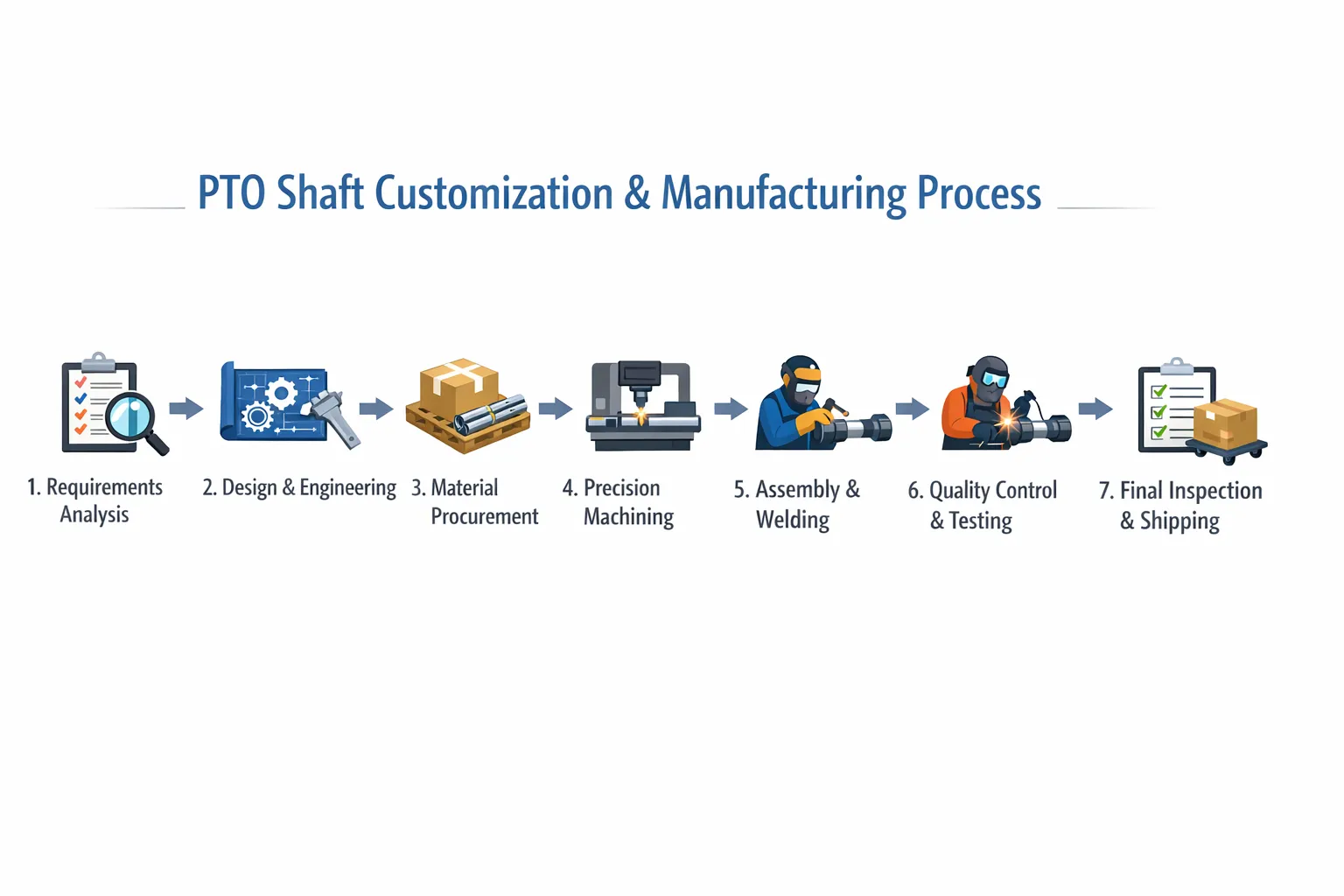
Configuration Solutions by UK pto-drive-shafts.com Co.,Ltd.
Premium Configuration Standards:
- Materials Science: All-Stainless Steel Construction
We almost exclusively utilize AISI 304 or 316L stainless steel for manufacturing food-grade universal shafts. Stainless steel offers natural resistance to oxidation, acids, and alkalis, and crucially, it complies with FDA and EU standards for food contact materials. For specific high-strength requirements, we may employ chemically nickel-plated alloy steel, strictly tested for adhesion to ensure no risk of peeling. - Lubrication & Sealing Revolution: FDA H1 Compliance
Standard industrial grease is toxic. Our food machinery shafts strictly select food-grade lubricants compliant with FDA H1 standards. Even in the event of accidental micro-leakage, there is no harm to human health. Furthermore, we design specialized “Boot Covers” that completely encapsulate the universal joint. This design retains lubrication while building a physical barrier against external moisture and debris. - Maintenance-Free Technology
For high-end applications, we have introduced solid lubrication coating technology. This coating adheres to friction surfaces via physical deposition, achieving true “oil-free lubrication.” This eliminates the risk of grease contamination entirely, making it ideal for powder processing environments like flour or milk powder production. - Hygienic Quick-Release Design
To facilitate frequent cleaning operations, our shafts feature Quick-Release Flanges or Splined Sleeves. Operators can remove the drive shaft in seconds without tools (like wrenches) to thoroughly clean hidden areas. This significantly reduces production line changeover downtime, directly boosting the factory’s OEE (Overall Equipment Effectiveness).
Pharmaceutical & Cleanroom Equipment: Precision Transmission with Zero Tolerance
Equipment Definition and Cleanroom Environments
The pharmaceutical industry represents the apex of the manufacturing pyramid. In blenders, capsule filling machines, sterile filling lines, and biological laboratory mechanisms, drive shafts are not just power transmission components but critical elements of GMP (Good Manufacturing Practice) compliance. In these scenarios, universal shafts often operate within ISO Class 5 or higher cleanrooms.
Deep Dive into Operating Conditions: The Invisible Enemy
Ultimate Cleanliness Standards
Pharmaceutical environments have zero tolerance for particulates and leakage. Metal particles generated during the break-in period of standard shafts, or oil mist from volatile lubricants, can cause entire batches of drugs to be scrapped. Especially for high-risk products like injectables or eye drops, the transmission system must be “invisible”—physically present but contributing zero contamination.
Chemical Resistance and Sterilization Survival
Unlike water washdowns in the food industry, pharmaceutical cleaning relies heavily on strong oxidizers and high temperatures. Common sterilization methods like VHP (Vaporized Hydrogen Peroxide), formaldehyde fumigation, and 121°C high-temperature steam are extremely destructive to materials. Many conventional rubber seals rapidly age, embrittle, and crack in VHP environments, leading to seal failure.
High-Precision Control for Dosing
In tablet presses or capsule fillers, drive shafts often drive the core metering and distribution mechanisms. If the shaft exhibits excessive backlash or insufficient torsional stiffness, it leads to desynchronization of station movements, causing fluctuations in drug dosage. In the pharmaceutical industry, dosage inconsistency is a matter of patient safety.
Technical Countermeasures by UK pto-drive-shafts.com Co.,Ltd.
Advanced Pharmaceutical Configurations:
- Fully Enclosed Hygienic Design
We have developed fully enclosed universal joints specifically for pharmaceutical equipment. By installing precision-welded or sealed stainless steel shrouds over the joint, the shaft body forms a smooth cylinder free of screw holes, crevices, or recesses. Filled with long-life grease and permanently sealed, it emits no substances during operation and blocks external cleaning fluids completely. - Medical-Grade Materials & Surface Treatment
Standards are upgraded to 316L or 17-4PH precipitation-hardening stainless steel. These materials offer superior corrosion resistance and high torque capacity. To further reduce the risk of microbial biofilm adhesion, we perform Electropolishing on shaft surfaces, achieving a surface roughness of Ra < 0.4μm—a mirror-like finish where bacteria have nowhere to hide. - Specialized Sealing Materials
We discard standard Nitrile rubber in favor of high-temperature Silicone or PTFE (Teflon) seals. These materials withstand sterilization temperatures of 121°C or higher and are chemically inert to various disinfectants, ensuring no harmful substances are leached. - Precision Balancing & Zero Backlash
To meet the precise operation needs of pharmaceutical equipment, every shaft leaving our factory undergoes rigorous dynamic balancing. We utilize double universal joint constant-velocity structures to ensure strictly consistent angular velocity during angled transmission. Through pre-loading technologies, we eliminate joint play to achieve ultra-low backlash, ensuring every capsule filling and tablet pressing action is executed with absolute precision.
Why Choose UK pto-drive-shafts.com Co.,Ltd.?
In the realm of food and pharmaceutical machinery, selecting a drive shaft is not merely about purchasing a part; it is about choosing a safety guarantee. UK pto-drive-shafts.com Co.,Ltd., backed by deep engineering heritage in Suffolk, offers:
- Bespoke Engineering Design: We understand that every production line is unique. Whether it’s special lengths, unique flange interfaces, or extreme operating conditions, our engineering team provides customized solutions.
- Full Traceability: For pharmaceutical clients, we provide complete material certification (3.1 certificates), FDA compliance documentation, and surface roughness reports, satisfying all your GMP validation documentation needs.
- Global Service Support: While rooted in the UK, our perspective is global. Our rapid response mechanism ensures your production line never stalls due to spare parts issues.
UK pto-drive-shafts.com Co.,Ltd.
Dedicated to Excellence in Transmission, Safeguarding Food & Drug Safety
📍 Adres: Bury St Edmunds, Suffolk IP32 7LX, Wielka Brytania
📧 E-mail: [email protected]
🌐 Strona internetowa: www.pto-drive-shafts.com























