
제품 설명
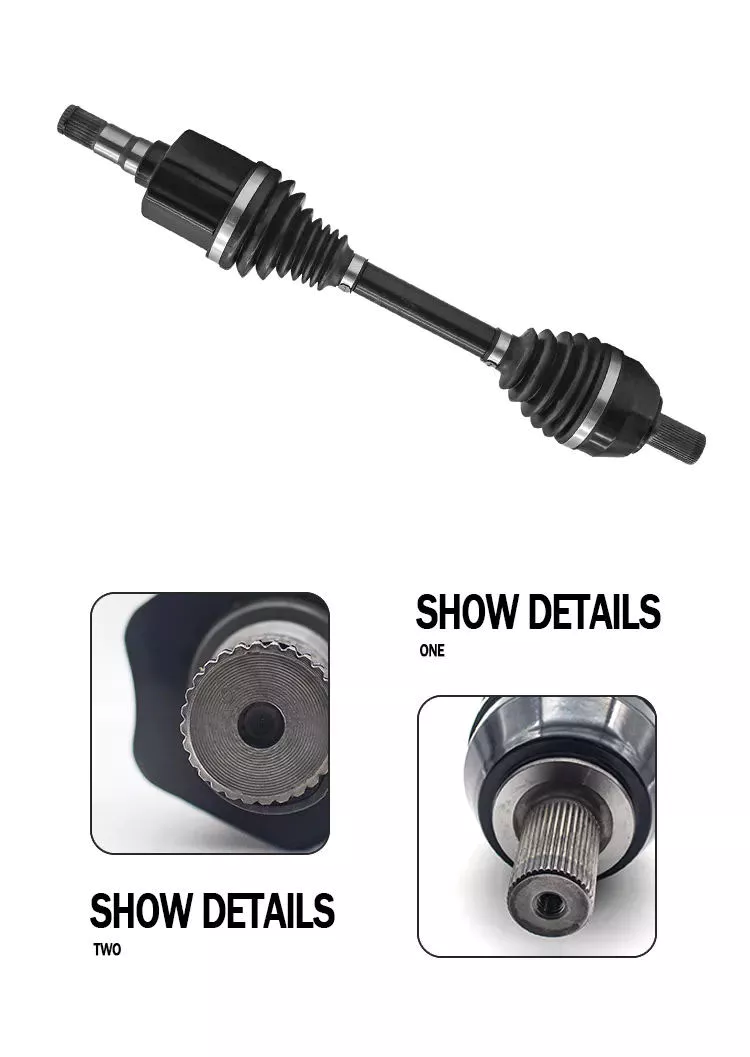
제품 설명
제품 매개변수
| Item | Spur Gear Axle Shaft |
| 재료 | 4140,4340,40Cr,42Crmo,42Crmo4,20Cr,20CrMnti, 20Crmo,35Crmo |
| OEM NO | Customize |
| 인증 | ISO/TS16949 |
| Test Requirement | Magnetic Powder Test, Hardness Test, Dimension Test |
| 색상 | Paint , Natural Finish ,Machining All Around |
| 재료 | Aluminum: 5000series(5052…)/6000series(6061…)/7000series(7075…) |
| Steel: Carbon Steel,Middle Steel,Steel Alloy,etc. | |
| Stainess Steel: 303/304/316,etc. | |
| Copper/Brass/Bronze/Red Copper,etc. | |
| Plastic:ABS,PP,PC,Nylon,Delrin(POM),Bakelite,etc. | |
| 크기 | According to Customer’s drawing or samples |
| 프로세스 | CNC machining,Turning,Milling,Stamping,Grinding,Welding,Wire Injection,Cutting,etc. |
| 용인 | ≥+/-0.03mm |
| 표면 처리 | (Sandblast)&(Hard)&(Color)Anodizing,(Chrome,Nickel,Zinc…)Plating,Painting,Powder Coating,Polishing,Blackened,Hardened,Lasering,Engraving,etc. |
| File Formats | ProE,SolidWorks,UG,CAD,PDF(IGS,X-T,STP,STL) |
| Sample | 사용 가능 |
| 포장 | Spline protect cover ,Wood box ,Waterproof membrane; Or per customers’ requirements. |
Our Advantages
Why Choose US ???
1. Equipment :
Our company boasts all necessary production equipment,
including Hydraulic press machines, Japanese CNC lathe (TAKISAWA), Korean gear hobbing machine (I SNT), gear shaping machine, machining center, CNC grinder, heat treatment line etc.
2. Processing precision:
We are a professional gear & gear shafts manufacturer. Our gears are around 6-7 grade in mass production.
3. Company:
We have 90 employees, including 10 technical staffs. Covering an area of 20000 square meters.
4. Certification :
Oue company has passed ISO 14001 and TS16949
5.Sample service :
We provide free sample for confirmation and customer bears the freight charges
6.OEM service :
Having our own factory and professional technicians,we welcome OEM orders as well.We can design and produce the specific product you need according to your detail information
Cooperation Partner
회사 소개
Our Featured Products
| 재료: | Alloy Steel |
|---|---|
| 짐: | 구동축 |
| 축 모양: | 직선형 샤프트 |
| Appearance Shape: | Round |
| Sample Service: | Free |
| Lester Nos: | 6468, 6469 |
| 샘플: |
US$ 0/Piece
1개 (최소 주문 수량) | |
|---|
| 맞춤 설정: |
사용 가능
| 맞춤형 요청 |
|---|
Are there any limitations or disadvantages associated with drive shafts?
While drive shafts are widely used and offer several advantages, they also have certain limitations and disadvantages that should be considered. Here’s a detailed explanation of the limitations and disadvantages associated with drive shafts:
1. Length and Misalignment Constraints:
Drive shafts have a maximum practical length due to factors such as material strength, weight considerations, and the need to maintain rigidity and minimize vibrations. Longer drive shafts can be prone to increased bending and torsional deflection, leading to reduced efficiency and potential driveline vibrations. Additionally, drive shafts require proper alignment between the driving and driven components. Misalignment can cause increased wear, vibrations, and premature failure of the drive shaft or its associated components.
2. Limited Operating Angles:
Drive shafts, especially those using U-joints, have limitations on operating angles. U-joints are typically designed to operate within specific angular ranges, and operating beyond these limits can result in reduced efficiency, increased vibrations, and accelerated wear. In applications requiring large operating angles, constant velocity (CV) joints are often used to maintain a constant speed and accommodate greater angles. However, CV joints may introduce higher complexity and cost compared to U-joints.
3. Maintenance Requirements:
Drive shafts require regular maintenance to ensure optimal performance and reliability. This includes periodic inspection, lubrication of joints, and balancing if necessary. Failure to perform routine maintenance can lead to increased wear, vibrations, and potential driveline issues. Maintenance requirements should be considered in terms of time and resources when using drive shafts in various applications.
4. Noise and Vibration:
Drive shafts can generate noise and vibrations, especially at high speeds or when operating at certain resonant frequencies. Imbalances, misalignment, worn joints, or other factors can contribute to increased noise and vibrations. These vibrations may affect the comfort of vehicle occupants, contribute to component fatigue, and require additional measures such as dampers or vibration isolation systems to mitigate their effects.
5. Weight and Space Constraints:
Drive shafts add weight to the overall system, which can be a consideration in weight-sensitive applications, such as automotive or aerospace industries. Additionally, drive shafts require physical space for installation. In compact or tightly packaged equipment or vehicles, accommodating the necessary drive shaft length and clearances can be challenging, requiring careful design and integration considerations.
6. Cost Considerations:
Drive shafts, depending on their design, materials, and manufacturing processes, can involve significant costs. Customized or specialized drive shafts tailored to specific equipment requirements may incur higher expenses. Additionally, incorporating advanced joint configurations, such as CV joints, can add complexity and cost to the drive shaft system.
7. Inherent Power Loss:
Drive shafts transmit power from the driving source to the driven components, but they also introduce some inherent power loss due to friction, bending, and other factors. This power loss can reduce overall system efficiency, particularly in long drive shafts or applications with high torque requirements. It is important to consider power loss when determining the appropriate drive shaft design and specifications.
8. Limited Torque Capacity:
While drive shafts can handle a wide range of torque loads, there are limits to their torque capacity. Exceeding the maximum torque capacity of a drive shaft can lead to premature failure, resulting in downtime and potential damage to other driveline components. It is crucial to select a drive shaft with sufficient torque capacity for the intended application.
Despite these limitations and disadvantages, drive shafts remain a widely used and effective means of power transmission in various industries. Manufacturers continuously work to address these limitations through advancements in materials, design techniques, joint configurations, and balancing processes. By carefully considering the specific application requirements and potential drawbacks, engineers and designers can mitigate the limitations and maximize the benefits of drive shafts in their respective systems.

Can you provide real-world examples of vehicles and machinery that use drive shafts?
Drive shafts are widely used in various vehicles and machinery to transmit power from the engine or power source to the wheels or driven components. Here are some real-world examples of vehicles and machinery that utilize drive shafts:
1. Automobiles:
Drive shafts are commonly found in automobiles, especially those with rear-wheel drive or four-wheel drive systems. In these vehicles, the drive shaft transfers power from the transmission or transfer case to the rear differential or front differential, respectively. This allows the engine’s power to be distributed to the wheels, propelling the vehicle forward.
2. Trucks and Commercial Vehicles:
Drive shafts are essential components in trucks and commercial vehicles. They are used to transfer power from the transmission or transfer case to the rear axle or multiple axles in the case of heavy-duty trucks. Drive shafts in commercial vehicles are designed to handle higher torque loads and are often larger and more robust than those used in passenger cars.
3. Construction and Earthmoving Equipment:
Various types of construction and earthmoving equipment, such as excavators, loaders, bulldozers, and graders, rely on drive shafts for power transmission. These machines typically have complex drivetrain systems that use drive shafts to transfer power from the engine to the wheels or tracks, enabling them to perform heavy-duty tasks on construction sites or in mining operations.
4. Agricultural Machinery:
Agricultural machinery, including tractors, combines, and harvesters, utilize drive shafts to transmit power from the engine to the wheels or driven components. Drive shafts in agricultural machinery are often subjected to demanding conditions and may have additional features such as telescopic sections to accommodate variable distances between components.
5. Industrial Machinery:
Industrial machinery, such as manufacturing equipment, generators, pumps, and compressors, often incorporate drive shafts in their power transmission systems. These drive shafts transfer power from electric motors, engines, or other power sources to various driven components, enabling the machinery to perform specific tasks in industrial settings.
6. Marine Vessels:
In marine applications, drive shafts are commonly used to transmit power from the engine to the propeller in boats, ships, and other watercraft. Marine drive shafts are typically longer and designed to withstand the unique challenges posed by water environments, including corrosion resistance and appropriate sealing mechanisms.
7. Recreational Vehicles (RVs) and Motorhomes:
RVs and motorhomes often employ drive shafts as part of their drivetrain systems. These drive shafts transfer power from the transmission to the rear axle, allowing the vehicle to move and providing propulsion. Drive shafts in RVs may have additional features such as dampers or vibration-reducing components to enhance comfort during travel.
8. Off-Road and Racing Vehicles:
Off-road vehicles, such as SUVs, trucks, and all-terrain vehicles (ATVs), as well as racing vehicles, frequently utilize drive shafts. These drive shafts are designed to withstand the rigors of off-road conditions or high-performance racing, transmitting power efficiently to the wheels and ensuring optimal traction and performance.
9. Railway Rolling Stock:
In railway systems, drive shafts are employed in locomotives and some types of rolling stock. They transfer power from the locomotive’s engine to the wheels or propulsion system, enabling the train to move along the tracks. Railway drive shafts are typically much longer and may have additional features to accommodate the articulated or flexible nature of some train configurations.
10. Wind Turbines:
Large-scale wind turbines used for generating electricity incorporate drive shafts in their power transmission systems. The drive shafts transfer rotational energy from the turbine’s blades to the generator, where it is converted into electrical power. Drive shafts in wind turbines are designed to handle the significant torque and rotational forces generated by the wind.
These examples demonstrate the broad range of vehicles and machinery that rely on drive shafts for efficient power transmission and propulsion. Drive shafts are essential components in various industries, enabling the transfer of power from the source to the driven components, ultimately facilitating movement, operation, or the performance of specific tasks.

구동축은 길이 및 토크 요구 사항의 변화에 어떻게 대응합니까?
구동축은 회전력을 효율적으로 전달하기 위해 길이와 토크 요구량의 변화를 처리하도록 설계되었습니다. 구동축이 이러한 변화에 어떻게 대응하는지 설명드리겠습니다.
길이 변형:
구동축은 엔진 또는 동력원과 구동 부품 사이의 거리에 따라 다양한 길이로 제공됩니다. 특정 용도에 따라 맞춤 제작하거나 표준 길이로 구입할 수 있습니다. 엔진과 구동 부품 사이의 거리가 긴 경우에는 적절한 커플링이나 유니버설 조인트를 사용하여 여러 개의 구동축을 연결하여 거리를 늘릴 수 있습니다. 이러한 추가 구동축은 동력 전달 시스템의 전체 길이를 효과적으로 연장합니다.
또한, 일부 구동축은 텔레스코픽 구조로 설계되어 있습니다. 이 텔레스코픽 구조는 길이를 늘리거나 줄일 수 있어 다양한 차량 구성이나 역동적인 움직임에 맞춰 길이를 조절할 수 있습니다. 텔레스코픽 구동축은 엔진과 구동 부품 사이의 거리가 변할 수 있는 특정 유형의 트럭, 버스, 오프로드 차량 등에 주로 사용됩니다.
토크 요구 사항:
구동축은 엔진 또는 동력원의 출력과 구동 부품의 요구 사항에 따라 달라지는 토크를 처리하도록 설계되었습니다. 구동축을 통해 전달되는 토크는 엔진 출력, 부하 조건, 구동 부품이 받는 저항과 같은 요소에 따라 달라집니다.
제조업체는 구동축의 재질과 치수를 선택할 때 토크 요구 사항을 고려합니다. 구동축은 일반적으로 강철이나 알루미늄 합금과 같은 고강도 재질로 제작되어 변형이나 파손 없이 토크 하중을 견딜 수 있도록 합니다. 구동축의 직경, 벽 두께 및 설계는 과도한 처짐이나 진동 없이 예상되는 토크를 처리할 수 있도록 신중하게 계산됩니다.
대형 트럭, 산업 기계 또는 고성능 차량과 같이 높은 토크가 요구되는 응용 분야에서는 구동축에 추가적인 보강재가 사용될 수 있습니다. 이러한 보강재에는 더 두꺼운 벽, 강도에 최적화된 단면 형상 또는 우수한 토크 처리 능력을 갖춘 복합 재료가 포함될 수 있습니다.
또한, 구동축에는 유니버설 조인트나 등속 조인트(CV 조인트)와 같은 유연한 관절이 포함되는 경우가 많습니다. 이러한 관절은 각도 불일치를 허용하고 엔진, 변속기 및 구동 부품 사이의 작동 각도 변화를 보정합니다. 또한 진동과 충격을 흡수하여 구동축에 가해지는 스트레스를 줄이고 토크 처리 능력을 향상시키는 데 도움이 됩니다.
요약하자면, 구동축은 맞춤형 길이, 신축식 구조, 적절한 재질 및 치수, 그리고 유연한 연결부를 통해 다양한 길이 및 토크 요구 사항을 처리할 수 있습니다. 이러한 요소들을 신중하게 고려함으로써 구동축은 다양한 응용 분야의 특정 요구 사항을 충족하면서 효율적이고 안정적으로 동력을 전달할 수 있습니다.


editor by CX 2023-10-08























