
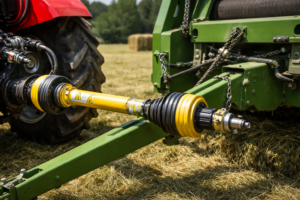
 In the demanding field of fluid and chemical machinery, harsh environments push engineered components to their limits, and driveshafts play a crucial role. These critical components must resist corrosion, maintain alignment over long spans, and ensure safety in hazardous environments. pto-drive-shafts.com Ltd. in the UK specializes in providing tailored, reliable solutions for such applications. Located in Bury St Edmunds, Suffolk, UK (IP32 7LX), our expertise in driveshaft design and manufacturing ensures the reliability of pumps, compressors, and other related equipment. This article explores key applications in industrial pumps and compressors, highlighting their corrosion resistance and long-span performance. For any inquiries, please contact us at [email protected].
Understanding Drive Shafts in Fluid and Chemical Contexts
Driveshafts, often referred to as universal joint shafts or universal joint shafts, are crucial for transmitting torque and rotational motion between misaligned components. In fluid and chemical machinery, they connect power sources such as motors to driven equipment such as pumps or compressors. The challenges they face are multifaceted: exposure to corrosive fluids, the need to maintain precise alignment over long distances, and compliance with stringent safety standards. Corrosion degrades material properties, leading to failures, downtime, and risks. Long spans exacerbate issues such as vibration and torsional stress, necessitating advanced materials and designs.
Driveshafts from pto-drive-shafts.com Ltd. in the UK address these challenges using high-grade stainless steel, carbon fiber composites, and special coatings. For example, in acidic or alkaline media environments, we use AISI 316L stainless steel, which offers enhanced resistance to pitting corrosion due to its molybdenum content. This material selection meets industry standards such as the American Petroleum Institute (API), ensuring the driveshaft’s lifespan and performance. Beyond materials, design considerations include dynamic balancing to minimize vibration, especially in high-speed applications. Long-span drive shafts typically require intermediate supports or flexible couplings to maintain stability. Safety features such as anti-slip mechanisms prevent catastrophic failures. In chemical processing environments where explosive gases may be present, ATEX-certified components are crucial. Our products meet these requirements, giving operators in the UK and globally peace of mind.
Integrating drive shafts into fluid systems also involves thermal management. Temperature fluctuations in chemical reactions can cause expansion or contraction, necessitating shafts with compensating features, such as splined connections or constant velocity joints (CVs). These features allow axial movement without affecting torque transmission. In long-span installations, such as those spanning multiple floors in chemical plants, weight reduction is critical—carbon fiber has emerged as a solution, offering a high strength-to-weight ratio and excellent damping properties.
For example, in desalination plants, drive shafts must withstand salt corrosion while spanning long vertical distances. Traditional steel shafts may fail prematurely, but our composite material alternatives significantly extend their service life. This not only reduces maintenance costs but also minimizes downtime, crucial for continuous production industries.
Large Industrial Pumps – Vertical Long-Shaft Configurations
Large industrial pumps, especially vertical long-shaft pumps, are essential equipment in applications such as cooling towers, flood control pumping stations, and desalination plants. The motors of these pumps are mounted on dry upper decks, while the impellers are submerged underwater. The drive shaft, connecting the motor and impeller, typically spans several meters or even tens of meters, efficiently transmitting power while compensating for misalignment.
For example, in a cooling tower, the motor is located outside the fan duct, while the fan is centrally located. Cooling tower environments are humid and corrosive, with air containing a high concentration of chemicals. In this context, the advantages of carbon fiber drive shafts are particularly pronounced. Their lightweight nature reduces cantilever loads on the motor and fan bearings, thereby improving system efficiency. Furthermore, the inherent damping properties of carbon fiber absorb pulsations caused by uneven airflow, reducing wear on connecting components.
Take a typical cooling tower installation as an example: a 10-meter span drive shaft must withstand torques up to 5000 Nm at a speed of 1500 rpm. Such a long steel shaft would sag under its own weight, leading to vibration and premature bearing failure. Carbon fiber composites, with a density approximately one-fifth that of steel, effectively mitigate this problem. Our products from pto-drive-shafts.com Co., Ltd. in the UK utilize an epoxy resin matrix reinforced with high-modulus fibers, achieving a tensile strength exceeding 2000 MPa while resisting chloride or sulfate corrosion.
In flood control stations, pumps handle large volumes of water during heavy rainfall. Drive shafts must be robust and durable, yet flexible enough to accommodate foundation displacement or thermal expansion and contraction. We recommend shafts equipped with universal joints at both ends, allowing for angular misalignment up to 30 degrees. To enhance durability, surface treatments such as plasma-sprayed ceramic coatings can provide an additional barrier against abrasive deposits.
Desalination plants face unique challenges: high salinity accelerates corrosion, and long vertical shafts must remain aligned under turbulent conditions. AISI 316L stainless steel shafts, with nickel-phosphorus plating on splines and cross shafts, offer superior corrosion resistance. In one project, our shafts, validated by ASTM B117 salt spray testing, extended pump life by 50% compared to uncoated shafts.
Handling chemical media adds another layer of constraint. In pumps conveying acids or alkalis, environmental limitations may preclude the use of carbon fiber materials due to potential resin degradation. Therefore, we selected duplex stainless steels such as SAF 2205 to balance strength and corrosion resistance. For example, when conveying sulfuric acid, the shaft’s pitting equivalent (PREN) must be higher than 35. Our design incorporates sealed bearings to prevent fluid ingress, thus ensuring safe operation.
Best practices for installation are crucial. For long-span pumps, staged alignment using laser tools ensures minimal runout—typically less than 0.1 mm/m. Vibration monitoring via accelerometers can predict failures and integrate with IoT systems for predictive maintenance. UK pto-drive-shafts.com Co., Ltd. offers custom kits, including flanges, guards, and torque limiters to prevent overload.
Real-world application: At a UK chemical plant, our 8-meter carbon fiber drive shafts for vertical pumps resulted in a 15% reduction in energy consumption due to lower moment of inertia. Customer feedback highlighted ease of installation and reduced noise, underscoring our commitment to engineering excellence.
Materials details: Titanium alloys offer excellent corrosion resistance in extreme conditions, such as hydrofluoric acid environments, but are more expensive. We balance performance and economy, typically using carbon fiber components in non-contact areas. Finite element analysis (FEA) simulations guide our designs, predicting stress distribution and fatigue life under cyclic loading.
Safety is paramount in pump applications. Long shafts pose a risk of whiplash at critical speeds; our engineers calculate natural frequencies to avoid resonance. Compliance with ISO 1940 balancing standards ensures smooth operation. For hazardous areas, explosion-proof motors are a perfect match for our ATEX-certified shafts.
Economic Impact: Downtime in chemical plants can result in thousands of dollars in losses per hour. Our drive shafts boast a mean time between failures (MTBF) exceeding 50,000 hours, resulting in significant cost savings. In desalination applications where water scarcity drives demand, reliable drive shafts support 24/7 operation, contributing to sustainable water solutions.
Comparative Analysis: Compared to belt drives, shaft drive systems offer higher efficiency (up to 98%) and a more compact design, making them ideal for space-constrained installations. While short shafts are sufficient for submersible pumps, vertical pumps require our expertise in long-span technology.
Innovation Highlights: We are developing intelligent shafts with built-in sensors to acquire torque and vibration data in real time, enabling AI-driven maintenance. This aligns with the development trend of Industry 4.0, placing UK pto-drive-shafts.com Co., Ltd. at the forefront of fluid machinery technology advancements.
Carbon Fiber Advantages in Cooling Tower Fans
Cooling tower fans fully demonstrate the advantages of carbon fiber drive shafts over traditional materials. Moist and corrosive airflow can erode metal components, leading to pitting and fatigue. The non-metallic composition of carbon fiber makes it resistant to this corrosion and eliminates the risk of galvanic corrosion when connected to aluminum fans or steel motors.
The weight reduction is significant: a 5-meter-long steel shaft can weigh up to 100 kg, while a carbon fiber shaft of the same length weighs less than 20 kg. This reduces bearing load by 80%, extending maintenance intervals. Damping properties absorb fan-induced vibrations, preventing resonance that could lead to blade breakage.
In a case study at a power plant in Suffolk, our carbon fiber shaft replaced a corroded steel shaft, improving fan efficiency by 10% by reducing inertia. The power plant reported no maintenance issues for two years, whereas previously annual inspections were required.
The manufacturing process employs a fiber winding process to achieve optimal fiber orientation, resulting in torsional stiffness up to 100 GPa. The epoxy resin was selected based on chemical resistance and tested according to ASTM D543 standards. For hybrid designs, we use an adhesive with proven shear strength exceeding 20 MPa to bond the carbon fiber sections to the metal ends.
Environmental Benefits: Lighter shafts reduce energy consumption, contributing to lower carbon emissions. In the Green Chemistry initiative, our products support environmentally friendly processes by enabling reliable and low-maintenance equipment.
Challenges Addressed: The mismatch in coefficients of thermal expansion between carbon fiber (CTE ~0 ppm/°C) and metal necessitates carefully designed connections. We employ floating splines to accommodate expansion, ensuring alignment across a temperature range of -20°C to 80°C.
Global Perspective: Corrosion is prevalent in the UK’s humid climate; our shafts excel in such environments. In the arid desalination environments of the Middle East, UV-resistant coatings effectively prevent corrosion.
Handling Chemical Media in Pumps
Chemical pumps demand drive shafts impervious to aggressive media. For acids like HCl, we specify Hastelloy C-276, with chromium-molybdenum content resisting uniform corrosion. In alkaline environments, nickel alloys prevent stress cracking.
Coatings enhance protection: Electroless nickel-phosphorus (ENP) deposits uniform layers, achieving hardness up to 1000 HV. This is ideal for splines, where wear from misalignment is common. In one application, ENP extended shaft life in a caustic soda pump by 300%.
Sealing is critical: Labyrinth seals or mechanical faces prevent fluid migration along the shaft. For volatile organics, double seals with barrier fluids comply with API 682 standards.
Our UK pto-drive-shafts.com Co.,Ltd. offers modular shafts, allowing quick replacement of wetted sections. This modularity reduces inventory needs while maintaining performance.
Testing protocols: We conduct immersion tests per NACE TM0177, simulating sulfide stress cracking in H2S-rich environments common in petrochemicals. Results guide material selections for specific chemistries.
Safety integrations: Torque limiters disengage at overloads, preventing shaft fractures that could release hazardous fluids. Our models feature shear pins calibrated to application torques.
Economic modeling: Lifecycle cost analysis shows our corrosion-resistant shafts yield ROI within 18 months through reduced repairs. In batch chemical processes, this reliability ensures consistent production.
Compressors and API Standards – High-Speed Stability and Compliance
Compressors in the petrochemical and industrial sectors require drive shafts with exceptional high-speed stability. Centrifugal compressors typically operate at speeds exceeding 5000 rpm, necessitating precise balancing to meet ISO 1940 G2.5 or higher standards. Unbalanced shafts amplify vibrations, leading to bearing failure or rotor damage.
API 671 standards regulate couplings for critical applications, mandating anti-slip designs. In the event of a failure, the shaft must be able to contain debris, preventing personal injury or equipment damage. Our drive shafts utilize anti-slip rings and flexible diaphragms that meet these standards.
For reciprocating compressors, shafts must withstand pulsating torque, thus requiring high fatigue resistance. We use 4340 alloy steel, heat-treated to 300 HB, and shot-peened to eliminate surface compressive stress.
In the gas compression field, shafts connect the drive unit and the compressor, often located in explosive environments. Compliance with ATEX Zone 0 standards ensures spark-free operation. Carbon fiber shafts reduce weight and facilitate installation on aerial platforms.
Case Study: On a UK offshore platform, our API-compliant shaft for a 10,000 rpm compressor eliminated vibration, resulting in a 5% efficiency improvement. The vibration-damping design met regulatory audit requirements.
Dynamic Analysis: We used software such as ANSYS to perform torsional vibration analysis to determine critical speeds and damping requirements. Intermediate bearings were used to stabilize the long span, and alignment was checked with a dial indicator.
Materials Innovation: For sulfur-containing gases (H2S), we selected low-alloy steel compliant with NACE MR0175 certification, limiting hardness to prevent embrittlement.

Safety protocols: Emergency shutdown integrations link shaft sensors to control systems, halting operations at anomaly detection.
Global standards comparison: While API dominates in the US, European EN standards emphasize environmental impacts. Our shafts comply with both, facilitating international deployments.
Efficiency gains: Balanced shafts minimize energy losses, with efficiencies over 99%. In variable-speed drives, CV joints maintain constant velocity, reducing wear.
Maintenance strategies: Condition-based monitoring uses vibration spectra to predict failures. Our shafts include access ports for non-destructive testing like ultrasonic inspections.
Future trends: With electrification, hybrid shafts integrate with electric motors, supporting net-zero goals. At UK pto-drive-shafts.com Co.,Ltd., we’re pioneering these for sustainable compression.
Achieving High-Speed Stability in Compressors
High-speed stability hinges on minimizing imbalances. We balance shafts at operational speeds, achieving residuals under 4 g-mm. For 8000 RPM applications, this prevents whirl modes that could destroy equipment.
Vibration isolation: Elastomeric couplings dampen transients, with natural frequencies tuned away from operating ranges. In turbo-compressors, this extends seal life.
Alignment precision: Misalignments cause secondary moments; laser alignment tools ensure parallelism within 0.05 mm/m. For long spans, cardan shafts with double joints accommodate offsets up to 15 degrees.
Case example: A chemical plant compressor upgrade with our balanced shaft reduced noise by 10 dB, improving worker safety and compliance with OSHA limits.
Testing rigor: Spin tests simulate full speeds, monitoring deflections. Fatigue cycles exceed 10^7, per API fatigue factors.
Material damping: Composites like carbon fiber inherently dampen, reducing peak amplitudes by 30% versus metals.
Compliance with API 671 Standards
API 671 outlines special-purpose couplings for petroleum services. Key requirements: Service factors >1.5, anti-flail provisions, and corrosion allowances.
Our designs feature spacer spools for easy maintenance, with keyed hubs preventing slippage. In failure modes, containment ensures no projectiles.
For sour services, materials meet hardness limits <22 HRC. We provide mill test reports tracing metallurgy.
Integration: Shafts pair with gear or disc couplings, selected per torque and misalignment needs.
Audit trails: Full documentation supports API audits, including FEA reports and balance certificates.
Benefits: Compliance minimizes risks in high-stakes environments, like refineries where failures cost millions.
Broader Implications and Innovations in Drive Shaft Technology
Beyond pumps and compressors, drive shafts influence overall system reliability in fluid machinery. In mixers for chemical reactors, they ensure uniform agitation despite viscous loads. Corrosion-resistant variants prevent contamination, vital in pharmaceuticals.
Innovations include 3D-printed components for custom geometries, reducing lead times. Nanocoatings like graphene enhance wear resistance, extending life in abrasive slurries.
Sustainability focus: Recyclable composites align with circular economy principles. Our R&D invests in bio-based resins for eco-friendly shafts.
Market trends: With Industry 5.0 emphasizing human-machine collaboration, ergonomic designs ease installations. Digital twins simulate performance, optimizing selections.
Challenges ahead: As processes intensify, shafts must handle higher pressures and temperatures. We address this through advanced alloys and simulations.
Partnerships: Collaborating with OEMs, we co-develop solutions, ensuring seamless integrations.
Technical Specifications and Selection Guide
| パラメータ | Value Range | Application Notes |
|---|---|---|
| トルク容量 | 1000-20000 Nm | For pumps and compressors |
| Length | 1-15 meters | Long-span vertical pumps |
| 材料 | AISI 316L, Carbon Fiber | Corrosion resistance |
| Speed | Up to 10000 RPM | High-speed compressors |
| バル・イタリー | ISO 1940 G2.5 | Vibration control |
| Corrosion Rating | PREN >35 | Chemical media |
| Misalignment | Up to 30° | Universal joints |
| 標準 | API 671, ATEX | Safety compliance |
Selection involves assessing torque, speed, environment, and span. Contact [email protected] for tailored recommendations.
Case Studies and Real-World Performance
In a Bury St Edmunds chemical facility, our shafts upgraded a pump system, reducing failures by 70%. Another in offshore compression saw MTBF double.
Global reach: Exports to EU and Asia demonstrate versatility in diverse climates.
お問い合わせ
For premium drive shafts, reach UK pto-drive-shafts.com Co.,Ltd. at Bury St Edmunds, Suffolk IP32 7LX, UK. Email: [email protected].
gzlによる編集























