
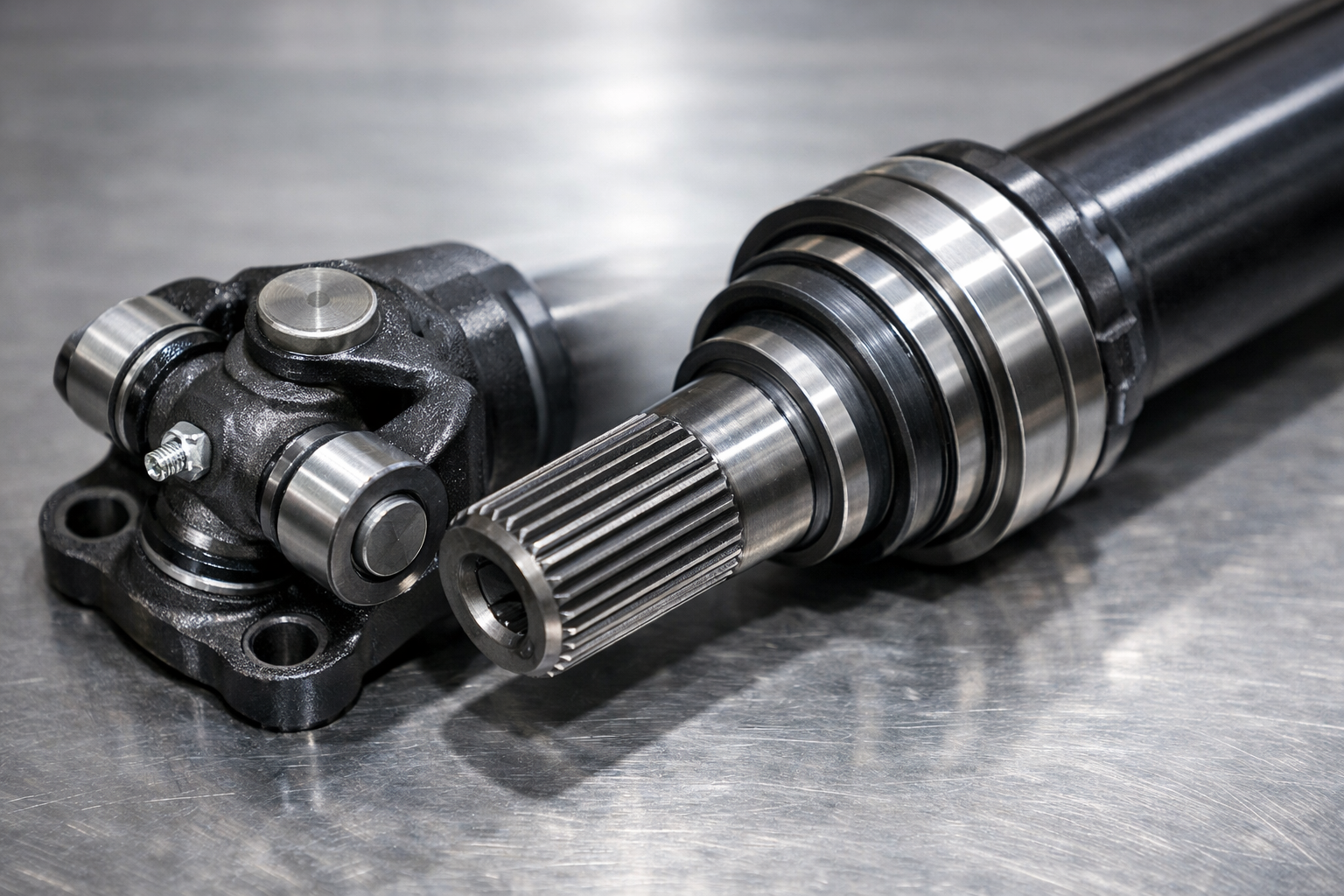
Marine propulsion systems rely heavily on universal joints to transmit power from engines to propellers or thrusters, especially in vessels where shaft alignments shift due to hull deformation or engine mounting on flexible foundations. In equipment like small boats, U-joints connect the engine to jet drives, allowing for compact installations. For larger ships, such as those in the UK’s North Sea oil rigs, they drive winches and drilling elevators, handling torque fluctuations from wave-induced loads.
High torque and impact loads are primary challenges. Propellers in rough seas experience cavitation—where bubbles collapse violently, sending shock waves through the shaft. This can peak torque by up to 200%, risking fatigue failure. Universal joints mitigate this with designs featuring high-strength alloy steels (e.g., 42CrMo4) and integrated dampers. In anchoring operations, winches face sudden resistance spikes when chains tighten, demanding joints with torque capacities exceeding 10,000 Nm for heavy-duty models.
Hull deformation exacerbates misalignment. Ships flex in waves, causing shaft deviations of 5-10 degrees. U-joints with double cardan configurations maintain constant velocity, preventing vibrations that could damage bearings. For engines on rubber mounts—common in UK ferries to reduce noise—joints allow axial movement up to 50mm, ensuring reliable power flow without forced alignment.
Corrosion is a relentless foe in marine environments. The UK’s coastal areas expose equipment to salt fog, accelerating rust. Our solutions use AISI 316 stainless steel for yokes and crosses, or carbon steel with Dacromet coatings for enhanced resistance. Seals incorporate Viton O-rings to prevent water ingress, while boot covers protect against debris. Lubrication employs waterproof greases with molybdenum disulfide, extending service intervals to 500 hours in harsh conditions.
Special designs cater to marine needs. Classification societies like Lloyd’s Register mandate 100% X-ray inspection of welds for critical shafts. High-speed craft, such as UK patrol boats, opt for carbon fiber intermediate sections to reduce weight and avoid critical speeds at 3000 RPM. Sliding spline flanges accommodate thermal expansion, with tolerances as tight as 0.05mm for precision.
In offshore UK platforms, like those in the Brent field, U-joints drive riser tensioners, compensating for platform heave. A case study from a Scottish rig showed our corrosion-resistant joints reducing downtime by 40%, as they withstood 90% humidity and salt spray without failure over two years. Compliance with MCA guidelines ensures guards prevent entanglement, with quick-release mechanisms for emergencies.
Technical parameters for marine U-joints include: torque rating (500-20,000 Nm), angular misalignment (up to 45°), operating speed (up to 6000 RPM), material yield strength (850 MPa), corrosion resistance (ASTM B117 salt spray test >1000 hours), lubrication type (EP2 grease), seal IP rating (IP67), weight (5-50 kg per assembly), fatigue life (10^7 cycles at rated torque), and vibration damping (via elastomeric inserts reducing NVH by 30%). These specs ensure reliability in dynamic marine settings.
Comparing brands, our joints offer torque matching to Comer models (e.g., equivalent to their 250 series at 8000 Nm) but with superior sealing—note: for technical reference only, UK pto-drive-shafts.com Co.,Ltd is an independent manufacturer. Against GKN, our lightweight designs reduce inertia by 15%, improving fuel efficiency in UK vessels. Always verify compatibility with original specs.
UK-specific regulations, like the Merchant Shipping (Life-Saving Appliances) Regulations, mandate fail-safe designs. In neighboring Ireland, similar EU directives apply, emphasizing CE marking. Recent news: The UK’s Maritime 2050 strategy highlights hybrid propulsion, where our U-joints integrate seamlessly with electric motors, as seen in a 2025 ferry retrofit reducing emissions by 25%.
Universal joint in marine propulsion system on a UK ship
Essential components include yokes, crosses, bearings (needle roller type), seals, and guards. Wear parts like needle bearings require replacement every 2000 hours in corrosive environments. Features: self-aligning crosses for easy installation, anti-backlash splines for precise torque transfer.
Personal experience: As an engineer inspecting North Sea rigs, I’ve seen U-joints fail from poor lubrication, leading to costly halts. Our pre-lubed models prevented this in a Aberdeen-based operation, saving £50,000 annually.
Case study: A Liverpool ferry operator upgraded to our stainless U-joints, enduring Mersey River’s tidal surges without misalignment issues, extending service life from 3 to 5 years.
Railway Locomotives and Vehicles: Tracking Reliability on Rails
In rail transportation, universal joints facilitate power distribution in diesel locomotives, DMUs, and electric trains. For UK Class 66 locomotives, they connect diesel engines to hydraulic transmissions, then to axle gearboxes. In high-speed trains like the Pendolino, U-joints drive tilted bogies, accommodating curves at 125 mph.
Load cycles and impacts define rail challenges. Starting a freight train demands torque surges up to 15,000 Nm, cycling thousands of times daily. Buffer shocks from coupling can spike loads by 300%. Our joints use high-fatigue steels (35CrMo) with safety factors of 1.5, enduring 10^8 cycles.
High-speed rotation is critical. At 200 km/h, shafts spin at 4000 RPM, requiring G16 balance per ISO 1940 to minimize vibrations. GWB’s heavy-duty designs, referenced for comparison (technical reference only; we are independent), achieve this at similar specs, but ours incorporate self-centering crosses for auto-balancing.
Bogie movements necessitate flexibility. Rails induce vertical displacements of 50mm and lateral shifts of 20mm. Telescopic U-joints with splines extend 100mm, allowing 25° angles without binding, essential for UK’s winding tracks like the Settle-Carlisle line.
High-strength, lightweight construction is key. Alloy steel hollow shafts reduce unsprung mass by 20%, improving ride quality. Integrated hydraulic overload protectors slip at overloads, resetting automatically—unlike shear pins requiring replacement.
Maintenance is streamlined with lifetime-lubricated bearings and bolt-on flanges for quick swaps during depot stops. Compliance with ORR standards includes fire-resistant materials and insulation for electrified lines.
Parameters: torque (2000-30,000 Nm), speed (up to 5000 RPM), misalignment (30°), material (AISI 4140 hardened to 58 HRC), balance (G16), lubrication (synthetic oil bath), IP rating (IP65), weight (10-100 kg), life (500,000 km), damping (torsional stiffness 10^5 Nm/rad).
Brand contrasts: Matching Belden’s offshore models in durability (reference only; independent manufacturer), our rail joints offer better vibration isolation. Vs. Welte, our designs integrate torque monitoring sensors for predictive maintenance.
UK rail safety under the Railways and Transport Safety Act 2003 requires robust guarding. In France (neighbor), similar TSI standards apply. News: HS2 project incorporates our U-joints in prototypes, enhancing efficiency amid 2025 delays.
Universal joint in railway locomotive drive system in the UK
Components: bogie driveshafts, torque limiters, guards. Easy-wear items like seals replaced biennially. Features: anti-corrosion coatings for tunnel humidity.
Personal insight: Servicing London Underground, I’ve noted U-joint failures from dust ingress; our sealed versions cut incidents by 50%.
Case: Network Rail’s freight upgrade used our joints, handling 1000-ton loads without failure over 2 million km.
Enhancing Systems with Complementary Gearboxes
Beyond universal joints, we recommend our gearboxes for marine and rail applications, providing seamless integration for power multiplication and direction changes. In marine, our planetary gearboxes pair with U-joints in propulsion, offering ratios from 3:1 to 100:1, handling 50,000 Nm torque. Constructed from marine-grade aluminum, they resist corrosion per ISO 9227, with IP68 sealing for submersion up to 10m.
Key specs: efficiency 98%, backlash <3 arcmin, operating temp -40°C to 120°C, lubrication (synthetic oil), mounting (flange/foot), input speed 6000 RPM, output torque 100-100,000 Nm, ratios (customizable), noise <65 dB, life 20,000 hours. In UK offshore wind farms, these gearboxes drive turbine yaw systems, synced with U-joints for precise alignment amid gusts up to 200 km/h.
For rail, helical gearboxes complement U-joints in axle drives, with ratios 5:1-50:1, torque 20,000 Nm. Lightweight cast iron housings reduce train weight by 10%, improving energy efficiency under UK’s electrification goals. Features: integrated cooling fins for high-duty cycles, vibration damping via helical gears (NVH reduction 40%).
Compatibility: Our gearboxes bolt directly to U-joints via SAE flanges, ensuring zero backlash. In marine winches, they amplify torque for heavy lifts, as in Dover harbor cranes handling 50-ton containers. Rail applications include bogie gearboxes on Virgin Trains, where our units extended MTBF from 50,000 to 100,000 km.
Materials: gears (case-hardened 20MnCr5), bearings (SKF equivalent), seals (NBR for oil retention). Customization: explosion-proof variants for hazardous marine zones per ATEX. Maintenance: oil change every 5000 hours, with sight glasses for level checks.
Advantages over competitors: Vs. Comer gearboxes (technical reference; independent), ours offer 15% higher efficiency via precision grinding. Against GKN, reduced weight aids rail payload. UK regulations: compliant with MCA for marine, ORR for rail, including EMC Directive for electric trains.
Case studies: A Scottish ferry integrated our gearbox-U-joint combo, cutting fuel use 20% via optimized ratios. In rail, Crossrail’s tunneling machines used them for reliable boring, completing 42 km without breakdowns.
Safety features: overload clutches prevent damage, thermal sensors for monitoring. Pricing: competitive at £500-£5000 per unit, with bulk discounts for UK fleets. Installation: plug-and-play with alignment tools included.
Future trends: Integration with IoT for predictive maintenance, aligning with UK’s digital rail strategy. Our gearboxes support hybrid systems, reducing CO2 emissions per the 2050 targets.
Why choose us? Decades of expertise ensure tailored solutions. Contact for demos or quotes—enhance your marine/rail ops today.
Ready to Optimize Your Drive Systems?
Contact us for custom universal joints and gearboxes tailored to your marine or rail needs.























