
Description du produit
Product Specification:
| Title | LiuGong excavator part drive shaft 62A0091 |
| Part Name | Arbre de transmission |
| Part No. | 62A0091 |
| Marque | LiuGong |
| Condition | Original/genuine parts |
| Net Weight | 1.4 KG |
| Packaging | Safety carton or wooden box |
| Delivery time | 2-5 working days |
Company Profile:
ZheJiang CZPT Machinery Equipment Co., Ltd is 1 of the wholesaler, which specializes in providing LiuGong spare parts in China.
Our product range as following.
-
Parts for LiuGong wheel loader CLG835, ZL 30E, CLG842, ZL40B, ZL50C, ZL50CN, CLG856, CLG855, CLG862, CLG877 etc..
-
Parts for LiuGong excavator CLG205C, CLG915C, CLG916D, CLG920D/922D/923D/925D, CLG926LC etc..
-
Parts for LiuGong motor grader CLG414, CLG416, CLG418, CLG420.
-
Parts for LiuGong roller CLG612H, CLG614H, CLG618H, CLG614, CLG620 etc..
-
Parts for LiuGong compact wheel loader CLG816/816G, CLG820C, CLG836 etc..
-
Parts for LiuGong skid steer loader CLG365A, CLG375A
-
Parts for LiuGong backhoe loader CLG766, CLG777
-
Parts for LiuGong forklift CPC30, CPC35, CPCD30, CPCD 35 etc..
-
ZF transmission 4WG-200, 6WG-200, 4WG-180, 6WG-180.
-
PERMCO hydraulic pumps
We also have engine parts available for LiuGong machines. If you have any interest or enquiry of LiuGong parts, welcome to contact us.
Know more information, please visit to : http://liugongparts
Warehouse & spare parts pictures :
Packaging pictures
Our advantages & Services
1. Our company in the city where is liuGong factory/headquarter located, spare parts are taken from LiuGong warehouse directly.
2. Our company sell LiuGong genuine spare parts, complying with highest LiuGong performance standards.
3. Our company have own warehouse, which will guarantee you the high availability and short lead time (normal order 1-5 working days ).
4. Our team has rich experience in LiuGong spare parts.
5. Provide flexible pricing, offer discount and deferred payment for the wholesale buyers.
6. Accept payment by T/T and western union.
7. Accept terms of FOB, CIF, CPT ……etc.
If you want to know more infomation, please feel free to call or email us.
/* 22 janvier 2571 19:08:37 */!function(){function s(e,r){var a,o={};try{e&&e.split(“,”).forEach(function(e,t){e&&(a=e.match(/(.*?):(.*)$/))&&1
| Service après-vente : | Yes |
|---|---|
| Garantie: | Yes |
| Taper: | Arbre de transmission |
| Application: | Liugong Excavator |
| Condition: | Nouveau |
| Original: | Yes |
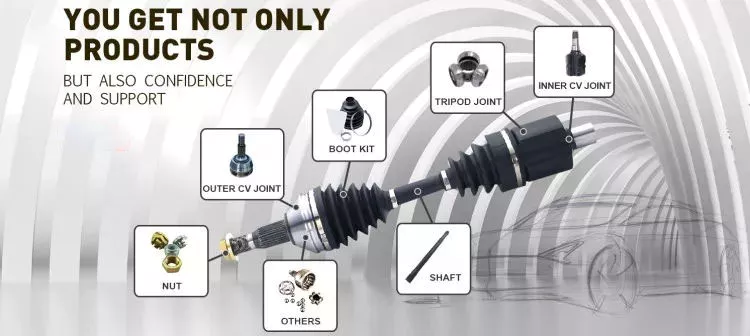
How do drive shafts ensure efficient power transfer while maintaining balance?
Drive shafts employ various mechanisms to ensure efficient power transfer while maintaining balance. Efficient power transfer refers to the ability of the drive shaft to transmit rotational power from the source (such as an engine) to the driven components (such as wheels or machinery) with minimal energy loss. Balancing, on the other hand, involves minimizing vibrations and eliminating any uneven distribution of mass that can cause disturbances during operation. Here’s an explanation of how drive shafts achieve both efficient power transfer and balance:
1. Material Selection:
The material selection for drive shafts is crucial for maintaining balance and ensuring efficient power transfer. Drive shafts are commonly made from materials such as steel or aluminum alloys, chosen for their strength, stiffness, and durability. These materials have excellent dimensional stability and can withstand the torque loads encountered during operation. By using high-quality materials, drive shafts can minimize deformation, flexing, and imbalances that could compromise power transmission and generate vibrations.
2. Design Considerations:
The design of the drive shaft plays a significant role in both power transfer efficiency and balance. Drive shafts are engineered to have appropriate dimensions, including diameter and wall thickness, to handle the anticipated torque loads without excessive deflection or vibration. The design also considers factors such as the length of the drive shaft, the number and type of joints (such as universal joints or constant velocity joints), and the use of balancing weights. By carefully designing the drive shaft, manufacturers can achieve optimal power transfer efficiency while minimizing the potential for imbalance-induced vibrations.
3. Balancing Techniques:
Balance is crucial for drive shafts as any imbalance can cause vibrations, noise, and accelerated wear. To maintain balance, drive shafts undergo various balancing techniques during the manufacturing process. Static and dynamic balancing methods are employed to ensure that the mass distribution along the drive shaft is uniform. Static balancing involves adding counterweights at specific locations to offset any weight imbalances. Dynamic balancing is performed by spinning the drive shaft at high speeds and measuring any vibrations. If imbalances are detected, additional adjustments are made to achieve a balanced state. These balancing techniques help minimize vibrations and ensure smooth operation of the drive shaft.
4. Universal Joints and Constant Velocity Joints:
Drive shafts often incorporate universal joints (U-joints) or constant velocity (CV) joints to accommodate misalignment and maintain balance during operation. U-joints are flexible joints that allow for angular movement between shafts. They are typically used in applications where the drive shaft operates at varying angles. CV joints, on the other hand, are designed to maintain a constant velocity of rotation and are commonly used in front-wheel-drive vehicles. By incorporating these joints, drive shafts can compensate for misalignment, reduce stress on the shaft, and minimize vibrations that can negatively impact power transfer efficiency and balance.
5. Maintenance and Inspection:
Regular maintenance and inspection of drive shafts are essential for ensuring efficient power transfer and balance. Periodic checks for wear, damage, or misalignment can help identify any issues that may affect the drive shaft’s performance. Lubrication of the joints and proper tightening of fasteners are also critical for maintaining optimal operation. By adhering to recommended maintenance procedures, any imbalances or inefficiencies can be addressed promptly, ensuring continued efficient power transfer and balance.
In summary, drive shafts ensure efficient power transfer while maintaining balance through careful material selection, thoughtful design considerations, balancing techniques, and the incorporation of flexible joints. By optimizing these factors, drive shafts can transmit rotational power smoothly and reliably, minimizing energy losses and vibrations that can impact performance and longevity.

Comment les arbres de transmission améliorent-ils les performances des automobiles et des camions ?
Les arbres de transmission jouent un rôle essentiel dans l'amélioration des performances des automobiles et des camions. Ils contribuent à divers aspects de ces performances, notamment la transmission de la puissance, la traction, la tenue de route et le rendement global. Voici une explication détaillée de la manière dont les arbres de transmission améliorent les performances des automobiles et des camions :
1. Alimentation électrique : Drive shafts are responsible for transmitting power from the engine to the wheels, enabling the vehicle to move forward. By efficiently transferring power without significant losses, drive shafts ensure that the engine’s power is effectively utilized, resulting in improved acceleration and overall performance. Well-designed drive shafts with minimal power loss contribute to the vehicle’s ability to deliver power to the wheels efficiently.
2. Transfert de couple : Les arbres de transmission permettent de transmettre le couple du moteur aux roues. Le couple est la force de rotation qui propulse le véhicule vers l'avant. Des arbres de transmission de haute qualité, dotés d'une capacité de conversion de couple optimale, garantissent une transmission efficace du couple généré par le moteur aux roues. Ceci améliore la capacité du véhicule à accélérer rapidement, à tracter des charges lourdes et à gravir des pentes abruptes, optimisant ainsi ses performances globales.
3. Traction et stabilité : Les arbres de transmission contribuent à la traction et à la stabilité des automobiles et des camions. Ils transmettent la puissance aux roues, leur permettant d'exercer une force sur la chaussée. Ceci permet au véhicule de maintenir son adhérence, notamment lors des accélérations ou sur des terrains glissants ou accidentés. La transmission efficace de la puissance par les arbres de transmission améliore la stabilité du véhicule en assurant une répartition équilibrée de la puissance sur toutes les roues, optimisant ainsi le contrôle et la maniabilité.
4. Maniabilité et maniabilité : Les arbres de transmission influent sur la tenue de route et la maniabilité des véhicules. Ils assurent une liaison directe entre le moteur et les roues, permettant un contrôle précis et une grande réactivité. Des arbres de transmission bien conçus, avec un jeu minimal, contribuent à une réponse plus directe et immédiate aux commandes du conducteur, améliorant ainsi l'agilité et la maniabilité du véhicule.
5. Réduction du poids : Les arbres de transmission contribuent à réduire le poids des automobiles et des camions. Fabriqués à partir de matériaux tels que l'aluminium ou les composites renforcés de fibres de carbone, ils diminuent le poids total du véhicule. Cette réduction de poids améliore le rapport poids/puissance, ce qui se traduit par une meilleure accélération, une maniabilité accrue et une consommation de carburant optimisée. De plus, les arbres de transmission légers réduisent la masse en rotation, permettant au moteur de monter en régime plus rapidement et d'améliorer ainsi ses performances.
6. Rendement mécanique : Les arbres de transmission performants minimisent les pertes d'énergie lors de la transmission de puissance. Grâce à des éléments tels que des roulements de haute qualité, des joints à faible friction et une lubrification optimisée, ils réduisent la friction et minimisent les pertes de puissance dues à la résistance interne. Ceci améliore le rendement mécanique de la transmission, permettant ainsi à une plus grande puissance d'atteindre les roues et d'optimiser les performances globales du véhicule.
7. Améliorations des performances : Drive shaft upgrades can be popular performance enhancements for enthusiasts. Upgraded drive shafts, such as those made from stronger materials or with enhanced torque capacity, can handle higher power outputs from modified engines. These upgrades allow for increased performance, such as improved acceleration, higher top speeds, and better overall driving dynamics.
8. Compatibilité avec les modifications de performance : Les modifications apportées aux performances, telles que la mise à niveau du moteur, l'augmentation de la puissance ou les modifications de la transmission, nécessitent souvent des arbres de transmission compatibles. Les arbres de transmission conçus pour supporter des couples plus élevés ou s'adapter aux configurations de transmission modifiées garantissent des performances et une fiabilité optimales. Ils permettent au véhicule d'exploiter efficacement la puissance et le couple accrus, ce qui améliore les performances et la réactivité.
9. Durabilité et fiabilité : Des arbres de transmission robustes et bien entretenus contribuent à la durabilité et à la fiabilité des automobiles et des camions. Ils sont conçus pour résister aux contraintes et aux charges liées à la transmission de puissance. Des matériaux de haute qualité, un équilibrage approprié et un entretien régulier garantissent le bon fonctionnement des arbres de transmission, minimisant ainsi les risques de pannes ou de problèmes de performance. Des arbres de transmission fiables améliorent les performances globales en assurant une transmission de puissance constante et en réduisant les temps d'arrêt.
10. Compatibilité avec les technologies avancées : Les arbres de transmission évoluent au rythme des progrès technologiques dans le secteur automobile. Ils sont de plus en plus intégrés à des systèmes avancés tels que les motorisations hybrides, les moteurs électriques et le freinage régénératif. Les arbres de transmission conçus pour fonctionner en parfaite synergie avec ces technologies optimisent leur efficacité et leurs performances, contribuant ainsi à l'amélioration globale du véhicule.
In summary, drive shafts enhance the performance of automobiles and trucks by optimizing power delivery, facilitating torque transfer, improving traction and stability, enhancing handling and maneuverability, reducing weight, increasing mechanical efficiency, enabling compatibility with performance upgrades and advanced technologies, and ensuring durability and reliability. They play a crucial role in ensuring efficient power transmission, responsive acceleration, precise handling, and overall improved performance of vehicles.

How do drive shafts contribute to transferring rotational power in various applications?
Drive shafts play a crucial role in transferring rotational power from the engine or power source to the wheels or driven components in various applications. Whether it’s in vehicles or machinery, drive shafts enable efficient power transmission and facilitate the functioning of different systems. Here’s a detailed explanation of how drive shafts contribute to transferring rotational power:
1. Vehicle Applications:
In vehicles, drive shafts are responsible for transmitting rotational power from the engine to the wheels, enabling the vehicle to move. The drive shaft connects the gearbox or transmission output shaft to the differential, which further distributes the power to the wheels. As the engine generates torque, it is transferred through the drive shaft to the wheels, propelling the vehicle forward. This power transfer allows the vehicle to accelerate, maintain speed, and overcome resistance, such as friction and inclines.
2. Machinery Applications:
In machinery, drive shafts are utilized to transfer rotational power from the engine or motor to various driven components. For example, in industrial machinery, drive shafts may be used to transmit power to pumps, generators, conveyors, or other mechanical systems. In agricultural machinery, drive shafts are commonly employed to connect the power source to equipment such as harvesters, balers, or irrigation systems. Drive shafts enable these machines to perform their intended functions by delivering rotational power to the necessary components.
3. Power Transmission:
Drive shafts are designed to transmit rotational power efficiently and reliably. They are capable of transferring substantial amounts of torque from the engine to the wheels or driven components. The torque generated by the engine is transmitted through the drive shaft without significant power losses. By maintaining a rigid connection between the engine and the driven components, drive shafts ensure that the power produced by the engine is effectively utilized in performing useful work.
4. Flexible Coupling:
One of the key functions of drive shafts is to provide a flexible coupling between the engine/transmission and the wheels or driven components. This flexibility allows the drive shaft to accommodate angular movement and compensate for misalignment between the engine and the driven system. In vehicles, as the suspension system moves or the wheels encounter uneven terrain, the drive shaft adjusts its length and angle to maintain a constant power transfer. This flexibility helps prevent excessive stress on the drivetrain components and ensures smooth power transmission.
5. Torque and Speed Transmission:
Drive shafts are responsible for transmitting both torque and rotational speed. Torque is the rotational force generated by the engine or power source, while rotational speed is the number of revolutions per minute (RPM). Drive shafts must be capable of handling the torque requirements of the application without excessive twisting or bending. Additionally, they need to maintain the desired rotational speed to ensure the proper functioning of the driven components. Proper design, material selection, and balancing of the drive shafts contribute to efficient torque and speed transmission.
6. Length and Balance:
The length and balance of drive shafts are critical factors in their performance. The length of the drive shaft is determined by the distance between the engine or power source and the driven components. It should be appropriately sized to avoid excessive vibrations or bending. Drive shafts are carefully balanced to minimize vibrations and rotational imbalances, which can affect the overall performance, comfort, and longevity of the drivetrain system.
7. Safety and Maintenance:
Drive shafts require proper safety measures and regular maintenance. In vehicles, drive shafts are often enclosed within a protective tube or housing to prevent contact with moving parts, reducing the risk of injury. Safety shields or guards may also be installed around exposed drive shafts in machinery to protect operators from potential hazards. Regular maintenance includes inspecting the drive shaft for wear, damage, or misalignment, and ensuring proper lubrication of the U-joints. These measures help prevent failures, ensure optimal performance, and extend the service life of the drive shaft.
In summary, drive shafts play a vital role in transferring rotational power in various applications. Whether in vehicles or machinery, drive shafts enable efficient power transmission from the engine or power source to the wheels or driven components. They provide a flexible coupling, handle torque and speed transmission, accommodate angular movement, and contribute to the safety and maintenance of the system. By effectively transferring rotational power, drive shafts facilitate the functioning and performance of vehicles and machinery in numerous industries.


editor by CX 2024-05-09























