
Navigating the Harsh Realities of Marine Propulsion
🛠️ From the Engineer’s Log: The Vibration at Southampton
“I recall recently inspecting a converted harbor tugboat in Southampton. The crew reported severe vibrations during bollard pull tests. The problem wasn’t with the engine or propeller itself, but with the intermediate shaft. The previous supplier hadn’t considered the ‘soft-foot’ nature of the flexible-mounted diesel engine. Under full load, the engine block tilted by nearly 8 millimeters, causing the universal joint to exceed its standard operating angle. We replaced it with a heavy-duty long-rail universal joint specifically designed for Z-drive misalignment. The effect was immediate: smoother operation, reduced bearing heat, and the crew could finally think clearly on the bridge. That’s why we place such importance on service factor.”
— Senior Technical Lead, UK pto-drive-shafts.com
Critical Application: Azimuth Thrusters (Z-Drives)
Azimuth thrusters are the standard for vessels requiring exceptional maneuverability, such as harbour tugs, Offshore Support Vessels (OSVs), and Dynamic Positioning (DP) drillships. The ability to rotate the propeller 360 degrees provides omnidirectional thrust, but it places unique demands on the driveline.
Mechanical Architecture & Transmission Path
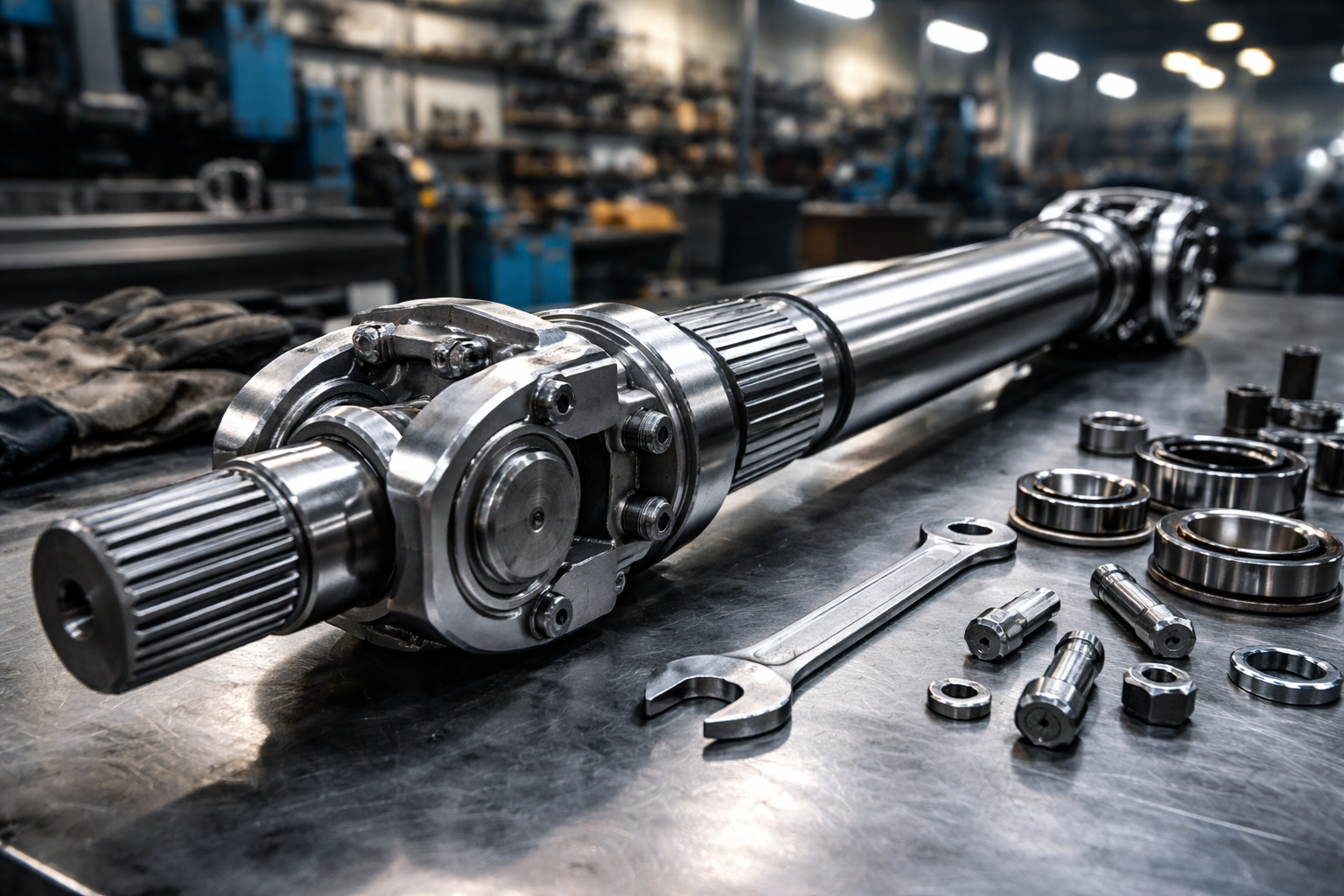
In a typical Z-drive configuration, the diesel engine or electric motor is mounted inside the hull. Power is transmitted horizontally to the upper gearbox of the propulsion unit via a long intermediate shaft. This shaft is often referred to as the intermediate drive shaft or a highly flexible universal joint assembly.
Specific Operational Conditions:
- Resiliently Mounted Engines: To comply with noise and vibration regulations (essential for crew comfort on 24/7 operations), modern engines sit on rubber isolators. Under full load, the engine block physically moves—tilting and shifting laterally.
- Rigidly Mounted Thrusters: The thruster well is welded directly to the hull structure, creating a rigid connection.
- Displacement Compensation: The cardan shaft must bridge the gap between the moving engine and the static thruster, absorbing dynamic relative displacements of ±10mm or more without transmitting destructive thrust loads to the bearings.
Dynamic Hull Deformation & Shaft Alignment
Vessels operating in British waters face enormous wave heights. As a vessel navigates through waves, its hull beams periodically sag and arch (vertical bending) as well as twist. For large offshore support vessels (OSVs), this deformation can cause changes of several millimeters in the distance between the engine and propeller.
Traditional rigid couplings cannot withstand such changes. Our industrial-grade universal joints utilize the Hooke’s joint principle to absorb these displacements. However, precise alignment is crucial to avoiding the effects of speed inconsistencies. We advocate for a “Z” or “W” configuration that keeps the input and output angles (β₁ and β₂) equal, thereby counteracting speed fluctuations.
Vibration Control & Classification Society Compliance
Marine propulsion systems are prone to torsional vibration. The periodic cylinder firing pressure of a diesel engine acts as an excitation source.
- Barred Speed Range (BSR): Classification societies like Lloyd’s Register (LR), DNV, and ABS have strict rules regarding prohibited resonance speed ranges.
- Rapid Passage: Shafts must be designed to withstand the transient high-cycle fatigue stresses encountered when passing through these resonance zones during startup and shutdown.
Key Technical Parameters for Marine Z-Drive Shafts
Our shafts are engineered to meet the rigorous demands of the UK marine sector. Below are the typical specifications for our heavy-duty marine series.
| Paramètre | Typical Value / Requirement |
|---|---|
| Rotational Speed Range | 750 – 1800 RPM (Adaptable for High-Speed Diesels) |
| Torque Capacity (Nominal) | 5 kNm – 100 kNm+ (Scalable for larger vessels) |
| Deflection Angle | 3° – 10° (Dynamic operational range) |
| Core Material | High-Strength Alloy Steel (e.g., 42CrMo4, Quenched & Tempered) |
| Service Factor (Shock Load) | > 1.5 (For Tugs/Ice-Class) to > 2.5 (Dredgers) |
| Norme d'équilibrage | ISO 1940 G6.3 or G2.5 (Precision Balanced) |
| Protection contre la corrosion | Marine Grade Paint (C5-M ISO 12944), Rilsan Coated Splines |
| Protection des cannelures | Maze Seals / Multi-lip Seals to prevent salt water ingress |
Local Relevance: Serving the UK Maritime Industry
From the offshore wind farms of the North Sea to the bustling container ports of Felixstowe, Southampton, and Liverpool, the UK maritime sector demands equipment that complies with stringent safety and environmental standards.
3.1 Compliance and Safety
Our shafts are manufactured to align with the requirements of the Merchant Shipping (Marine Equipment) Regulations. We work closely with marine architects to ensure our shaft calculations meet the torsional vibration analysis (TVA) requirements set forth by:
- Lloyd's Register (LR)
- DNV (Det Norske Veritas)
- ABS (American Bureau of Shipping)
Localized Challenges: The North Sea Environment
The corrosive atmosphere of the North Sea is classified as C5-M (Marine) under ISO 12944. Standard drive shafts will fail rapidly due to spline seizure caused by rust. Our shafts for the UK market feature:
- Rilsan® Coated Splines: A specialized nylon coating that reduces friction and prevents fretting corrosion, essential for shafts that remain idle in salty air.
- Multi-Layer Coating System: Zinc-rich primers and epoxy intermediates achieving a Dry Film Thickness (DFT) exceeding 320 microns.
Solutions to Common Marine Propulsion Pain Points
Pain Point 1: Premature Spline Wear
Scenario: High-frequency vibration from the propeller feedback causes fretting corrosion in the sliding splines.
Notre solution : We utilize Oil-Bath Lubrication or specialized Molybdenum Disulfide (MoS2) coatings on the spline teeth to maintain a lubrication film even under micro-movements.
Pain Point 2: Installation Misalignment
Scenario: Difficult access in the hull makes perfect alignment impossible, leading to vibration.
Notre solution : Our Floating Shaft Designs utilize flanges for self-centering but allow for calculated misalignment. We also provide laser alignment support services to ensure the phase angles are complementary .
Pain Point 3: Shock Loads from Debris
Scenario: A tug propeller strikes submerged debris.
Notre solution : Our shafts act as a mechanical fuse but are built with high Shock Torque Capacity. For extreme applications (like Dredgers), we can integrate Shear Pin Couplings to sacrifice a cheap pin rather than the expensive gearbox.
Comprehensive Drivetrain Solutions: Marine Gearboxes
The efficiency of a driveshaft depends on the gearbox it is connected to. UK pto-drive-shafts.com specializes in providing high-performance marine gearboxes compatible with your propulsion systems.
Whether you need a reduction gearbox for a low-speed propeller or a booster gearbox for a power take-off shaft driving a fire pump (FiFi system), our gearboxes are perfectly matched to our shafting systems for optimal efficiency. We offer:
- Planetary Reduction Gears: Compact, high-torque density for Z-drive azimuth units.
- Pump Drive Gearboxes: For dredging pumps and hydraulic power packs.
- Custom ratios: To match specific engine RPMs to propeller efficiency curves.
Integrating our shafts with our gearboxes ensures a single point of responsibility for the drivetrain’s vibration performance.
Frequently Asked Questions (FAQ)
Q: Can you retrofit a shaft for an older tugboat built in the 1990s?
A: Yes. We specialize in reverse engineering. If you provide the flange dimensions (DIN/SAE) and the compressed/extended lengths, we can fabricate a drop-in replacement that meets modern material standards.
Q: Do your shafts come with class certification?
A: We can provide 3.1 or 3.2 material certificates and coordinate with surveyors from Lloyd’s, DNV, or BV to witness testing and issue class certificates upon request.
Q: What is the lead time for a custom Z-drive shaft in the UK?
A: For standard flange sizes, we can often assemble within 3-4 weeks. Emergency replacements for grounded vessels can be expedited.
Clause de non-responsabilité: UK pto-drive-shafts.com Co., Ltd. is an independent manufacturer of aftermarket and OEM-equivalent arbres de transmission. References to other manufacturers such as GKN, Voith, Centa, Spicer, or their part numbers are for identification and compatibility comparison purposes only. We are not affiliated with, endorsed by, or sponsored by these brands.
Ready to Optimize Your Marine Propulsion?
Don’t let vibration or corrosion compromise your vessel’s safety. Contact our engineering team in Suffolk for a technical assessment.
UK pto-drive-shafts.com Co., Ltd.
Adresse : Bury St Edmunds, Suffolk IP32 7LX, Royaume-Uni
E-mail: [email protected]























