
Description du produit
Description du produit
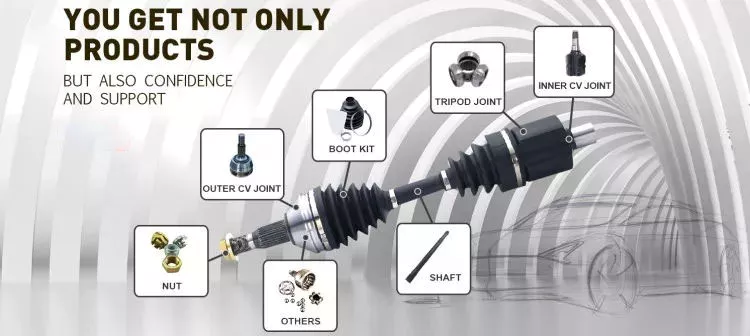
| Item Name | Drive shaft/ C.V Joint/ C.V Boot Cover 95% Japanese Car Model |
| Car model | For Toyota,Honda,Nissan,Mitsubishi,Mazda,Hyundai,Kia,Subaru |
| Marque | EEP |
| Qty/Box | 1 PC/Box |
| MOQ | 4PCS |
| Garantie | 1 Year/30,000-60,000Kilometers |
| Packing | EEP poly bag + CZPT color box+EEP Carton or customized packing |
| Payment | T/T, Western Union, L/C, Cash |
| Delivery | 1-7 days for stock items, 7-25 days for production order |
| Shipment | by DHL/ FEDEX/ TNT, by Air, by sea |
| Certificat | ISO9001, TS16949, SGS |
Detailed Photos
Product Specification:
| Constant velocity universal joint special steel CF53 | Normalization treatment to refine the internal structure of the material and greatly improve the performance of the C.V Joint. |
| C.V Boot | Imported neoprene to ensure of its hardness, high or low temperature test (-40 ºC –120 ºC) and high performance for elongation. |
| 1CR13 Clamp | Adopted 1CR13 martensitic stainless steel with high strength and strong corrosion resistance. |
| Molybdenum Disulfide Grease | Ample grease, operating efficiently under -40 ° C ~ 150 ° C temperature, effectively reduce metal wear by its excellent wear resistance and extend products’ service life by strong anti-aging performance. |
EEP Auto Parts CO., Ltd main products line:
1. Auto rubber bushing: engine mount, strut mount, center bearing, differential mount, control arm bushing, stabilizer bushing, other suspension bushing
2. Suspension Parts: shock absorber, control arm, ball joint,stabilizer link, tie rod end, steering rack
3. CV joint, drive shaft, cv joint boot
4. Brake parts: brake pads, brake disc, brake master cylinder, wheel cylinder
5. Fuel pump, water pump, radiator, gasket kit, engine belt
Our Advantages
Advantages of Service:
• OEM & ODM Availability
• Years of cooperation with global top brand companies
• 100% performance test before delivery
• 10000+ part numbers
• Storage sales: NO MOQ
• Punctual delivery date & shorter lead time
• Positive customer testimonials from 108 countries
• Complete products range
Certifications
Profil de l'entreprise
Exhibition Show:
We attend professional auto parts trade fair to promote our products. A great many of customers would come to our booth, show interest in our products and are willing to try our products. Trial order to test quality is warmly welcomed too!
EEP Auto Parts CO., Ltd company profile:
EEP AUTO PARTS CO., LTD, established in 1995, has been specializing in manufacturing and selling suspension parts for Japanese cars with 27 years experience. EEP AUTO PARTS has developed more than 8000 different OEM codes for Toyota, Honda, Nissan, Mitsubishi, Mazda and Subaru including shock absorber, ball joint, stabilizer link, tie rod end, rack end, control arm, bushing and mounting. We have been committed to providing high efficiency, quality guaranteed, long durability auto parts to our customers. Until now CZPT Auto Parts CO., Ltd owns 3 branch companiese which are respectively located in HangZhou, Urumchi and ZheJiang . Each branch is in charge of different markets in order to meet customers’ needs in different countries, total warehouse covering area 31,600 square meters,thus, we are able to deliver goods to you promptly.
FAQ
| Service après-vente : | Standard |
|---|---|
| Condition: | Nouveau |
| Couleur: | Silver, Black |
| Certification: | CE, ISO |
| Taper: | Arbre de transmission |
| Application Brand: | Nissan, Toyota, Ford, Honda Mitsubishi Mazda Benz |
| Personnalisation : |
Disponible
| Demande personnalisée |
|---|
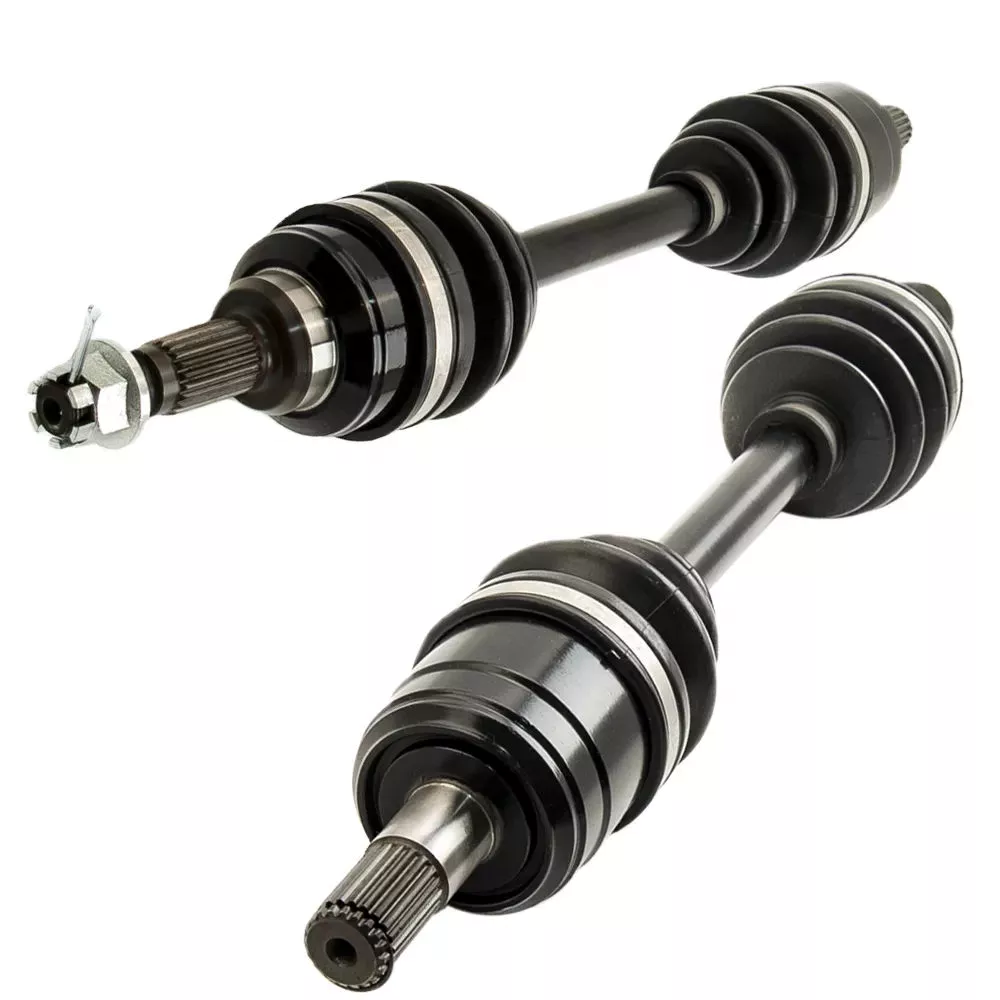
How do drive shafts ensure efficient power transfer while maintaining balance?
Drive shafts employ various mechanisms to ensure efficient power transfer while maintaining balance. Efficient power transfer refers to the ability of the drive shaft to transmit rotational power from the source (such as an engine) to the driven components (such as wheels or machinery) with minimal energy loss. Balancing, on the other hand, involves minimizing vibrations and eliminating any uneven distribution of mass that can cause disturbances during operation. Here’s an explanation of how drive shafts achieve both efficient power transfer and balance:
1. Material Selection:
The material selection for drive shafts is crucial for maintaining balance and ensuring efficient power transfer. Drive shafts are commonly made from materials such as steel or aluminum alloys, chosen for their strength, stiffness, and durability. These materials have excellent dimensional stability and can withstand the torque loads encountered during operation. By using high-quality materials, drive shafts can minimize deformation, flexing, and imbalances that could compromise power transmission and generate vibrations.
2. Design Considerations:
The design of the drive shaft plays a significant role in both power transfer efficiency and balance. Drive shafts are engineered to have appropriate dimensions, including diameter and wall thickness, to handle the anticipated torque loads without excessive deflection or vibration. The design also considers factors such as the length of the drive shaft, the number and type of joints (such as universal joints or constant velocity joints), and the use of balancing weights. By carefully designing the drive shaft, manufacturers can achieve optimal power transfer efficiency while minimizing the potential for imbalance-induced vibrations.
3. Balancing Techniques:
Balance is crucial for drive shafts as any imbalance can cause vibrations, noise, and accelerated wear. To maintain balance, drive shafts undergo various balancing techniques during the manufacturing process. Static and dynamic balancing methods are employed to ensure that the mass distribution along the drive shaft is uniform. Static balancing involves adding counterweights at specific locations to offset any weight imbalances. Dynamic balancing is performed by spinning the drive shaft at high speeds and measuring any vibrations. If imbalances are detected, additional adjustments are made to achieve a balanced state. These balancing techniques help minimize vibrations and ensure smooth operation of the drive shaft.
4. Universal Joints and Constant Velocity Joints:
Drive shafts often incorporate universal joints (U-joints) or constant velocity (CV) joints to accommodate misalignment and maintain balance during operation. U-joints are flexible joints that allow for angular movement between shafts. They are typically used in applications where the drive shaft operates at varying angles. CV joints, on the other hand, are designed to maintain a constant velocity of rotation and are commonly used in front-wheel-drive vehicles. By incorporating these joints, drive shafts can compensate for misalignment, reduce stress on the shaft, and minimize vibrations that can negatively impact power transfer efficiency and balance.
5. Maintenance and Inspection:
Regular maintenance and inspection of drive shafts are essential for ensuring efficient power transfer and balance. Periodic checks for wear, damage, or misalignment can help identify any issues that may affect the drive shaft’s performance. Lubrication of the joints and proper tightening of fasteners are also critical for maintaining optimal operation. By adhering to recommended maintenance procedures, any imbalances or inefficiencies can be addressed promptly, ensuring continued efficient power transfer and balance.
In summary, drive shafts ensure efficient power transfer while maintaining balance through careful material selection, thoughtful design considerations, balancing techniques, and the incorporation of flexible joints. By optimizing these factors, drive shafts can transmit rotational power smoothly and reliably, minimizing energy losses and vibrations that can impact performance and longevity.
Comment les arbres de transmission gèrent-ils les variations de charge et de vibrations en fonctionnement ?
Les arbres de transmission sont conçus pour supporter les variations de charge et de vibrations en fonctionnement grâce à divers mécanismes et caractéristiques. Ces mécanismes contribuent à assurer une transmission de puissance fluide, à minimiser les vibrations et à préserver l'intégrité structurelle de l'arbre de transmission. Voici une explication détaillée du fonctionnement des arbres de transmission face aux variations de charge et de vibrations :
1. Sélection et conception des matériaux :
Les arbres de transmission sont généralement fabriqués à partir de matériaux à haute résistance et rigidité, tels que les alliages d'acier ou les matériaux composites. Le choix des matériaux et la conception tiennent compte des charges prévues et des conditions de fonctionnement de l'application. Grâce à l'utilisation de matériaux appropriés et à l'optimisation de la conception, les arbres de transmission peuvent supporter les variations de charge attendues sans subir de déformation excessive.
2. Capacité de couple :
Les arbres de transmission sont conçus pour supporter un couple spécifique adapté aux charges prévues. Ce couple tient compte de facteurs tels que la puissance de la source d'entraînement et les besoins en couple des composants entraînés. En choisissant un arbre de transmission doté d'un couple suffisant, on peut absorber les variations de charge sans dépasser ses limites et risquer ainsi une panne ou un dommage.
3. Équilibrage dynamique :
Lors de la fabrication, les arbres de transmission peuvent subir un équilibrage dynamique. Un déséquilibre de l'arbre peut engendrer des vibrations en fonctionnement. Le processus d'équilibrage consiste à ajouter ou retirer stratégiquement des masses afin d'assurer une rotation régulière de l'arbre et de minimiser les vibrations. L'équilibrage dynamique contribue à atténuer les effets des variations de charge et réduit le risque de vibrations excessives.
4. Amortisseurs et contrôle des vibrations :
Les arbres de transmission peuvent intégrer des amortisseurs ou des mécanismes de contrôle des vibrations afin de minimiser davantage ces dernières. Ces dispositifs sont généralement conçus pour absorber ou dissiper les vibrations pouvant résulter de variations de charge ou d'autres facteurs. Les amortisseurs peuvent prendre la forme d'amortisseurs de torsion, d'isolateurs en caoutchouc ou d'autres éléments absorbant les vibrations, placés stratégiquement le long de l'arbre de transmission. En gérant et en atténuant les vibrations, les arbres de transmission garantissent un fonctionnement fluide et améliorent les performances globales du système.
5. Joints homocinétiques :
Les joints homocinétiques sont fréquemment utilisés dans les arbres de transmission pour compenser les variations d'angles de fonctionnement et maintenir une vitesse constante. Ils permettent à l'arbre de transmission de transmettre la puissance même lorsque les composants menant et mené sont inclinés différemment. En compensant ces variations d'angles, les joints homocinétiques contribuent à minimiser l'impact des variations de charge et à réduire les vibrations potentielles dues aux modifications de la géométrie de la transmission.
6. Lubrification et entretien :
Une lubrification adéquate et un entretien régulier sont essentiels pour que les arbres de transmission supportent efficacement les variations de charge et de vibrations. La lubrification contribue à réduire le frottement entre les pièces mobiles, minimisant ainsi l'usure et la production de chaleur. Un entretien régulier, comprenant l'inspection et la lubrification des joints, garantit le maintien de l'arbre de transmission en parfait état, réduisant ainsi le risque de panne ou de dégradation des performances due aux variations de charge.
7. Rigidité structurelle :
Les arbres de transmission sont conçus pour présenter une rigidité structurelle suffisante afin de résister aux forces de flexion et de torsion. Cette rigidité contribue à préserver l'intégrité de l'arbre de transmission face aux variations de charge. En minimisant la déformation et en maintenant son intégrité structurelle, l'arbre de transmission peut transmettre efficacement la puissance et supporter les variations de charge sans compromettre ses performances ni générer de vibrations excessives.
8. Systèmes de contrôle et rétroaction :
Dans certaines applications, les arbres de transmission peuvent être équipés de systèmes de contrôle qui surveillent et ajustent en temps réel des paramètres tels que le couple, la vitesse et les vibrations. Ces systèmes utilisent des capteurs et des mécanismes de rétroaction pour détecter les variations de charge ou de vibrations et effectuer des ajustements en temps réel afin d'optimiser les performances. En gérant activement les variations de charge et les vibrations, les arbres de transmission peuvent s'adapter aux conditions de fonctionnement changeantes et assurer un fonctionnement régulier.
En résumé, les arbres de transmission supportent les variations de charge et de vibrations en fonctionnement grâce à une sélection et une conception rigoureuses des matériaux, à la prise en compte du couple admissible, à un équilibrage dynamique, à l'intégration d'amortisseurs et de mécanismes de contrôle des vibrations, à l'utilisation de joints homocinétiques, à une lubrification et un entretien appropriés, à une rigidité structurelle et, dans certains cas, à des systèmes de contrôle et de rétroaction. L'intégration de ces caractéristiques et mécanismes garantit une transmission de puissance fiable et efficace tout en minimisant l'impact des variations de charge et des vibrations sur les performances globales du système.

What is a drive shaft and how does it function in vehicles and machinery?
A drive shaft, also known as a propeller shaft or prop shaft, is a mechanical component that plays a critical role in transmitting rotational power from the engine to the wheels or other driven components in vehicles and machinery. It is commonly used in various types of vehicles, including cars, trucks, motorcycles, and agricultural or industrial machinery. Here’s a detailed explanation of what a drive shaft is and how it functions:
1. Definition and Construction: A drive shaft is a cylindrical metal tube that connects the engine or power source to the wheels or driven components. It is typically made of steel or aluminum and consists of one or more tubular sections with universal joints (U-joints) at each end. These U-joints allow for angular movement and compensation of misalignment between the engine/transmission and the driven wheels or components.
2. Power Transmission: The primary function of a drive shaft is to transmit rotational power from the engine or power source to the wheels or driven components. In vehicles, the drive shaft connects the transmission or gearbox output shaft to the differential, which then transfers power to the wheels. In machinery, the drive shaft transfers power from the engine or motor to various driven components such as pumps, generators, or other mechanical systems.
3. Torque and Speed: The drive shaft is responsible for transmitting both torque and rotational speed. Torque is the rotational force generated by the engine or power source, while rotational speed is the number of revolutions per minute (RPM). The drive shaft must be capable of transmitting the required torque without excessive twisting or bending and maintaining the desired rotational speed for efficient operation of the driven components.
4. Flexible Coupling: The U-joints on the drive shaft provide a flexible coupling that allows for angular movement and compensation of misalignment between the engine/transmission and the driven wheels or components. As the suspension system of a vehicle moves or the machinery operates on uneven terrain, the drive shaft can adjust its length and angle to accommodate these movements, ensuring smooth power transmission and preventing damage to the drivetrain components.
5. Length and Balance: The length of the drive shaft is determined by the distance between the engine or power source and the driven wheels or components. It should be appropriately sized to ensure proper power transmission and avoid excessive vibrations or bending. Additionally, the drive shaft is carefully balanced to minimize vibrations and rotational imbalances, which can cause discomfort, reduce efficiency, and lead to premature wear of drivetrain components.
6. Safety Considerations: Drive shafts in vehicles and machinery require proper safety measures. In vehicles, drive shafts are often enclosed within a protective tube or housing to prevent contact with moving parts and reduce the risk of injury in the event of a malfunction or failure. Additionally, safety shields or guards are commonly installed around exposed drive shafts in machinery to protect operators from potential hazards associated with rotating components.
7. Maintenance and Inspection: Regular maintenance and inspection of drive shafts are essential to ensure their proper functioning and longevity. This includes checking for signs of wear, damage, or excessive play in the U-joints, inspecting the drive shaft for any cracks or deformations, and lubricating the U-joints as recommended by the manufacturer. Proper maintenance helps prevent failures, ensures optimal performance, and prolongs the service life of the drive shaft.
In summary, a drive shaft is a mechanical component that transmits rotational power from the engine or power source to the wheels or driven components in vehicles and machinery. It functions by providing a rigid connection between the engine/transmission and the driven wheels or components, while also allowing for angular movement and compensation of misalignment through the use of U-joints. The drive shaft plays a crucial role in power transmission, torque and speed delivery, flexible coupling, length and balance considerations, safety, and maintenance requirements. Its proper functioning is essential for the smooth and efficient operation of vehicles and machinery.


editor by CX 2023-09-21























