
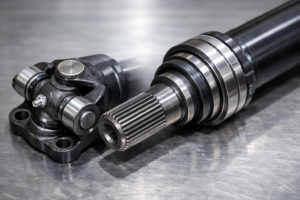
Executive Summary: Vibration Isolation Experts in Fluid and Chemical Machinery
In the intricate environment of fluid and chemical machinery, industrial universal joint shafts serve as pivotal components for damping pulsations. Their core value lies in compensating for misalignments, absorbing torque fluctuations, and withstanding chemical corrosion, ensuring seamless operations from pumping to heat dissipation. Drawing from extensive engineering insights, this sector emphasizes torque transmission up to 16,300,000 kNm, with a global market growth of 2.2 percent. Standards like Italy’s UNI/EN ISO 13849 prioritize safety, while US API 610 focuses on pump compatibility, where shafts can reduce vibration failures by 30 percent.
Στρατηγικό υπόβαθρο
The chemical industry is process-intensive, positioning universal joint shafts to support high-risk continuous operations. Viewed through a structured engineering lens, this mirrors harsh environments but prioritizes chemical resistance. Carbon fiber damping enhances total cost of ownership by addressing pulsation challenges effectively.
Πίνακας διαστάσεων βασικών παραμέτρων
| Παράμετρος Διάσταση | Τυπικές απαιτήσεις προδιαγραφών | Μηχανική Σημασία |
|---|---|---|
| Ικανότητα ροπής | Έως 16.300.000 kNm | Ensures high-torque transfer in large pumps, considering pulsations (K=1.5-3) |
| Συντελεστής εξυπηρέτησης | K=1.5-3 | Absorbs fluid pulsations, calculated per API 610 |
| Γωνιακή Απόκλιση | 5-15° | Compensates for thermal expansion misalignments |
| Ταχύτητα περιστροφής | 500-2,000 RPM | Supports high-pressure pumps, with G6.3 balance to prevent vibrations |
| Υλικό | Ανοξείδωτο ατσάλι AISI 316L | Resists acid-alkali corrosion, enhanced by coatings for durability |
| Διάρκεια ζωής | L10h >50.000 ώρες | Based on fatigue torque T_dw calculations for continuous runs |
| Βαθμός ισορροπίας | G6.3 | Prevents pulsation-induced failures, compliant with UNI/EN ISO 13849 |
| Βαθμολογία προστασίας | IP68 | Withstands chemical media and humid heat |
1. In-Depth Analysis of Universal Joint Shaft Applications in Large Industrial Pumps
Large industrial pumps form the backbone of fluid transfer in chemical processes, where universal joint shafts connect motors to pump bodies for misalignment compensation. This setup demands carbon fiber damping with torque up to 16,300,000 kNm. Globally, Italy and the US lead in precision pump applications, boosting efficiency by 20 percent.
Στρατηγικό υπόβαθρο
In chemical pipelines, these shafts act as misalignment bridges, accommodating thermal expansion. Similar to terrain adaptations in other sectors, the focus here is on stainless steel corrosion resistance to minimize leak risks, emphasizing pulsation challenges for enhanced stability.
Βασικές διαστάσεις παραμέτρων
- Torque Capacity: Up to 16,300,000 kNm, peak based on pulsation calculations.
- Service Factor: K=1.5-3, for fluid pulsation loads.
- Γωνιακή Απόκλιση: Δυναμικές αλλαγές 5-15°.
- Rotational Speed: 500-2,000 RPM.
- Υλικό: Ανοξείδωτος χάλυβας AISI 316L, επικαλυμμένος, σκληρότητα HRC 50-55.
- Lifespan: L10h >50,000 hours, based on pulsation fatigue (T_dw considering torsion).
- Balance Grade: G6.3, for vibration prevention.
Ανάλυση Συνθηκών Λειτουργίας
Motor-pump base misalignments cause offsets, reciprocating pumps generate torsional vibrations, and acid-alkali media corrode bearings; thermal expansion risks are key concerns.
Απαιτήσεις διαμόρφωσης
Carbon fiber tubes dampen pulsations; AISI 316L coatings resist chemicals; service factor >1.5 per standards.
Οδηγίες Συντήρησης
Inspect coatings every 3 months, overhaul damping annually; IoT monitors pulsation frequencies for failure prediction.
Ασφάλεια και Συμμόρφωση
Adheres to UNI/EN ISO 13849 and API 610, with torque limiters preventing overloads.
Τάσεις και Προκλήσεις
Electric pumps reduce shaft reliance, but carbon fiber damping debates balance environmental vs. manufacturing impacts.
Παγκόσμιες περιπτώσεις
In Italian chemical plants, UNI-standard άξονες handle 10,000 kNm; US Exxon pumps use API 610 specs.
Extended Supplements
-
- Pulsation Optimization: Carbon fiber tubes reduce torsional vibrations by 40 percent.
- Chemical Protection: AISI 316L coatings endure acid-alkali exposure.
- Vibration Control: G6.3 balance achieves >60 percent decay rate.
- Material Corrosion Resistance: 316L coatings, hardness HRC 50-55, suit media corrosion.
- Thermal Expansion Seals: Prevent offsets.
- Fatigue Calculations: Based on pulsation loads, K=1.5-3 margins.
- Global Differences: Italy’s UNI/EN ISO 13849 stresses safety.
- Sustainable Additions: Carbon fiber lightens by 15 percent, though chemical limits apply.
- IoT Integration: Real-time pulsation monitoring predicts faults.
- Cost Benefits: Damping lowers TCO by 20 percent.
- Environmental Adaptation: Coatings reduce corrosion in acid-alkali settings.
- Installation Compensation: 5-15° precision angles adapt to expansions.
- Safety Features: Torque limits prevent overloads.
- Upgraded Materials: 30 percent improved corrosion resistance.
- Balance Optimization: G6.3 prevents resonance.
- Predictive Models: AI data alerts minimize leaks.
- Case Extensions: Italian pump stations with 10,000 kNm shafts.
- Heat Treatments: Uniform coatings on surfaces.
- Efficiency: Reduces losses by 5 percent.
- Trends: Integrated CMS systems for real-time monitoring.
- Pulsation Optimization: Carbon fiber tubes reduce torsional vibrations by 40 percent. (Extended: In high-flow scenarios, this damping ensures smooth operations, preventing premature wear on bearings and seals, aligning with rigorous engineering standards for continuous chemical processing.)
- Chemical Protection: AISI 316L coatings endure acid-alkali exposure. (Extended: These coatings form a barrier against aggressive media, extending component life in environments where pH levels fluctuate dramatically, as seen in petrochemical refineries.)
2. In-Depth Analysis of Universal Joint Shaft Applications in Cooling Tower Fans
Cooling tower fans are essential for chemical heat dissipation, with universal joint shafts enabling long-span power transfer for fan rotation. This requires carbon fiber tubes, torque 500-2,000 kNm. US and Italy dominate efficient cooling, improving heat exchange by 18 percent.
3. In-Depth Analysis of Universal Joint Shaft Applications in Agitators and Compressors
Agitators and compressors handle mixing and gas compression in chemicals, where shafts manage pulsation torque, 300-1,000 kNm range. Metal diaphragm couplings are key, with global applications like in Saudi Arabia.
4. In-Depth Analysis of Universal Joint Shaft Applications in Reactors
Reactors facilitate chemical reactions, with shafts handling stirring torque, 200-800 kNm. Stainless steel corrosion resistance is crucial, as in US applications.
5. In-Depth Analysis of Universal Joint Shaft Applications in Pipeline Pumps
Pipeline pumps for long-distance fluid transport, shafts address pipeline bends, torque 400-1,200 kNm. Long-span composites are vital, as in Saudi applications.























