
Produktbeschreibung
As a professional manufacturer for propeller shaft, we have +800 items for all kinds of car, main suitable
for AMERICA & EUROPE market.
Our advantage:
1. Full range of products
2. MOQ qty: 5pcs/items
3. Delivery on time
4: Warranty: 1 YEAR
5. Develope new items: FREE
|
Markenname |
KOWA DRIVE SHAFT |
|
Item name |
OEM |
|
Car maker |
For all japanese/korean/european/american car |
|
Moq |
5pcs |
|
Guarantee |
12 months |
|
sample |
Available if have stock |
|
Price |
Send inquiry to get lastest price |
|
BOX/QTY |
1PCS/Bag 4PCS /CTNS |
For some items, we have stock, small order (+3000USD) is welcome.
The following items are some of drive shafts, If you need more information, pls contact us for ASAP.
| For Japanese Car | |||
| for TOYOTA | for TOYOTA | ||
| 43420-57170 | 43420-57180 | 43410-0W081 | 43420-0W080 |
| 43410-57120 | 43420-57190 | 43410-0W091 | 43420-0W090 |
| 43410-57130 | 43420-57120 | 43410-0W100 | 43420-0W110 |
| 43410-57150 | 43420-02B10 | 43410-0W110 | 43420-0W160 |
| 43410-06221 | 43420-02B11 | 43410-0W140 | 43420-32161 |
| 43410-06231 | 43420-02B60 | 43410-0W150 | 43420-33250 |
| 43410-06460 | 43420-02B61 | 43410-0W180 | 43420-33280 |
| 43410-06570 | 43420-02B62 | 43410-12410 | 43420-48090 |
| 43410-06580 | 43420-06221 | 43410-33280 | 43420-48091 |
| 43410-066-90 | 43420-06231 | 43410-33290 | 43430OK571 |
| 43410-06750 | 43420-06460 | 43410-33330 | 66-5245 |
| 43410-06780 | 43420-06490 | 43410-48070 | 66-5247 |
| 43410-06A40 | 43420-06500 | 43410-48071 | 43420-57150 |
| 43410-06A50 | 43420- 0571 0 | 43410-0W061 | 43420-0W061 |
| 43410-07070 | 43420-06610 | 43410-0W071 | 43420-0W071 |
| for Acura | for LEXUS | ||
| 44305STKA00 | 66-4198 | 43410-06200 | 43410-06480 |
| 44305STKA01 | 66-4261 | 43410-06450 | 43410-06560 |
| 44305SZPA00 | 66-4262 | 66-5265 | |
| 44306STKA00 | 66-4270 | for MITSUBISHI | |
| 44306STKA01 | 66-4271 | 3815A309 | 3815A310 |
| 44306SZPA00 | |||
| for Honda | for MAZDA | ||
| 44571S1571 | 44306S3VA61 | 5L8Z3A428AB | GG052550XD |
| 44011S1571 | 44306S3VA62 | 5L8Z3A428DA | GG052560XE |
| 44305S2HN50 | 44306S9VA51 | 66-2090 | GG362550XA |
| 44305SCVA50 | 44306S9VA71 | 6L8Z3A428A | YL8Z3A427AA |
| 44305SCVA51 | 44306SCVA50 | 9L8Z3A427B | YL8Z3A427BA |
| 44305SCVA90 | 44306SCVA51 | GG032550XD | YL8Z3A428AA |
| 44305SCVA91 | 44306SCVA90 | GG042550XD | YL8Z3A428BA |
| 44305STXA02 | 44306SCVA91 | GG042560XG | ZC32550XA |
| 44305SZAA01 | 44306STXA02 | ||
| 44306S2H951 | 44306SZAA01 | ||
| 44306SZAA11 | 44306SZAA01RM | ||
| 44306SZAA12 | 66-4213 | ||
| 66-4214 | |||
| for Europe Car | |||
| for VOLKSWAGEN | for VOLKSWAGEN | ||
| 4885712AD | 7B0407271B | 7E0407271G | 7LA407272C |
| 4885713AF | 7B0407272 | 7E0407271P | 7LA4 0571 2CX |
| 4881214AE | 7B0407272E | 7LA407271E | |
| 7B0407271A | |||
| for America Car | |||
| for CHRYSLER | for MERCURY | ||
| 4593447AA | 557180AD | 4F1Z3B437AA | GG322560X |
| 4641855AA | 52114390AB | 5L8Z3A428DB | GG362560XA |
| 4641855AC | 5273546AC | 66-2249 | YL8Z3A427CA |
| 4641856AA | 66-3108 | 9L8Z3A427C | YL8Z3A427DA |
| 4641856AC | 66-3109 | 9L8Z3A427D | YL8Z3A427EA |
| 4882517 | 66-3130 | GG062550XD | YL8Z3A427FA |
| 4882518 | 66-3131 | GG062560XE | YL8Z3A428CA |
| 4882519 | 66-3234 | GG312560X | ZZDA2560X |
| 4882520 | 66-3518 | ZZDA2560XC | ZZDA2560XA |
| 557130AB | 66-3520 | for RAM | |
| 66-3552 | 66-3522 | 4885713AD | 55719AB |
| 66-3553 | 66-3551 | 4881214AD | 66-3404 |
| 66-3554 | 66-3639 | 55719AA | 66-3740 |
| 68193908AB | 66-3641 | 68571398AA | |
| for FORD | for DODGE | ||
| 1F0571400 | E6DZ3V428AARM | 4593449AA | 7B0407272A |
| 1F0571410 | E8DZ3V427AARM | 4641855AE | 7B0407272B |
| 1F2Z3B436AA | E8DZ3V428AARM | 4641855EE | 7B0407272C |
| 2F1Z3A428CA | E90Y3V427AARM | 4641856AD | R4881214AE |
| 2M5Z3B437CA | E90Y3V428AARM | 4641856AF | RL189279AA |
| 4F1Z3B437BA | F0DZ3V427AARM | 4885710AC | 557180AG |
| 5M6Z3A428AA | F0DZ3V428AARM | 4885710AE | 5170822AA |
| 5S4Z3B437AA | F21Z3B437A | 4885710AF | 52114390AA |
| 66-2005 | F21Z3B437B | 4885710AG | 5273546AD |
| 66-2008 | F2DZ3B436A | 4885711AC | 5273546AE |
| 66-2571 | F2DZ3B436B | 4885711AD | 5273546AF |
| 66-2084 | F2DZ3B437A | 4885712AC | 5273558AB |
| 66-2086 | F2DZ3B437B | 4885712AE | 5273558AD |
| 66-2095 | F4DZ3B437A | 4885712AG | 5273558AE |
| 66-2101 | F57Z3B436BA | 4885712AH | 5273558AF |
| 66-2143 | F57Z3B437BA | 4885713AC | 4881214AC |
| 6S4Z3B437BA | F5DZ3A427BA | 4885713AG | 4881214AF |
| 8S4Z3B437A | F5DZ3A428AS | 4885713AI | 4881214AG |
| 9L8Z3A427A | F5DZ3B426D | 4885713AJ | 557130AA |
| E6DZ3V427AARM | F5DZ3B436D | 5273558AG | 557180AE |
| YF1Z3A428RS | F5DZ3B437B | 66-3382 | 557180AF |
| YL8Z3A428DA | F5TZ3B436A | 66-3511 | 66-3514 |
| YS4Z3B437BB | GG032560XG | 66-3759 | 66-3564 |
| YS4Z3B437CB | GG362550X | ||
| YF1Z3A427L | |||
| for CHEVROLET | for JEEP | ||
| 257191 | 26062613 | 4578885AA | 5215710AA |
| 22791460 | 4578885AB | 5215711AB | |
| 26011961 | 4578885AC | 5215711AB | |
| 26571730 | 2657189 | 4720380 | 5273438AC |
| 2657165 | 66-1401 | 4720381 | 5273438AD |
| 26058932 | 66-1438 | 5012456AB | 5273438AE |
| 26065719 | 88982496 | 5012457AB | 5273438AG |
| for HUMMER | 5066571AA | 66-3220 | |
| 1571204 | 595716 | 557120AB | 66-3221 |
| 15886012 | 66-1417 | 557120AC | 66-3298 |
| for CADILLAC | 557120AD | 66-3352 | |
| 88957151 | 66-1416 | 557120AE | 66-3417 |
| 66-1009 | 66-1430 | 5189278AA | 66-3418 |
| 66-1415 | 88957150 | 5189279AA | 66-3419 |
| Kundendienst: | 1 Jahr |
|---|---|
| Zustand: | Neu |
| Color: | Black |
| Zertifizierung: | ISO |
| Typ: | Antriebswelle |
| Application Brand: | Nissan, Toyota, Europe Japan Korea |
| Proben: |
US$ 300/Piece
1 Stück (Mindestbestellmenge) | |
|---|
| Anpassung: |
Verfügbar
| Kundenspezifische Anfrage |
|---|
Wie verhalten sich Antriebswellen im Betrieb gegenüber Schwankungen von Drehzahl und Drehmoment?
Antriebswellen sind so konstruiert, dass sie Drehzahl- und Drehmomentschwankungen im Betrieb durch spezielle Mechanismen und Konfigurationen ausgleichen können. Diese Mechanismen ermöglichen es den Antriebswellen, sich den wechselnden Anforderungen der Kraftübertragung anzupassen und gleichzeitig einen reibungslosen und effizienten Betrieb zu gewährleisten. Im Folgenden finden Sie eine detaillierte Erklärung, wie Antriebswellen Drehzahl- und Drehmomentschwankungen bewältigen:
1. Flexible Kupplungen:
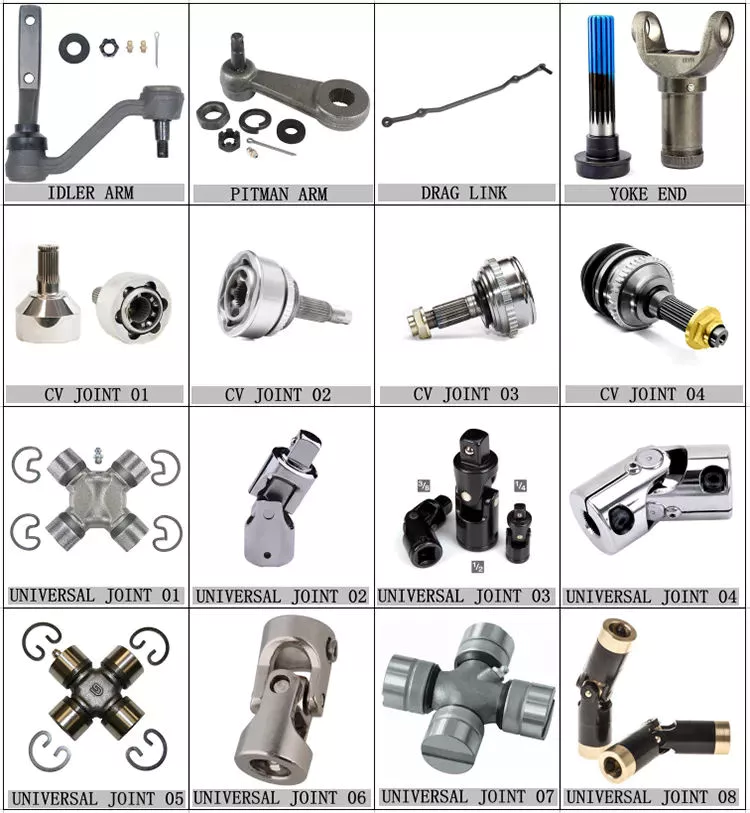
Antriebswellen verfügen häufig über flexible Kupplungen wie Kreuzgelenke (U-Gelenke) oder Gleichlaufgelenke (CV-Gelenke), um Drehzahl- und Drehmomentschwankungen auszugleichen. Diese Kupplungen gewährleisten Flexibilität und ermöglichen die Kraftübertragung der Antriebswelle auch dann, wenn Antriebs- und Abtriebskomponenten nicht perfekt ausgerichtet sind. Kreuzgelenke bestehen aus zwei Gabeln, die durch ein kreuzförmiges Lager verbunden sind und eine Winkelbewegung zwischen den Antriebswellensegmenten ermöglichen. Diese Flexibilität gleicht Drehzahl- und Drehmomentschwankungen aus und kompensiert Fluchtungsfehler. Gleichlaufgelenke, die häufig in Kfz-Antriebswellen eingesetzt werden, halten die Drehzahl konstant und gleichen gleichzeitig wechselnde Betriebswinkel aus. Diese flexiblen Kupplungen ermöglichen eine gleichmäßige Kraftübertragung und reduzieren Vibrationen und Verschleiß, die durch Drehzahl- und Drehmomentschwankungen verursacht werden.
2. Gleitverbindungen:
Bei manchen Antriebswellenkonstruktionen werden Schiebegelenke eingesetzt, um Längenänderungen und Abstandsänderungen zwischen Antriebs- und Abtriebskomponenten auszugleichen. Ein Schiebegelenk besteht aus einem inneren und einem äußeren Rohrabschnitt mit Verzahnung oder einem Teleskopmechanismus. Ändert sich die Länge der Antriebswelle aufgrund von Federungsbewegungen oder anderen Faktoren, ermöglicht das Schiebegelenk die Ausdehnung oder Stauchung der Welle, ohne die Kraftübertragung zu beeinträchtigen. Durch die axiale Bewegungsfreiheit verhindern Schiebegelenke ein Blockieren oder übermäßige Belastung der Antriebswelle bei Drehzahl- und Drehmomentänderungen und gewährleisten so einen reibungslosen Betrieb.
3. Ausgewogenheit:
Antriebswellen werden ausgewuchtet, um ihre Leistung zu optimieren und durch Drehzahl- und Drehmomentschwankungen verursachte Vibrationen zu minimieren. Unwuchten in der Antriebswelle können zu Vibrationen führen, die nicht nur den Komfort der Fahrzeuginsassen beeinträchtigen, sondern auch den Verschleiß der Welle und ihrer zugehörigen Komponenten erhöhen. Beim Auswuchten wird die Masse entlang der Antriebswelle neu verteilt, um eine gleichmäßige Gewichtsverteilung zu erreichen, Vibrationen zu reduzieren und die Gesamtleistung zu verbessern. Dynamisches Auswuchten, bei dem typischerweise kleine Gewichte hinzugefügt oder entfernt werden, gewährleistet einen ruhigen Lauf der Antriebswelle auch unter variierenden Drehzahlen und Drehmomentbelastungen.
4. Materialauswahl und Design:
Die Materialauswahl und die Konstruktion von Antriebswellen spielen eine entscheidende Rolle für den Umgang mit Drehzahl- und Drehmomentschwankungen. Antriebswellen werden typischerweise aus hochfesten Werkstoffen wie Stahl oder Aluminiumlegierungen gefertigt, die aufgrund ihrer Fähigkeit ausgewählt werden, den unter wechselnden Betriebsbedingungen auftretenden Kräften und Belastungen standzuhalten. Durchmesser und Wandstärke der Antriebswelle werden sorgfältig bestimmt, um ausreichende Festigkeit und Steifigkeit zu gewährleisten. Darüber hinaus berücksichtigt die Konstruktion Faktoren wie kritische Drehzahl, Torsionssteifigkeit und Resonanzvermeidung, die zur Aufrechterhaltung von Stabilität und Leistung bei Drehzahl- und Drehmomentschwankungen beitragen.
5. Schmierung:
Eine ausreichende Schmierung ist für Antriebswellen unerlässlich, um Drehzahl- und Drehmomentschwankungen problemlos zu bewältigen. Durch das Schmieren von Gelenken wie Kreuzgelenken oder Gleichlaufgelenken werden Reibung und Wärmeentwicklung im Betrieb reduziert, was einen reibungslosen Lauf gewährleistet und den Verschleiß minimiert. Eine ausreichende Schmierung beugt zudem dem Festfressen von Bauteilen vor und ermöglicht es der Antriebswelle, Drehzahl- und Drehmomentschwankungen effektiver auszugleichen. Regelmäßige Schmierung ist notwendig, um optimale Leistung zu gewährleisten und die Lebensdauer der Antriebswelle zu verlängern.
6. Systemüberwachung:
Die Überwachung der Leistung des Antriebswellensystems ist wichtig, um Probleme im Zusammenhang mit Drehzahl- und Drehmomentschwankungen zu erkennen. Ungewöhnliche Vibrationen, Geräusche oder Veränderungen in der Kraftübertragung können auf potenzielle Probleme mit der Antriebswelle hinweisen. Regelmäßige Inspektionen und Wartungsarbeiten ermöglichen die frühzeitige Erkennung und Behebung von Problemen, beugen Folgeschäden vor und gewährleisten, dass die Antriebswelle Drehzahl- und Drehmomentschwankungen weiterhin effektiv bewältigt.
Zusammenfassend lässt sich sagen, dass Antriebswellen Drehzahl- und Drehmomentschwankungen im Betrieb durch flexible Kupplungen, Schiebegelenke, Auswuchtverfahren, geeignete Materialauswahl und Konstruktion, Schmierung und Systemüberwachung ausgleichen. Diese Mechanismen und Verfahren ermöglichen es der Antriebswelle, Fluchtungsfehler, Längenänderungen und Schwankungen im Leistungsbedarf zu kompensieren und so eine effiziente Kraftübertragung, einen ruhigen Lauf und reduzierten Verschleiß in verschiedenen Anwendungen zu gewährleisten.

What safety precautions should be followed when working with drive shafts?
Working with drive shafts requires adherence to specific safety precautions to prevent accidents, injuries, and damage to equipment. Drive shafts are critical components of a vehicle or machinery’s driveline system and can pose hazards if not handled properly. Here’s a detailed explanation of the safety precautions that should be followed when working with drive shafts:
1. Personal Protective Equipment (PPE):
Always wear appropriate personal protective equipment when working with drive shafts. This may include safety goggles, gloves, steel-toed boots, and protective clothing. PPE helps protect against potential injuries from flying debris, sharp edges, or accidental contact with moving parts.
2. Lockout/Tagout Procedures:
Before working on a drive shaft, ensure that the power source is properly locked out and tagged out. This involves isolating the power supply, such as shutting off the engine or disconnecting the electrical power, and securing it with a lockout/tagout device. This prevents accidental engagement of the drive shaft while maintenance or repair work is being performed.
3. Vehicle or Equipment Support:
When working with drive shafts in vehicles or equipment, use proper support mechanisms to prevent unexpected movement. Securely block the vehicle’s wheels or utilize support stands to prevent the vehicle from rolling or shifting during drive shaft removal or installation. This helps maintain stability and reduces the risk of accidents.
4. Proper Lifting Techniques:
When handling heavy drive shafts, use proper lifting techniques to prevent strain or injuries. Lift with the help of a suitable lifting device, such as a hoist or jack, and ensure that the load is evenly distributed and securely attached. Avoid lifting heavy drive shafts manually or with improper lifting equipment, as this can lead to accidents and injuries.
5. Inspection and Maintenance:
Prior to working on a drive shaft, thoroughly inspect it for any signs of damage, wear, or misalignment. If any abnormalities are detected, consult a qualified technician or engineer before proceeding. Regular maintenance is also essential to ensure the drive shaft is in good working condition. Follow the manufacturer’s recommended maintenance schedule and procedures to minimize the risk of failures or malfunctions.
6. Proper Tools and Equipment:
Use appropriate tools and equipment specifically designed for working with drive shafts. Improper tools or makeshift solutions can lead to accidents or damage to the drive shaft. Ensure that tools are in good condition, properly sized, and suitable for the task at hand. Follow the manufacturer’s instructions and guidelines when using specialized tools or equipment.
7. Controlled Release of Stored Energy:
Some drive shafts, particularly those with torsional dampers or other energy-storing components, can store energy even when the power source is disconnected. Exercise caution when working on such drive shafts and ensure that the stored energy is safely released before disassembly or removal.
8. Training and Expertise:
Work on drive shafts should only be performed by individuals with the necessary training, knowledge, and expertise. If you are not familiar with drive shafts or lack the required skills, seek assistance from qualified technicians or professionals. Improper handling or installation of drive shafts can lead to accidents, damage, or compromised performance.
9. Follow Manufacturer’s Guidelines:
Always follow the manufacturer’s guidelines, instructions, and warnings specific to the drive shaft you are working with. These guidelines provide important information regarding installation, maintenance, and safety considerations. Deviating from the manufacturer’s recommendations may result in unsafe conditions or void warranty coverage.
10. Disposal of Old or Damaged Drive Shafts:
Dispose of old or damaged drive shafts in accordance with local regulations and environmental guidelines. Improper disposal can have negative environmental impacts and may violate legal requirements. Consult with local waste management authorities or recycling centers to ensure appropriate disposal methods are followed.
By following these safety precautions, individuals can minimize the risks associated with working with drive shafts and promote a safe working environment. It is crucial to prioritize personal safety, use proper equipment and techniques, and seek professional help when needed to ensure the proper handling and maintenance of drive shafts.
Can you explain the different types of drive shafts and their specific applications?
Drive shafts come in various types, each designed to suit specific applications and requirements. The choice of drive shaft depends on factors such as the type of vehicle or equipment, power transmission needs, space limitations, and operating conditions. Here’s an explanation of the different types of drive shafts and their specific applications:
1. Solid Shaft:
A solid shaft, also known as a one-piece or solid-steel drive shaft, is a single, uninterrupted shaft that runs from the engine or power source to the driven components. It is a simple and robust design used in many applications. Solid shafts are commonly found in rear-wheel-drive vehicles, where they transmit power from the transmission to the rear axle. They are also used in industrial machinery, such as pumps, generators, and conveyors, where a straight and rigid power transmission is required.
2. Tubular Shaft:
Tubular shafts, also called hollow shafts, are drive shafts with a cylindrical tube-like structure. They are constructed with a hollow core and are typically lighter than solid shafts. Tubular shafts offer benefits such as reduced weight, improved torsional stiffness, and better damping of vibrations. They find applications in various vehicles, including cars, trucks, and motorcycles, as well as in industrial equipment and machinery. Tubular drive shafts are commonly used in front-wheel-drive vehicles, where they connect the transmission to the front wheels.
3. Constant Velocity (CV) Shaft:
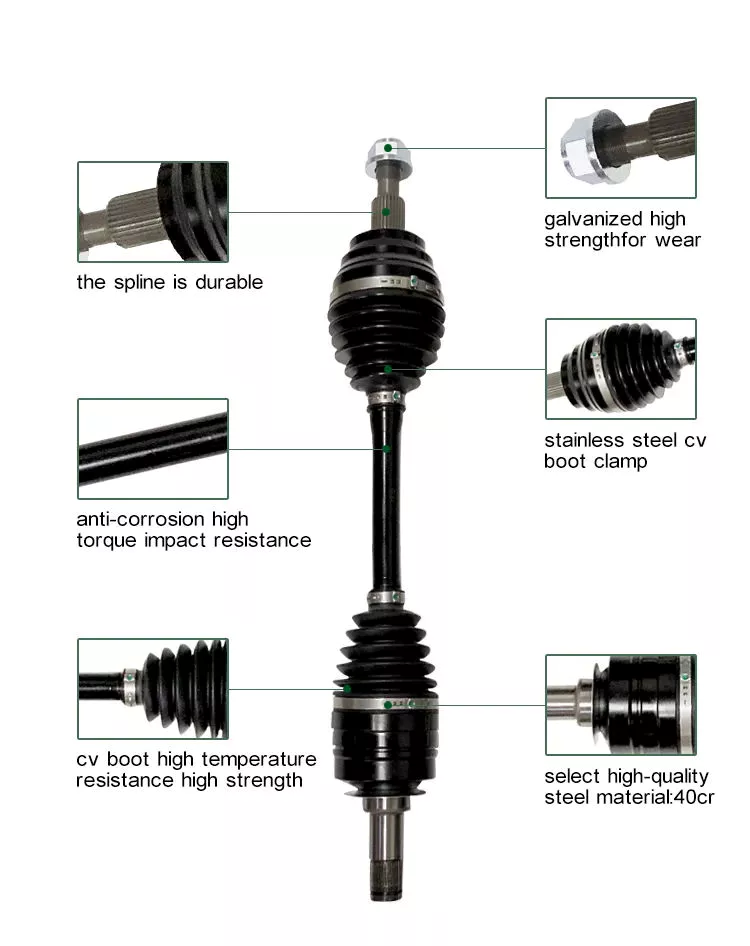
Constant Velocity (CV) shafts are specifically designed to handle angular movement and maintain a constant velocity between the engine/transmission and the driven components. They incorporate CV joints at both ends, which allow flexibility and compensation for changes in angle. CV shafts are commonly used in front-wheel-drive and all-wheel-drive vehicles, as well as in off-road vehicles and certain heavy machinery. The CV joints enable smooth power transmission even when the wheels are turned or the suspension moves, reducing vibrations and improving overall performance.
4. Slip Joint Shaft:
Slip joint shafts, also known as telescopic shafts, consist of two or more tubular sections that can slide in and out of each other. This design allows for length adjustment, accommodating changes in distance between the engine/transmission and the driven components. Slip joint shafts are commonly used in vehicles with long wheelbases or adjustable suspension systems, such as some trucks, buses, and recreational vehicles. By providing flexibility in length, slip joint shafts ensure a constant power transfer, even when the vehicle chassis experiences movement or changes in suspension geometry.
5. Double Cardan Shaft:
A double Cardan shaft, also referred to as a double universal joint shaft, is a type of drive shaft that incorporates two universal joints. This configuration helps to reduce vibrations and minimize the operating angles of the joints, resulting in smoother power transmission. Double Cardan shafts are commonly used in heavy-duty applications, such as trucks, off-road vehicles, and agricultural machinery. They are particularly suitable for applications with high torque requirements and large operating angles, providing enhanced durability and performance.
6. Composite Shaft:
Composite shafts are made from composite materials such as carbon fiber or fiberglass, offering advantages such as reduced weight, improved strength, and resistance to corrosion. Composite drive shafts are increasingly being used in high-performance vehicles, sports cars, and racing applications, where weight reduction and enhanced power-to-weight ratio are critical. The composite construction allows for precise tuning of stiffness and damping characteristics, resulting in improved vehicle dynamics and drivetrain efficiency.
7. PTO Shaft:
Power Take-Off (PTO) shafts are specialized drive shafts used in agricultural machinery and certain industrial equipment. They are designed to transfer power from the engine or power source to various attachments, such as mowers, balers, or pumps. PTO shafts typically have a splined connection at one end to connect to the power source and a universal joint at the other end to accommodate angular movement. They are characterized by their ability to transmit high torque levels and their compatibility with a range of driven implements.
8. Marine Shaft:
Marine shafts, also known as propeller shafts or tail shafts, are specifically designed for marine vessels. They transmit power from the engine to the propeller, enabling propulsion. Marine shafts are usually long and operate in a harsh environment, exposed to water, corrosion, and high torque loads. They are typically made of stainless steel or other corrosion-resistant materials and are designed to withstand the challenging conditions encountered in marine applications.
It’simportant to note that the specific applications of drive shafts may vary depending on the vehicle or equipment manufacturer, as well as the specific design and engineering requirements. The examples provided above highlight common applications for each type of drive shaft, but there may be additional variations and specialized designs based on specific industry needs and technological advancements.


editor by CX 2023-09-26























